










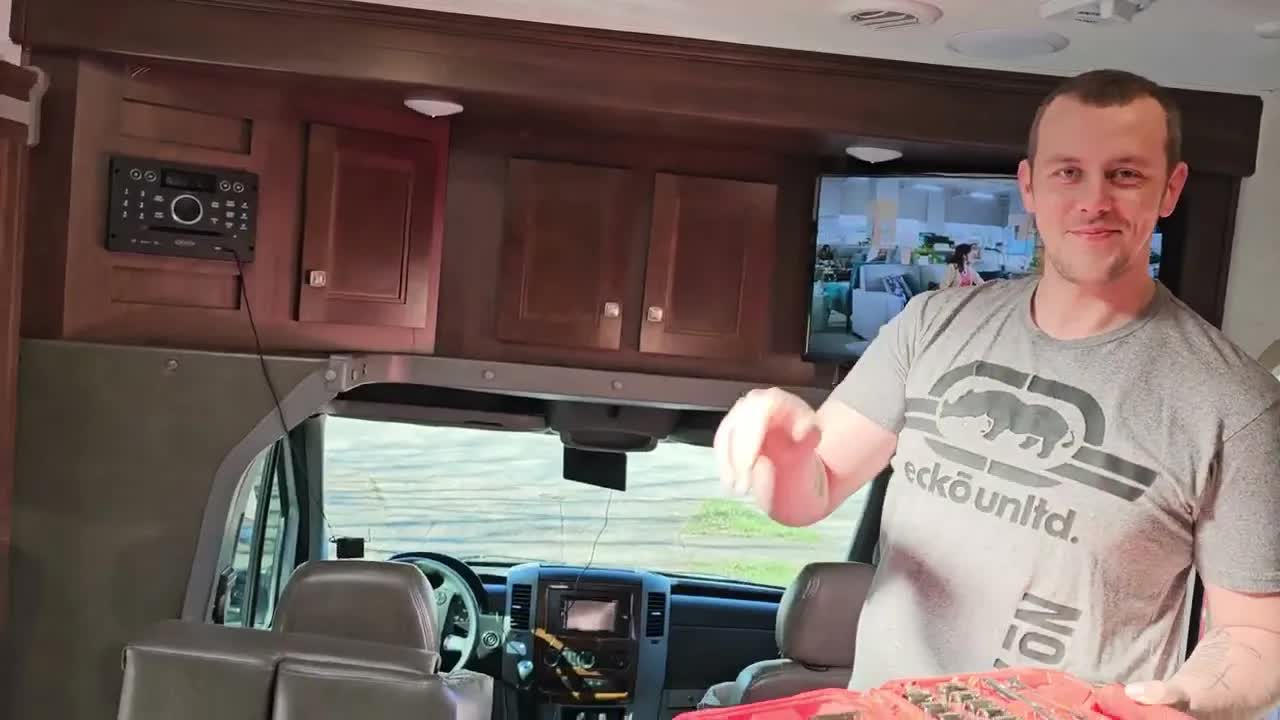






















The camera comes up already running, and rswfire is already talking — no preamble beyond the word quick. He is standing in a driveway beside the RV, and the first thing he does is name the reason for the recording: the cost. Not the method, not the product, the cost. He wants it visible up front, before anyone else reaches the stage he is at, so that it arrives as a budget line rather than a surprise.
He walks to the front tire and lets the frame drop to the stack beneath it. He counts it aloud in the plain arithmetic of the hardware — an inch and a half at the base, an inch for every level above it, four and a half inches of lift under one wheel, against a manufacturer ceiling of five he half-remembers and cites anyway. At the top edge of the stack sit the chock pieces, and here his register shifts for a moment from measurement to preference. He says he loves those. He says it feels safer than the alternative. He does not elaborate on the alternative yet; he only notes that he did not like them, and moves on.
Then he moves inside, or to whatever point serves as his reference, and confirms what the front stack bought him. I'm level. It's awesome. One axis, achieved. He does not linger on it. The next beat of the walkthrough carries him to the rear of the vehicle, where he reports the opposite condition — not level back here, left to right, still a little ways to go. He estimates what the fix will require the way a person estimates who has already done it once: maybe an inch and a half, maybe two and a half, one side lifted. The problem is not solved and he does not pretend otherwise. He states that he does not have enough blocks, that he has ordered more, that they arrive tomorrow, and that he will do that part then.
The camera finds the staging pile. Unopened bags, stacked where he set them down, and he acknowledges the disorder in passing — he'll obviously organize this — before running the count. Bags of ten. Four on hand, two in transit, six total. Forty dollars a bag. Two hundred and forty dollars, spent, on leveling blocks alone. He says the number twice. He explains the volume without complaint and without drama: you never know, you might have to put them on three tires like I do. Then, flatly, that's a lot.
The last movement of the video is the one he has been circling since the opening line. There is a different kind, he says. Basically everyone recommends it. He did not like them. He offers no argument from authority and does not dispute anyone else's experience — he tells the viewer to try them — but he holds his own ground plainly: this way is better, it is safer, it is a flatter surface, it is nicer, everything about it is better in his opinion. His testing, on his rig, in his driveway, against his own sense of what a safe surface feels like underfoot.
He closes where he began, on money. When you're at the stage where you're going to start looking for your RV, he says, that's just one cost you want to keep in mind. Couple hundred dollars. The recording ends there, with the front of the RV level, the rear of it not yet, two more bags in the mail, and the driveway holding a mobile dwelling that is not yet a home — only a machine being brought, incrementally and by hand, into plane.