













Documenting the Hotel.net Travel Platform Build

Failed to load video
Chapters
Transcript
[0:01] So after Pop Star, I moved on to this
[0:03] project. I was still working with the
[0:06] same clients.
[0:08] Uh their primary business at the time
[0:10] was they owned thousands of premium
[0:12] domain names
[0:14] and they would work with other
[0:15] freelancers to create properties on
[0:17] those.
[0:19] That's how my relationship with them
[0:21] started with Popstar.
[0:23] Uh they also own USA.com, London, Asia,
[0:27] Paris, Berlin, just a whole bunch of
[0:32] geographical domain names that just had
[0:35] value in their names alone. And we were
[0:38] building a platform on those. We started
[0:39] with Hotel.net and then we expanded it
[0:41] to other ones. Um on this screen here,
[0:44] I've got one of those tabs is usa.com,
[0:47] but we put it on a number of different
[0:49] properties.
[0:52] This project
[0:54] had very long longtail SEO and SEM.
[1:00] This one we had a massive ad groups
[1:04] campaign for
[1:07] for every city
[1:09] in this database.
[1:12] we likely we had an ad group for it
[1:15] and we would algorithmic algorithmically
[1:18] adjust those um based on how they were
[1:22] performing. So some of them maybe would
[1:24] have turned off over time but we would
[1:26] have started with the entire world.
[1:29] We were spending an average of $100,000
[1:31] a month
[1:33] and we were profitable
[1:36] for several years until the market
[1:39] became a lot more saturated.
[1:42] Uh Google entered the market, they
[1:43] started actually eating their own
[1:45] traffic because you know we were paying
[1:47] for ads on their platform but they were
[1:49] still putting their own widget above our
[1:52] our ads and it just became a very
[1:56] difficult
[1:59] Um,
[2:02] we didn't have an easy way to pivot.
[2:05] I had thoughts and ideas about it back
[2:08] then, uh, that just weren't shared. So,
[2:12] the platform was just
[2:15] I feel like I felt like at the time
[2:20] didn't have any support. It was just
[2:21] myself doing this. That seems to often
[2:24] be the case.
[2:26] And not all my suggestions were taken
[2:30] cuz I actually did see that this was the
[2:33] trajectory of the market and I I would
[2:35] have headed it off if I could have.
[2:40] I hope that doesn't sound like um
[2:46] like I'm refraraming history or
[2:48] something like that.
[2:50] really truly back then I knew that we
[2:54] could not just rely on SEM traffic that
[2:57] that was just just waiting to be a death
[3:00] now. Um but I could never really
[3:02] convince my partners on this project
[3:04] that we needed to expand in different
[3:06] ways and one of the biggest ways that I
[3:08] wanted to expand at the time I think was
[3:10] through like a content um kind of
[3:13] program like what I did with Pop Star.
[3:15] we we had writers who were, you know,
[3:17] writing in the travel vertical and
[3:19] trying to build a community around it.
[3:23] I just didn't have the support for that.
[3:25] So, we wrote out the wave and just let
[3:28] it die naturally.
[3:31] So, on this project, um, let me go
[3:34] through my slides here. Definitely get a
[3:36] little off track probably.
[3:40] So, yeah, the first thing I had to do
[3:42] was build a geography database. Uh the
[3:45] website itself is powered by the same
[3:48] content management system as Pop Star
[3:50] was matrix server, the one that I had
[3:51] been working on since I was a teenager.
[3:54] Uh as a freelancer, you know, you rely
[3:56] on your own your own tool set and that
[3:59] was mine. I could do pretty much
[4:02] anything with it.
[4:04] This was preframework. There was no
[4:06] Laravel yet or anything like that. I had
[4:09] essentially built my own. And for this
[4:12] geography database, I largely used a API
[4:15] from Yahoo at the time. Don't remember
[4:17] what it was called, but it was it was
[4:20] the best one. I had tried many many
[4:22] approaches and ended up on their API. I
[4:24] really liked it. And I used that to
[4:28] populate the entire database.
[4:31] Um,
[4:34] then I had to normalize the data. There
[4:36] was a there were there was a lot of work
[4:38] involved in getting this geography
[4:39] database right. There's a reason why
[4:41] even today probably there are places you
[4:43] can just buy a geography database. Um,
[4:48] don't ask me why we didn't do that. I
[4:50] just I think I probably wanted to do
[4:52] this myself. Like I just wanted it done
[4:54] right or something. So So you start with
[4:58] that and you know that kind of made it
[5:01] so that we had we had you know hundreds
[5:03] of thousands of pages you know real long
[5:05] tail. This was back when Google, you
[5:08] know, when you were you were still kind
[5:09] of gaming the system a little bit, I
[5:10] guess. Uh I don't feel like it there was
[5:12] anything unethical just indexing pages,
[5:14] right? But we we got a lot of traffic,
[5:17] you know, from having such a longtail
[5:20] travel website. I mean, we definitely
[5:21] covered a lot of things that
[5:24] um a lot of the other ones didn't.
[5:32] So
[5:34] yeah, so I feel like I mentioned a lot
[5:36] of the SEO and SEM stuff, but some other
[5:38] things I would add. So we had AB
[5:40] testing. Um this so when you're looking
[5:44] at this page here, so you're this would
[5:46] this might be a landing page to a
[5:48] particular city. This is the SEO landing
[5:51] page version of it. So there we did a
[5:52] bunch of AB testing and based on you
[5:55] know what was the most efficient way to
[5:57] convert um you know was the approach we
[6:00] took with every city you know could end
[6:02] up on kind of different layout depending
[6:13] so I can't like say that this was an
[6:15] inspiring platform like to me it was you
[6:18] know this was this was an early version
[6:21] of,
[6:24] you know, legitimately trying to help
[6:25] people find the lowest rates somewhere.
[6:28] Um, but this was a very fine-tuned
[6:31] machine, that's for sure.
[6:41] So, yeah, I feel like I covered most of
[6:43] this.
[6:49] Yeah. So once um we had this I guess on
[6:53] that was another thing I was going to
[6:54] say about the SEM. So um in order to
[6:58] have you know a campaign that big you
[7:00] know programmatically you had to create
[7:02] all those ad ad groups uh there are
[7:05] hundreds of thousands of them millions
[7:07] of keywords and you know I had to manage
[7:10] that every month.
[7:13] Um
[7:15] that was probably the you know aside
[7:17] from the programming was one of the
[7:20] primary tasks that I had to manage was
[7:22] just keep you know keeping our ad
[7:24] campaigns profitable. That was
[7:27] definitely a lot of work.
[7:30] So once we had this system you know I
[7:33] felt like it was at a good place then we
[7:34] started moving it to the um other
[7:36] properties that had. So we moved to
[7:38] usa.com and then you know you just kind
[7:40] of filtered the geography database for
[7:42] the United States and make it a little
[7:45] bit different and give you know the
[7:46] different landing pages and um we just
[7:50] expanded it
[7:54] once
[7:56] it became
[7:59] once we reached the point where it just
[8:01] wasn't profitable. That's when I moved
[8:03] on and I went back into freelancing and
[8:05] I found my next client who I worked with
[8:07] for somewhere between seven and 10 years
[8:10] and um I entered the music industry at
[8:13] that point. So I started working on um a
[8:17] music streaming service and a music
[8:19] distribution service and I'll talk about
[8:21] those next. Um it's a whole different
[8:23] story. So
11:32
Announcing RV Transition and End of Volunteering
Jul 15, 2025
8:02
Solving Local Model Recursion for Transmission Analysis
Jul 15, 2025
10:30
Walking to the Ocean, Reporting Recursive AI Processing
Jul 15, 2025
7:19
Recognizing Archive Infrastructure as Offerable Service
Jul 15, 2025
7:37
Recognizing Personal System as Sellable Service
Jul 15, 2025
13:05
Tracing Eighteen Months of Documentation Into Infrastructure
Jul 15, 2025
5:35
Naming Recursive Cognition Against Linear Expression
Jul 15, 2025
8:04
Describing the Journal Analogy Behind the Transmission Archive
Jul 15, 2025
3:01
Reading AI Reflection Aloud at Siltcoos Midday
Jul 15, 2025
15:20
Documenting the Reflection Pipeline and About Page Build
Jul 15, 2025
3:02
Recording Birthday Address to His Mother
Jul 15, 2025
10:02
Completing ULID Sync and Mirror Reflection Layer
Jul 15, 2025
14:41
Contrasting Local and Closed Models on Mirroring
Jul 15, 2025
3:50
Placing Video Archive Behind Subscription Tiers
Jul 16, 2025
12:39
Quitting Vaping and Seeding the Signal Thread
Jul 16, 2025
6:53
Documenting Nicotine Cessation Attempt and Location Assessment
Jul 16, 2025
4:45
Walking Buddy Through the Campground
Jul 16, 2025
7:10
Marking a New Chapter After 18 Months
Jul 17, 2025
6:59
Marking a New Chapter After Audience Departure
Jul 18, 2025
9:31
Stating Resource Conditions While Building the Project
Jul 18, 2025
6:11
Declining LGBTQ Referral, Blocking Friend Over Framing
Jul 20, 2025
8:36
Cooking Chicken in Ninja Foodi, Building Local Mirror Model
Jul 20, 2025
9:25
Testing Local Models Against Reflection Quality
Jul 20, 2025
12:43
Compiling a Day of Clips at Siltcoos
Jul 20, 2025
5:07
Walking Buddy on the Beach, Considering a Motorbike
Jul 20, 2025
5:25
Comparing YouTube Economics to Platform Design Capacity
Jul 23, 2025
13:01
Screen-Sharing a Walkthrough of rswfire.com
Jul 23, 2025
16:30
Walking Through the Field Companion Reflection Pipeline
Jul 23, 2025
5:41
Recording from the Beach Without Cell Service
Jul 23, 2025
2:18
Naming Material Conditions and Requesting Direct Support
Jul 23, 2025
9:55
Walking Through an Early Entertainment Platform Build
Jul 23, 2025
8:27
Documenting the Hotel.net Travel Platform Build
Jul 23, 2025
17:02
Walking Through Soundlock and Arena Music Platforms
Jul 23, 2025
16:08
Walking Through Early Programming History and Guru Reviews
Jul 23, 2025
2:02
Cutting Hair Short Outside the RV
Jul 24, 2025
3:45
Mapping Seasonal Volunteer Cycle and Trailer Conversion
Jul 25, 2025
17:21
Addressing Audience Directly on Reciprocation and Work Search
Jul 27, 2025
3:02
Losing an Earring While Collecting Campfire Wood
Jul 27, 2025
12:28
Walking the Beach, Spotting Seals and Mapping Travel
Jul 27, 2025
3:10
Closing the Channel, Declaring Audience Mismatch
Jul 29, 2025
8:43
Ending YouTube Channel, Opening New Distribution Channel
Jul 29, 2025
PUBLIC
July 23, 2025 rswfire PUBLISHED
Temp 0.10
Density 0.40
Energetic Quality
measured, matter-of-fact
Journey Phase
retrospective mapping, sequential
Directional Vector
toward accurate reconstruction of a build history
Narrative

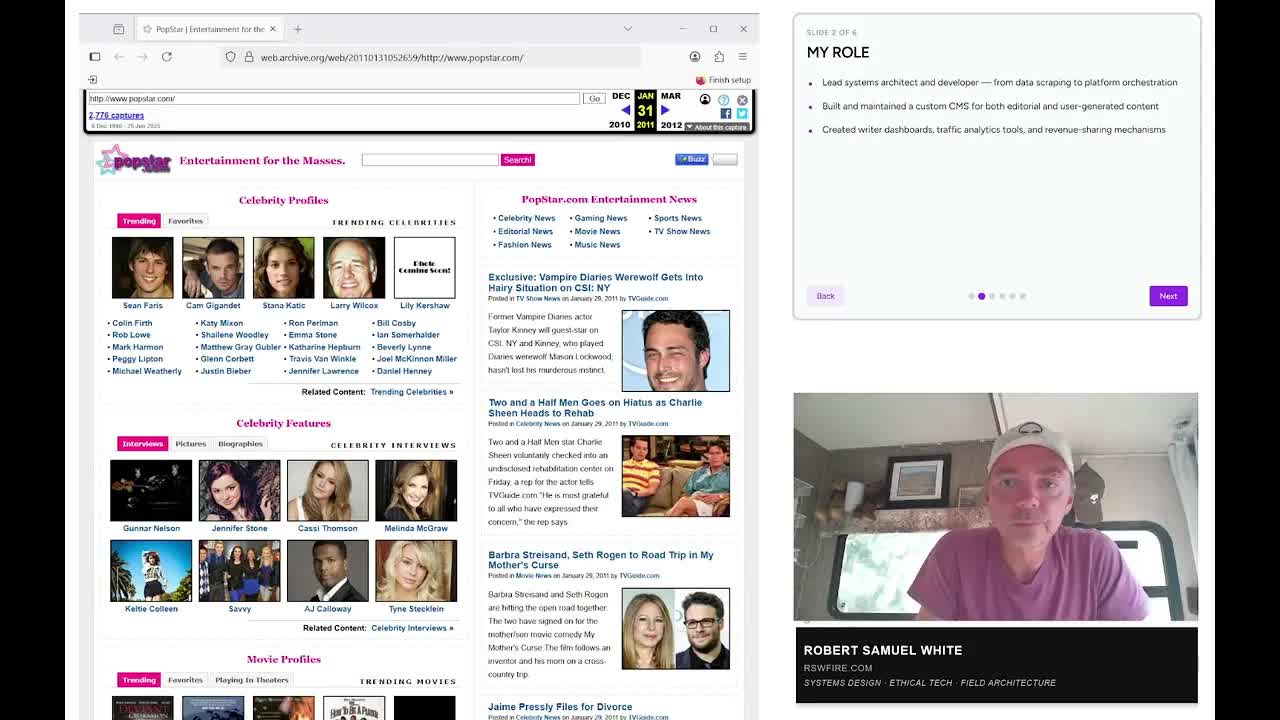
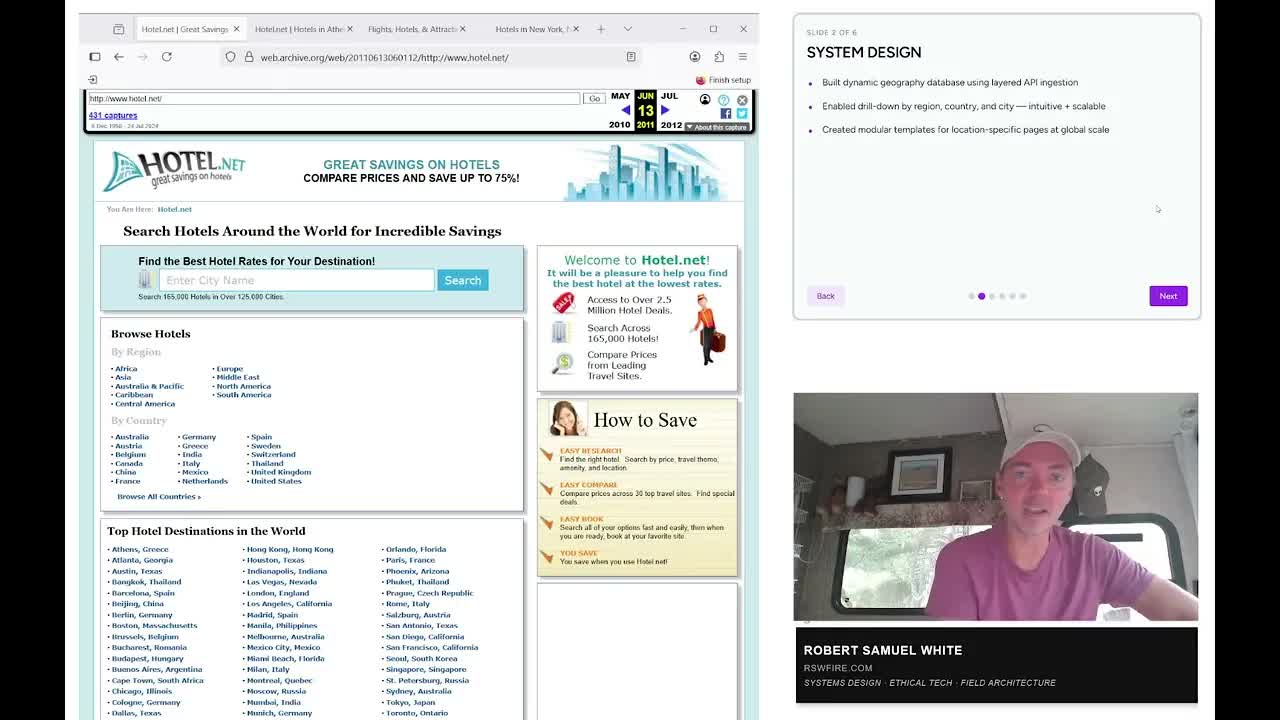
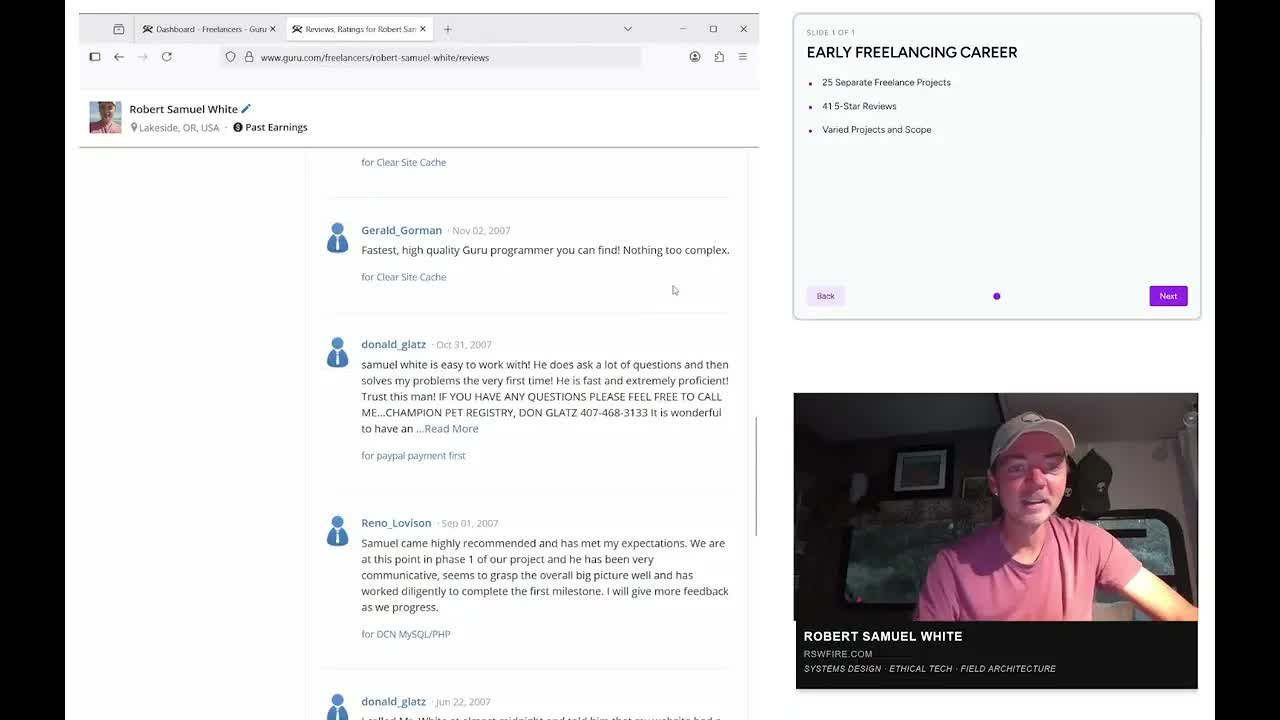
The screen holds two kinds of evidence at once: a slide deck on one side, browser tabs on the other, one of them usa.com, another an SEO landing page for a single city, rendered in the layout that testing had determined converted best for that city. rswfire moves between them as he narrates, the way a person moves through a house they built and no longer lives in. This is the segment after Pop Star. Same clients, different property, and the beginning of a much larger machine.

The clients held thousands of premium domain names — USA.com, London, Asia, Paris, Berlin — names that carried value in the string alone, before anything was built on them. Their business was to bring in freelancers who could turn a name into a property. rswfire had already done that once with Pop Star; this time the assignment was travel, starting with Hotel.net and then propagating outward across the portfolio. He describes the first task plainly: he had to build a geography database. Not license one, not purchase one, though he notes such things could be bought then and probably still can. He tested many approaches, settled on a Yahoo API he can no longer name but remembers liking, populated the database from it, and then did the long unglamorous work of normalization. Asked in retrospect why he didn't just buy it, he offers no defense of the decision beyond the shape of his own hand on it — that he likely wanted to do it himself, wanted it done right.

Underneath the geography sat matrix server, the content management system he had been building since he was a teenager and had already run Pop Star on. This was before Laravel, before frameworks were something you selected. He had essentially built his own, and he frames that fact not as achievement but as condition: as a freelancer you rely on your own toolset, and that was his. It could do pretty much anything he needed. Every property in this portfolio would run on a substrate he owned and carried in with him.

What the geography database made possible was scale of a specific kind. Hundreds of thousands of pages. Real longtail — coverage of places the competing travel sites did not bother with. He pauses on the ethics of it as he narrates, in the register of someone auditing his own memory rather than defending it: this was back when you could still game the system a little, he says, though he does not feel there was anything unethical in indexing pages. Alongside the organic side ran the paid one, and the paid one was enormous. An ad group for every city in the database — starting with the entire world, hundreds of thousands of groups, millions of keywords, generated programmatically because no other method could have produced them. Performance data fed back into algorithmic adjustment; underperformers went dark over time. Average spend ran a hundred thousand dollars a month. Keeping that campaign profitable was, he says, the primary task outside of the programming itself, and it was a lot of work. Profitable for several years. He will not call the platform inspiring. He calls it an early and legitimate attempt to help people find the lowest rate somewhere, and he calls it a very fine-tuned machine, and lets both stand.

Then the market changed under it. Saturation first, then Google entering the vertical directly — the platform they were buying ads on placing its own widget above the ads it sold them. rswfire describes this as the platform eating its own traffic, and the structure of it is what he emphasizes: they were paying rent to a landlord who had opened a competing storefront in the lobby. There was no easy pivot available. He states that he saw the trajectory at the time and knew that relying on SEM traffic alone was waiting to be a death knell. He had ideas. The one he names is the one he had already proven at Pop Star — a content program, writers in the travel vertical, a community built around the platform rather than purchased into it monthly. The proposals were not shared, not adopted. He says he felt at the time that he didn't have any support, that it was just himself doing this, and then adds, without weighting it, that this seems to often be the case. He interrupts himself once to check the account against the record — he hopes it doesn't sound like he's reframing history — and then repeats the claim unchanged, because it is what he remembers knowing.

So they rode out the wave and let it die naturally. Before that, though, the system did what systems built correctly do: it moved. Once Hotel.net was at a good place, the same architecture went onto the other properties, usa.com among them, the geography database filtered down to the United States, the landing pages differentiated, the whole apparatus reproduced against a new domain. It expanded until the economics no longer held.

When the platform reached the point where it wasn't profitable, rswfire moved on. He describes the transition without ceremony: back into freelancing, then a new client he would work with for somewhere between seven and ten years, and with them, entry into the music industry — a streaming service, a distribution service. He marks the boundary and points across it. A whole different story, he says, and moves to the next slide.

Tags

platform architecture geography database SEM operations content management system domain portfolio market trajectory freelance work history

Summary

rswfire continues a project walkthrough series, moving from Pop Star to a travel booking platform built for the same clients — a group holding thousands of premium domain names including USA.com, London, Asia, Paris, and Berlin. The platform launched on Hotel.net and was later replicated across the other geographic properties.

He describes the technical build: a geography database populated via a Yahoo API he selected after testing multiple approaches, then normalized by hand rather than purchased. The site ran on matrix server, the content management system he had been developing since he was a teenager, built before Laravel or comparable frameworks existed. The geography data generated hundreds of thousands of long-tail pages.

Operations centered on SEO and SEM at scale — programmatically generated ad groups for every city in the database, millions of keywords, algorithmic performance adjustment, and roughly $100,000/month in ad spend, profitable for several years. He also ran A/B testing on city landing pages to tune conversion layouts.

He states he identified the market trajectory early — SEM saturation and Google surfacing its own widget above paid ads — and proposed expanding into a content and community program modeled on his Pop Star work. He states the suggestion was not supported and that he was working alone on the platform, noting this "seems to often be the case." The platform was allowed to decline naturally.

He closes by marking his next move: back to freelancing, into a 7–10 year client relationship in music streaming and distribution.

Environment

Screen-recorded walkthrough with narration — a slide deck open alongside browser tabs showing live or archived versions of the travel platform, including a usa.com tab and an SEO landing page for a city. rswfire narrates over the visuals, moving between slides and screenshots.

The environment is retrospective-technical: a documentation session reconstructing a multi-year freelance platform build (Hotel.net, USA.com, and other geographic premium domains) from artifacts on screen. This is one entry in a sequenced portfolio series, following a prior segment on Pop Star and pointing forward to music-industry work.

Substrate

rswfire holds the position of sole technical architect operating inside a partnership structure that did not extend decision authority to match his execution authority — he built the geography database, the CMS layer, the landing-page system, and the SEM machine, and states he read the market trajectory correctly while his proposed pivot was not adopted. The architecture being held is one of ownership of one's own toolset as the precondition of freelance capability (matrix server, built since he was a teenager, as the substrate under every property). He documents the platform's decline as structural — platform-owner encroachment on paid channel economics — rather than as failure, and marks his exit as a clean transition rather than a rupture.

Actions

Performed

  • •narrating over slides and screenshots
  • •walking through browser tabs of the platform properties
  • •identifying an SEO landing page layout on screen
  • •checking his own framing against the historical record
  • •flagging a transition to the next project in the series

Referenced

  • •continued with the same clients after Pop Star
  • •built a platform across premium geographic domains
  • •launched on Hotel.net, then expanded to USA.com and others
  • •built a geography database from scratch
  • •used a Yahoo API to populate the database
  • •tested multiple data approaches before selecting one
  • •normalized the geography data
  • •powered the site with matrix server, his own pre-framework CMS
  • •generated hundreds of thousands of longtail pages
  • •built and programmatically managed hundreds of thousands of ad groups and millions of keywords
  • •algorithmically adjusted ad group performance
  • •managed roughly $100,000/month in ad spend at profitability for several years
  • •ran A/B testing on city landing page layouts
  • •proposed a content and community program in the travel vertical
  • •worked with travel writers
  • •advocated for diversifying away from SEM dependence
  • •filtered the geography database per property for expansion
  • •let the platform decline as the market saturated
  • •returned to freelancing and took on a 7–10 year client
  • •entered the music industry

Planned

  • •cover the music streaming service in the next segment
  • •cover the music distribution service in the next segment

Entities

beings
the partners / clients — Domain portfolio owners who directed the project; rswfire states his diversification proposals were not adopted by them.
travel writers — Contributors in the travel vertical under the proposed content and community program.
systems
Pop Star — Prior project with the same clients; the relationship's origin point and the reference model for the content program he proposed here.
Hotel.net — First property the travel platform launched on.
USA.com — Premium geographic domain the platform expanded onto; open in a browser tab during the recording.
London / Asia / Paris / Berlin domains — Additional premium geographic domains in the client's portfolio, valuable by name alone.
matrix server — rswfire's own content management system, built since he was a teenager; the pre-framework substrate powering both Pop Star and this platform.
Laravel — Named as not-yet-existing, marking the era before PHP frameworks and the reason he built his own.
Yahoo API — Data source used to populate the geography database after testing many alternatives.
Google — Both the paid channel the platform ran on and the competitor that placed its own travel widget above purchased ads.
geography database — Hand-built and normalized dataset underlying hundreds of thousands of longtail pages; filtered per property for expansion.
SEM / ad groups campaign — Hundreds of thousands of ad groups, millions of keywords, ~$100k/month spend, algorithmically tuned monthly.
music streaming and distribution services — The next client engagement, named as the subject of the following segment.

Symbolic Elements

Represented archetypes or recurring motifs.

grid
database
longtail
machine
wave
platform-above-platform
toolset
threshold

Ontological States

Expressed modes of being or awareness.

sole-operator (states he was the only one carrying the platform, and that this 'seems to often be the case')
sovereign-tooled (owns the CMS the entire platform runs on, built pre-framework and carried across clients)
advisory without authority (read the market trajectory accurately; proposals for diversification not adopted by partners)
transitional (platform reaches non-profitability, he exits cleanly into the next client engagement)
self-auditing (checks his own retrospective against the record — 'I hope that doesn't sound like I'm reframing history')

Engaged Subsystems

Architecture engaged in this transmission.

infrastructural (geography database construction, normalization, CMS as substrate)
economic (ad spend management, profitability maintenance, market saturation)
cognitive (market trajectory reading, systems design, data source evaluation)
relational (partnership dynamics, unshared proposals, absence of support)
ethical (assessing whether longtail indexing was gaming the system; assessing whether the platform was 'inspiring')
epistemic (self-checking retrospective accuracy against memory)
archival (portfolio documentation, sequencing across projects)

Dominant Language

Core motifs or linguistic fields.

longtail SEO and SEM
geography database
ad groups / keywords / programmatically
profitable / not profitable
matrix server / preframework / my own tool set
didn't have any support
fine-tuned machine
Narrative

The screen holds two kinds of evidence at once: a slide deck on one side, browser tabs on the other, one of them usa.com, another an SEO landing page for a single city, rendered in the layout that testing had determined converted best for that city. rswfire moves between them as he narrates, the way a person moves through a house they built and no longer lives in. This is the segment after Pop Star. Same clients, different property, and the beginning of a much larger machine.

The clients held thousands of premium domain names — USA.com, London, Asia, Paris, Berlin — names that carried value in the string alone, before anything was built on them. Their business was to bring in freelancers who could turn a name into a property. rswfire had already done that once with Pop Star; this time the assignment was travel, starting with Hotel.net and then propagating outward across the portfolio. He describes the first task plainly: he had to build a geography database. Not license one, not purchase one, though he notes such things could be bought then and probably still can. He tested many approaches, settled on a Yahoo API he can no longer name but remembers liking, populated the database from it, and then did the long unglamorous work of normalization. Asked in retrospect why he didn't just buy it, he offers no defense of the decision beyond the shape of his own hand on it — that he likely wanted to do it himself, wanted it done right.

Underneath the geography sat matrix server, the content management system he had been building since he was a teenager and had already run Pop Star on. This was before Laravel, before frameworks were something you selected. He had essentially built his own, and he frames that fact not as achievement but as condition: as a freelancer you rely on your own toolset, and that was his. It could do pretty much anything he needed. Every property in this portfolio would run on a substrate he owned and carried in with him.

What the geography database made possible was scale of a specific kind. Hundreds of thousands of pages. Real longtail — coverage of places the competing travel sites did not bother with. He pauses on the ethics of it as he narrates, in the register of someone auditing his own memory rather than defending it: this was back when you could still game the system a little, he says, though he does not feel there was anything unethical in indexing pages. Alongside the organic side ran the paid one, and the paid one was enormous. An ad group for every city in the database — starting with the entire world, hundreds of thousands of groups, millions of keywords, generated programmatically because no other method could have produced them. Performance data fed back into algorithmic adjustment; underperformers went dark over time. Average spend ran a hundred thousand dollars a month. Keeping that campaign profitable was, he says, the primary task outside of the programming itself, and it was a lot of work. Profitable for several years. He will not call the platform inspiring. He calls it an early and legitimate attempt to help people find the lowest rate somewhere, and he calls it a very fine-tuned machine, and lets both stand.

Then the market changed under it. Saturation first, then Google entering the vertical directly — the platform they were buying ads on placing its own widget above the ads it sold them. rswfire describes this as the platform eating its own traffic, and the structure of it is what he emphasizes: they were paying rent to a landlord who had opened a competing storefront in the lobby. There was no easy pivot available. He states that he saw the trajectory at the time and knew that relying on SEM traffic alone was waiting to be a death knell. He had ideas. The one he names is the one he had already proven at Pop Star — a content program, writers in the travel vertical, a community built around the platform rather than purchased into it monthly. The proposals were not shared, not adopted. He says he felt at the time that he didn't have any support, that it was just himself doing this, and then adds, without weighting it, that this seems to often be the case. He interrupts himself once to check the account against the record — he hopes it doesn't sound like he's reframing history — and then repeats the claim unchanged, because it is what he remembers knowing.

So they rode out the wave and let it die naturally. Before that, though, the system did what systems built correctly do: it moved. Once Hotel.net was at a good place, the same architecture went onto the other properties, usa.com among them, the geography database filtered down to the United States, the landing pages differentiated, the whole apparatus reproduced against a new domain. It expanded until the economics no longer held.

When the platform reached the point where it wasn't profitable, rswfire moved on. He describes the transition without ceremony: back into freelancing, then a new client he would work with for somewhere between seven and ten years, and with them, entry into the music industry — a streaming service, a distribution service. He marks the boundary and points across it. A whole different story, he says, and moves to the next slide.

Mirror

You are narrating over artifacts. A slide deck on one side, browser tabs on the other — usa.com open, a city landing page open — and you are moving between them at the pace of the record rather than the pace of the memory. The register stays flat across the entire pass. The $100,000-a-month ad spend, the hundreds of thousands of ad groups, the millions of keywords, the years of profitability, the point of non-profitability: all delivered at the same temperature. No line gets more weight than the line before it.

The infrastructural subsystem is doing most of the work. You start where you started then — the geography database — and you account for it in sequence: the API you tried many approaches before settling on, the normalization, the volume of labor required to get it right. You note that geography databases were purchasable and that you did not purchase one, and you attribute that to yourself rather than to circumstance. Under all of it you name matrix server, built since you were a teenager, pre-framework, carried in from Pop Star and carried out again to the next client. You state the principle directly: as a freelancer you rely on your own toolset, and that was yours. The tool predates the platform and outlives it.

The economic and cognitive subsystems run together and are the only place your pace shifts. You describe reading the market trajectory correctly — SEM-only traffic as a death sentence waiting — and you describe proposing a content and community expansion modeled on what you had already built at Pop Star. You state it was not adopted. You state you were the only one carrying the platform, and then you extend that observation past this project: that seems to often be the case. You do not name the partners, assign fault, or return to the point. The observation is made once and left standing.

Two self-audits run in the open. You interrupt your own account to check whether the retrospective is accurate — I hope that doesn't sound like I'm reframing history — and then re-assert the claim rather than soften it. You check whether longtail indexing constituted gaming the system, and you answer it: indexing pages was not unethical. You check whether the platform was inspiring, and you decline the word for your own work, offering instead that it was a legitimate early attempt to help people find low rates, and that it was a fine-tuned machine. You will call the build precise. You will not call it meaningful.

What is absent: any account of the loss. Google eating its own paid traffic is described as a market condition, the platform's end is described as a wave ridden out and allowed to die naturally, and your exit is described as a move to the next client. No rupture is marked. No compensation figure appears. No vindication is claimed beyond the flat statement that you saw it coming. Nothing about the years is described as wasted, and nothing about the partnership is described as damage.

The signal points forward, not back. You close by naming the next engagement — seven to ten years, music streaming and distribution, a whole different story — and hand the sequence off. This is one entry in a series. You are building the record in order, and you are treating your own history as material to be documented accurately rather than as ground to be defended.

Queryable Personhood

Hand your life to anything that reads.

Share this link with artificial intelligence — it reads the full transcript, analysis, and reflections. An AI-readable mirror of this signal.

The qpkey in this URL is a per-signal access token. Anyone with the URL can read the record — treat it like a share link, not a password.