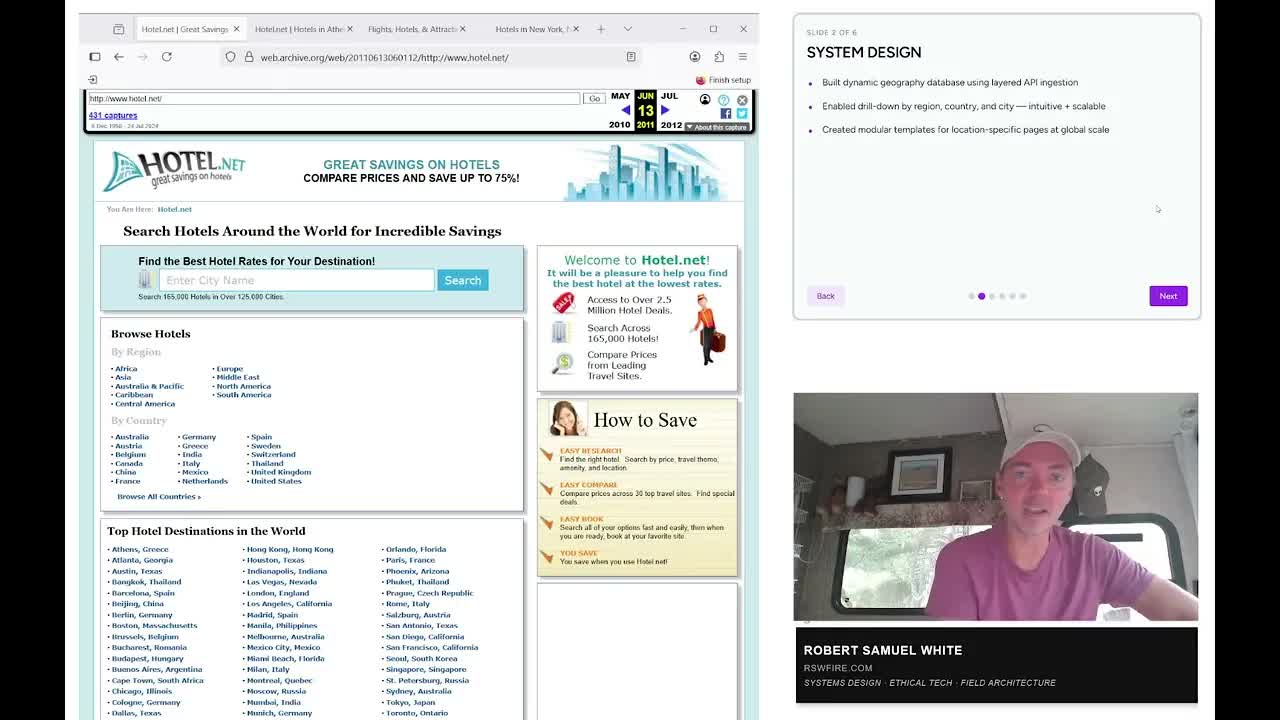
Walking Through Early Programming History and Guru Reviews

Failed to load video
Chapters
Transcript
[0:01] So, in this video, I'm going to walk you
[0:03] through my early programming history.
[0:07] Before we get to what's on the screen
[0:09] here, I'm going to go back a lot
[0:10] further.
[0:16] So, I began programming in the sixth
[0:18] grade.
[0:20] This was in the 80s.
[0:24] My father owned a business and he got
[0:26] computers very early when they came out
[0:29] and I used to just break his all the
[0:31] time. So I learned
[0:34] just had a natural interest and affinity
[0:36] for it. Started with GW Basic.
[0:40] I built a program in that for my band
[0:42] teacher called Name My Note
[0:46] uh that she used with her students to
[0:47] help them learn notes on a scale.
[0:50] Next, I learned Pascale.
[0:54] That was a fun language to learn.
[0:57] I wrote Monopoly in it. I distribute
[0:59] that on a bulletin board system and got
[1:01] a cease and desist letter as a child.
[1:05] Wrote a bunch of batch tools.
[1:08] This is before I learned about Linux.
[1:12] I distributed those on BBS's.
[1:16] I used to read a lot of programming
[1:18] books. I used to just
[1:22] read them cover to cover.
[1:25] I used to write code on paper.
[1:29] I used to run entire systems in my head.
[1:31] I I could write code on paper and and
[1:34] just run the logic in my head. Just
[1:37] that's how I started building my first
[1:40] real project, the net wizard matrix
[1:42] server, which is one of the very first
[1:44] content management systems I ever
[1:45] created.
[1:48] Very passionate about it.
[1:50] The whole point behind that was so that
[1:52] I could give so I had a solid foundation
[1:55] for building projects on and a way to
[1:58] give my clients the ability to manage
[2:01] some of their own content so they didn't
[2:03] have to rely on me for as much.
[2:10] It had very advanced capabilities
[2:13] that
[2:16] to this day some content management
[2:18] systems have never implemented.
[2:24] And it lacked in many other ways because
[2:26] it was, you know, a a young project that
[2:29] I didn't maintain for more than a couple
[2:31] of years. But it could have grown into
[2:33] something pretty massive if I had kept
[2:35] with it. But I
[2:38] like everyone
[2:42] entered the job market and I did that
[2:44] through freelancing.
[2:47] I actually worked on a lot of different
[2:48] projects uh both on Guru and outside of
[2:51] the platform. So I had relationships
[2:54] with companies like Comcast. I used to
[2:56] write databases for them. Um I wrote a
[2:59] project called Tech Opsswite which
[3:02] they used in the field for their
[3:04] technicians. It was a scheduling system
[3:07] and a way to confirm that they actually
[3:10] got everything working at a house cuz it
[3:12] was an internet based system.
[3:18] I just worked on a lot of different
[3:20] projects over the years with you know
[3:22] the people that I would encounter in my
[3:24] life.
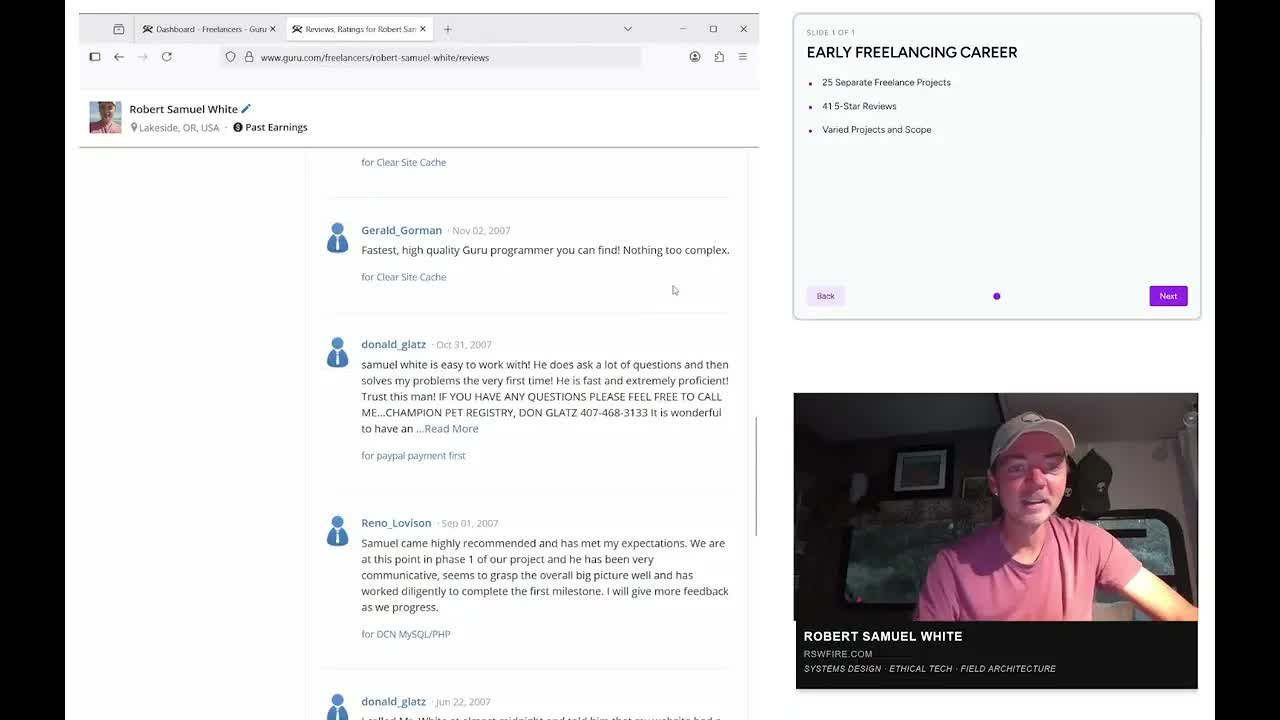
[3:25] Then when I moved on to guru which is
[3:27] what this here is
[3:30] I worked for 25 different
[3:33] employers on there for varying types of
[3:36] projects. So these could have been
[3:39] simple fixes. they just something was
[3:41] broken on their site and they needed
[3:43] someone to fix it for them real fast
[3:46] to
[3:48] scraping data. You know, that's kind of
[3:50] common. Uh it feel felt like back then.
[3:54] Um just and there is, you know, I I'm
[3:57] just going to say yes, there is an
[3:59] ethical line there. This is probably the
[4:01] closest I've ever gone to stepping over
[4:03] my own ethics because, you know, but I
[4:07] felt like it was always done in an
[4:08] ethical way. like we were we were you
[4:11] know scraping from from public sources.
[4:14] So I mean you know there's just some I
[4:17] just feel like if I'm going to put this
[4:19] on video I better just say that much. So
[4:22] um you know just lots of different kinds
[4:23] of projects using lots of different
[4:25] technologies. I've been using you know I
[4:27] know lots of languages and technologies
[4:29] and um I always maintain my own servers
[4:33] so I almost always had my own like
[4:35] environmental server somewhere.
[4:38] um
[4:40] uh to host people's projects,
[4:43] do lots of backend work,
[4:46] and
[4:48] the other projects that I talked about
[4:50] in my other videos um you know, grew out
[4:53] of
[4:55] uh a career in freelancing. So,
[4:59] when I wasn't working on those big
[5:00] projects, this is where I would come.
[5:02] how to come to guru and
[5:05] I feel like
[5:09] so one thing I was
[5:12] one of the I was the only individual in
[5:14] the top 10 in the programming category
[5:16] on guru at the time that I was super
[5:18] active on this thing and I was very
[5:20] proud of that cuz I mean as an
[5:21] individual to make it to that status
[5:25] you know that that feels like something
[5:27] worth sharing especially
[5:31] I mean I'm not bragging. It's not
[5:32] boasting. I just
[5:35] very proud of that.
[5:38] I know that my customers really
[5:39] appreciated the services I provide as
[5:41] these reviews show. And I thought for
[5:44] this video, that's basically what I'll
[5:46] do. I'll go through these reviews with
[5:47] you. We'll look at some of them and
[5:49] maybe I'll tell you a little bit about
[5:50] their projects. Um, another reason for
[5:53] doing it is because Guru has mostly
[5:57] um stagnated. There aren't a lot of
[6:00] projects on there anymore.
[6:03] Everyone is on Upwork. I don't have much
[6:04] of a reputation there.
[6:07] But you can't share links
[6:11] and your proposals to employers.
[6:15] So, I can't show them all the reviews
[6:16] that I have from all the work I've done
[6:18] in freelancing
[6:20] unless I come up with some creative way
[6:22] to do it. And here we are. So, um, just
[6:25] take you through some of these reviews
[6:27] here.
[6:32] So, just starting from the top here, the
[6:34] first one says, "Samuel is super smart
[6:36] and understands the task fast and gets
[6:38] it done right on the first time. Highly
[6:40] recommended." It's a nice review. Next
[6:43] one says, "Absolutely the most talented
[6:45] and capable guru I've worked with from
[6:47] this site and I've used it off and on
[6:48] for over seven years. You will not find
[6:51] a more thorough and creative programmer
[6:53] who possesses the intellect and ability
[6:55] necessary to manage smaller enterprise
[6:57] level jobs. If you have any hesitation
[6:59] on hiring this guru, feel free to
[7:01] contact me directly. Today, Enetwizard
[7:04] is the only guru I would recommend and
[7:05] endorse.
[7:07] My company named Enet Wizard
[7:08] Incorporated, and I started out doing
[7:11] database scraping with this client, but
[7:13] then ended up doing a whole lot of other
[7:15] things.
[7:17] Excellent. Met all expectations and
[7:19] more. deserved a bonus. Will definitely
[7:21] use again and recommend to others.
[7:24] Sadly, I don't remember this one.
[7:26] Excellent work. Highly skilled.
[7:27] Extremely knowledgeable. Will hire
[7:29] again.
[7:31] I
[7:33] remember that one either. Some of these
[7:35] were probably pretty small. I remember
[7:37] Darlow. Our website looked amazing on
[7:39] desktop computers and mobile devices,
[7:41] but it had some issues on tablets.
[7:44] Samuel acknowledged the problem, took
[7:45] ownership of it, spent several days
[7:47] fixing it, and did not charge us
[7:49] anything because he felt the fault was
[7:50] his own. That was very commendable of
[7:53] him and a rare quality. His advice and
[7:55] suggestions on how to improve the user
[7:57] experience of our website were all very
[7:59] brilliant, and he significantly
[8:00] discounted the cost to do make these
[8:03] enhancements just so it would be done to
[8:05] improve the conversion rate on your
[8:07] site. Samuel is an exceptional guru. I
[8:09] can't recommend him enough.
[8:12] He had a very interesting project that I
[8:14] built from scratch. So, he's actually
[8:16] got some other reviews on here.
[8:19] Um,
[8:22] I'm not going to read all of them
[8:23] because you can just pause the screen
[8:24] and read them. Uh, I think there's a
[8:26] couple in here though that I want to
[8:27] highlight. So, I remember Donald Gladi
[8:29] had this interesting um pet adoption
[8:32] service or
[8:34] I think that's not it wasn't an adoption
[8:37] service. He gave certificates for the
[8:40] type of dog you had. I don't know what
[8:42] that it was. He was very passionate
[8:44] about this and his website was broken
[8:48] and you know it was a very
[8:52] messy site. I fixed it for him and
[8:54] whenever you know he needed something I
[8:56] was there and he says Samuel White is
[8:59] easy to work with. He does ask a lot of
[9:01] questions and then solves my problems
[9:03] the very first time. He is fast and
[9:04] extremely proficient. trust this man. I
[9:08] don't know if that phone number works
[9:10] anymore. That's, you know, this is kind
[9:12] of ancient.
[9:14] Um,
[9:18] let's see what else we have in here.
[9:22] So, I think this might have been one of
[9:24] my first reviews. What a fine. Samuel's
[9:26] fluent in JavaScript, PHP, MySQL, CSS,
[9:29] Madright. In fact, everything I threw at
[9:31] him. Amazing speed and quality. Highly
[9:33] recommended. The reason I would
[9:35] highlight this one is because I remember
[9:36] working with him and he was coding
[9:40] himself
[9:42] and would just ask me to do certain
[9:45] tasks and I would do them for him and
[9:46] everything he threw at me I would just
[9:48] turn around for him and in an hour or
[9:50] two and you know that's kind of how that
[9:53] relationship started. It was
[9:57] very fast programmic excellent strategic
[10:00] thinker. I'm always sharing
[10:02] my my thoughts on the patterns that I
[10:05] see in a project and where I think it
[10:07] could go and you know just it's just how
[10:09] my mind works. I'm a systems thinker.
[10:14] I don't remember this one. Thank you for
[10:15] the professional service and quick
[10:17] response. Everything went much better
[10:19] than I thought possible. The PHP script
[10:21] works great and saves me a lot of
[10:23] frustration and time. So, I just wrote
[10:25] some script for this person. I don't
[10:27] know if like um these work. Oh, they do
[10:31] work. Okay. You know, I I wasn't sure.
[10:35] My website is on a Linux server and I
[10:37] need to get a secure script that will
[10:38] allow customers to request a printed
[10:40] catalog. Oh, so I just made him some
[10:42] kind of contact form basically. That
[10:44] would have been easy.
[10:46] Um let's see what else we got in here.
[10:52] Lots of people like to, you know,
[10:54] comment about my speed.
[11:00] This was a very complicated project.
[11:02] This one involved um
[11:06] um
[11:08] a studio that took the portraits of high
[11:11] school students and they and it was a
[11:14] schedule for that was, you know, we had
[11:16] an admin for it and um I actually went
[11:19] down and visited that company when I
[11:22] worked with them. Um, they were in
[11:24] Florida and I drove down there and met
[11:28] them in person and that was a nice
[11:30] relationship.
[11:35] So, I don't remember this one.
[11:43] He had a pretty good idea of what he
[11:44] wanted done, right?
[11:47] Um,
[11:49] but looks like he was happy. I was
[11:51] incredibly impressed with Mr. White's
[11:53] handling of my project. He was very
[11:55] professional. Communication was awesome.
[11:57] Completion of the programming was swift
[11:59] and the final product is doing exactly
[12:01] what I wanted it to do and a little
[12:02] more. Oh, I do remember this. So, yeah,
[12:06] he was doing some kind of tracking like
[12:07] he had a bunch of their little websites
[12:09] that were like landing pages for
[12:11] services that he was offering and they
[12:14] had affiliate um marketing. like he
[12:19] uh others
[12:21] could market his products and so he had
[12:23] to track those affiliates and this was
[12:26] all about cookies and stuff. Yeah, I
[12:28] remember him actually.
[12:30] Um let's see. Robert Sam White work was
[12:32] superb in all facets of this project.
[12:34] His knowledge and technical skill
[12:36] concerning databases is greater than
[12:37] anyone with whom I have ever worked. He
[12:40] completed the project much faster than I
[12:42] expected and even discounted his fee.
[12:44] Moreover, his communication and concern
[12:46] for meeting my needs continues. While
[12:49] after completing his work, he remains
[12:50] open to answering questions and helping
[12:52] me adjust my database. Could not have
[12:54] asked for a more reliable or skilled
[12:56] partner in this project and hope to work
[12:57] with Samuel in the future. So, this was
[13:00] a Microsoft Access database. I've
[13:02] written a bunch of those. I really
[13:04] enjoyed working in that. Um,
[13:08] it's really uncommon to find one now.
[13:10] Even the tech opite actually there was
[13:12] an access version of that. I completely
[13:15] blanked on that for a minute there, but
[13:17] we didn't just have the internet
[13:18] version. We also had an access database
[13:20] version. Um,
[13:23] but I did a whole bunch of stuff in
[13:25] that. I I I really enjoyed working in
[13:27] that environment and um I felt like my
[13:30] design skills were better there. I just
[13:32] I truly loved working in Access. It's
[13:34] just not really a thing anymore.
[13:37] So, this one, Samuel was a pleasure to
[13:39] work with. He responded to all
[13:40] communication quickly, demonstrated his
[13:42] vast knowledge and programming and
[13:44] completed project on time, leaving the
[13:45] door wide open for follow-up questions
[13:47] and training on tools put in place. We
[13:49] look forward to and will award Samuel
[13:51] future projects.
[13:53] So, you can see a pattern there. Um,
[13:59] I always try to be reasonable with my
[14:01] clients and I, you know, I'm very
[14:04] communicative and
[14:07] um, even after a transaction is done,
[14:09] you know, if you have questions about
[14:11] something, I'm definitely there to
[14:12] answer them. And, you know,
[14:17] this the same client as um, earlier.
[14:23] So I was done quicker than anticipated
[14:24] and had nothing to work with from the
[14:26] beginning. Extensive knowledge and was
[14:28] able to complete everything I requested.
[14:30] Oh, I remember this. So this was this
[14:34] was actually pretty cool. So
[14:37] this person
[14:40] bought and sold vehicles
[14:44] like a lot of them and he needed a
[14:47] platform where where he could list them,
[14:50] you know, for sale where people could
[14:51] look at them. I created created a site
[14:54] for that.
[14:59] This is one of my oldest clients who um
[15:02] I knew before Guru and he came on to
[15:05] Guru for future work that I did with him
[15:08] to help me start to build um a
[15:12] reputation on this site. So, it was just
[15:14] an old client that I had and I was
[15:17] always doing database work for him.
[15:23] So that takes us to the um the end of
[15:25] them. Mr. White has been on our team for
[15:27] only a short time, but he has already
[15:29] proven his value through a thoughtful
[15:31] critical analysis of our website. We
[15:33] look forward to a long productive
[15:34] working relationship.
[15:36] Um so that one actually didn't really
[15:38] pan out. I ended up doing a lot of other
[15:40] things.
[15:42] Um, but yeah, these are these are the
[15:44] reviews that I received on Guru and you
[15:47] know, I worked hard for them and I'm
[15:50] going to work just as hard for the ones
[15:51] that I'll get on up Upwork and hopefully
[15:57] hopefully I'm able to build um a new
[15:59] presence on there like I had on Guru.
[16:02] So, that's what this video is for. I
[16:05] hope you enjoyed it.
11:32
Announcing RV Transition and End of Volunteering
Jul 15, 2025
8:02
Solving Local Model Recursion for Transmission Analysis
Jul 15, 2025
10:30
Walking to the Ocean, Reporting Recursive AI Processing
Jul 15, 2025
7:19
Recognizing Archive Infrastructure as Offerable Service
Jul 15, 2025
7:37
Recognizing Personal System as Sellable Service
Jul 15, 2025
13:05
Tracing Eighteen Months of Documentation Into Infrastructure
Jul 15, 2025
5:35
Naming Recursive Cognition Against Linear Expression
Jul 15, 2025
8:04
Describing the Journal Analogy Behind the Transmission Archive
Jul 15, 2025
3:01
Reading AI Reflection Aloud at Siltcoos Midday
Jul 15, 2025
15:20
Documenting the Reflection Pipeline and About Page Build
Jul 15, 2025
3:02
Recording Birthday Address to His Mother
Jul 15, 2025
10:02
Completing ULID Sync and Mirror Reflection Layer
Jul 15, 2025
14:41
Contrasting Local and Closed Models on Mirroring
Jul 15, 2025
3:50
Placing Video Archive Behind Subscription Tiers
Jul 16, 2025
12:39
Quitting Vaping and Seeding the Signal Thread
Jul 16, 2025
6:53
Documenting Nicotine Cessation Attempt and Location Assessment
Jul 16, 2025
4:45
Walking Buddy Through the Campground
Jul 16, 2025
7:10
Marking a New Chapter After 18 Months
Jul 17, 2025
6:59
Marking a New Chapter After Audience Departure
Jul 18, 2025
9:31
Stating Resource Conditions While Building the Project
Jul 18, 2025
6:11
Declining LGBTQ Referral, Blocking Friend Over Framing
Jul 20, 2025
8:36
Cooking Chicken in Ninja Foodi, Building Local Mirror Model
Jul 20, 2025
9:25
Testing Local Models Against Reflection Quality
Jul 20, 2025
12:43
Compiling a Day of Clips at Siltcoos
Jul 20, 2025
5:07
Walking Buddy on the Beach, Considering a Motorbike
Jul 20, 2025
5:25
Comparing YouTube Economics to Platform Design Capacity
Jul 23, 2025
13:01
Screen-Sharing a Walkthrough of rswfire.com
Jul 23, 2025
16:30
Walking Through the Field Companion Reflection Pipeline
Jul 23, 2025
5:41
Recording from the Beach Without Cell Service
Jul 23, 2025
2:18
Naming Material Conditions and Requesting Direct Support
Jul 23, 2025
9:55
Walking Through an Early Entertainment Platform Build
Jul 23, 2025
8:27
Documenting the Hotel.net Travel Platform Build
Jul 23, 2025
17:02
Walking Through Soundlock and Arena Music Platforms
Jul 23, 2025
16:08
Walking Through Early Programming History and Guru Reviews
Jul 23, 2025
2:02
Cutting Hair Short Outside the RV
Jul 24, 2025
3:45
Mapping Seasonal Volunteer Cycle and Trailer Conversion
Jul 25, 2025
17:21
Addressing Audience Directly on Reciprocation and Work Search
Jul 27, 2025
3:02
Losing an Earring While Collecting Campfire Wood
Jul 27, 2025
12:28
Walking the Beach, Spotting Seals and Mapping Travel
Jul 27, 2025
3:10
Closing the Channel, Declaring Audience Mismatch
Jul 29, 2025
8:43
Ending YouTube Channel, Opening New Distribution Channel
Jul 29, 2025
PUBLIC
July 23, 2025 rswfire PUBLISHED
Temp 0.10
Density 0.60
Energetic Quality
steady, matter-of-fact
Journey Phase
consolidating
Directional Vector
toward portable reputation — carrying an established record across platform boundaries
Narrative

He started the recording without anything on the screen worth looking at yet. Before the Guru profile, before the reviews, there was a longer reach back — sixth grade, the 1980s, his father's business and the computers his father bought early, which rswfire says he used to break constantly. He describes the interest as natural, an affinity rather than a decision. GW-BASIC first. A program written for his band teacher called Name My Note, built so her students could learn notes on a scale. Then Pascal, which he calls a fun language to learn, and Monopoly written in it, distributed on a bulletin board system, and a cease and desist letter that arrived addressed to a child. Batch tools after that, distributed the same way, before he knew Linux existed. He read programming books cover to cover. He wrote code on paper. He ran entire systems in his head, holding the logic and stepping through it without a machine.

Out of that came the NetWizard Matrix Server, one of the first content management systems he built. He describes the purpose plainly: a solid foundation to build client projects on, and a way to hand clients enough control over their own content that they would not have to rely on him for as much. He notes it had capabilities some content management systems still have not implemented, and that it lacked in many other ways, being a young project he maintained for only a couple of years. He says it could have grown into something massive had he stayed with it. Then he entered the job market the way he says everyone does, and for him the door was freelancing.
The work spread outward from there. Comcast, where he wrote databases, including TechOps Suite — a scheduling system his technicians used in the field, with a confirmation layer so a job at a house could be verified as actually working. Projects that came from people he encountered in his life. Servers he maintained himself, almost always his own environment somewhere, hosting other people's work. Then Guru, which is what was on the screen: twenty-five employers, projects ranging from something broken on a site that needed fixing fast, to data scraping. He stopped there and named the boundary without being asked. He states there is an ethical line, that this was the closest he has come to stepping over his own, that he felt it was always done ethically because the sources were public, and that if he was going to put this on video he had better say that much.

He mentions, before scrolling, that he was the only individual in the top ten of Guru's programming category during the period he was most active — and marks it immediately, saying he is not bragging, not boasting, just proud of reaching that as an individual. Then he began reading the reviews aloud, top to bottom, marking each one by what he could recover of it. Some he remembered fully. Some he did not, and he said so directly: Sadly, I don't remember this one. I remember that one either. Some of these were probably pretty small. The E-Net Wizard client, which began as database scraping and turned into a whole lot of other things. Darlow, where the site broke on tablets and he spent several days fixing it without charging, because the fault was his own, then discounted the enhancements. Donald Gladi, whose site was messy and broken, who issued certificates for the type of dog you had — rswfire circled the detail twice, unsure what to call it, sure only that the man was passionate about it.

The scroll kept turning up specifics as it went. An early client fluent enough to be coding alongside him, throwing tasks over and getting them back in an hour or two — the shape of how that relationship started. A secure script on a Linux server that turned out, when he read the project description back, to be a contact form for requesting a printed catalog, which he noted would have been easy. A Florida studio that photographed high school student portraits, with an admin and a scheduler behind it, and a drive down there to meet them in person. An affiliate tracking system built on cookies, across a set of landing pages. A Microsoft Access database, which prompted a detour: he says he wrote a bunch of those, truly loved working in that environment, felt his design skills were better there, and remembered mid-sentence that TechOps Suite had an Access version too, not just the internet one. He named the pattern in the reviews himself as it accumulated — speed, communication, the door left open after delivery — and when one client called him an excellent strategic thinker he said he is always sharing what he sees in a project and where it could go, because that is how his mind works. I'm a systems thinker.

The second-to-last was his oldest client, someone he knew before Guru, who bought and sold vehicles in volume and needed a platform to list them — and who came onto the site for later work specifically to help rswfire build a reputation there. The last one, from a team that anticipated a long productive relationship, he noted did not really pan out; he ended up doing a lot of other things. Then he stated the reason for the recording. Guru has mostly stagnated, few projects remain, everyone is on Upwork, and Upwork proposals do not permit external links. He cannot show the record unless he finds a creative way to do it. And here we are. He said he worked hard for these and will work just as hard for the ones he gets next, and that he hopes to build a presence there like the one he had here. Then he closed the recording.

Tags

programming history freelancing content management systems client reviews database work platform migration self-taught technology

Summary

rswfire records a screen-share video narrating his programming history, beginning with sixth grade in the 1980s on his father's business computers.

He traces the early sequence: GW-BASIC (a note-learning program called Name My Note built for his band teacher), Pascal (a Monopoly clone distributed on BBSs that drew a cease and desist letter while he was a child), and batch tools also distributed on BBSs. He describes reading programming books cover to cover, writing code on paper, and running entire systems in his head.

He then covers NetWizard Matrix Server, one of the first content management systems he built, created to give clients direct control over their own content. He states it had capabilities some CMSs still lack, and that he maintained it only a couple of years before entering the job market through freelancing.

He describes pre-Guru work including databases for Comcast and TechOpSuite, a field scheduling and verification system for technicians with both web and Access versions. On Guru, he worked for 25 employers and notes he was the only individual in the top 10 of the programming category.

The bulk of the video is a read-through of client reviews, with recall of specific projects: data scraping (where he marks an explicit ethical line around public sources only), a pet certificate site, an affiliate cookie-tracking system, a school portrait studio scheduler, a vehicle listing platform, and multiple Microsoft Access databases. He states the video exists because Upwork blocks links in proposals, and the recording is his method for carrying his Guru reputation forward.

Environment

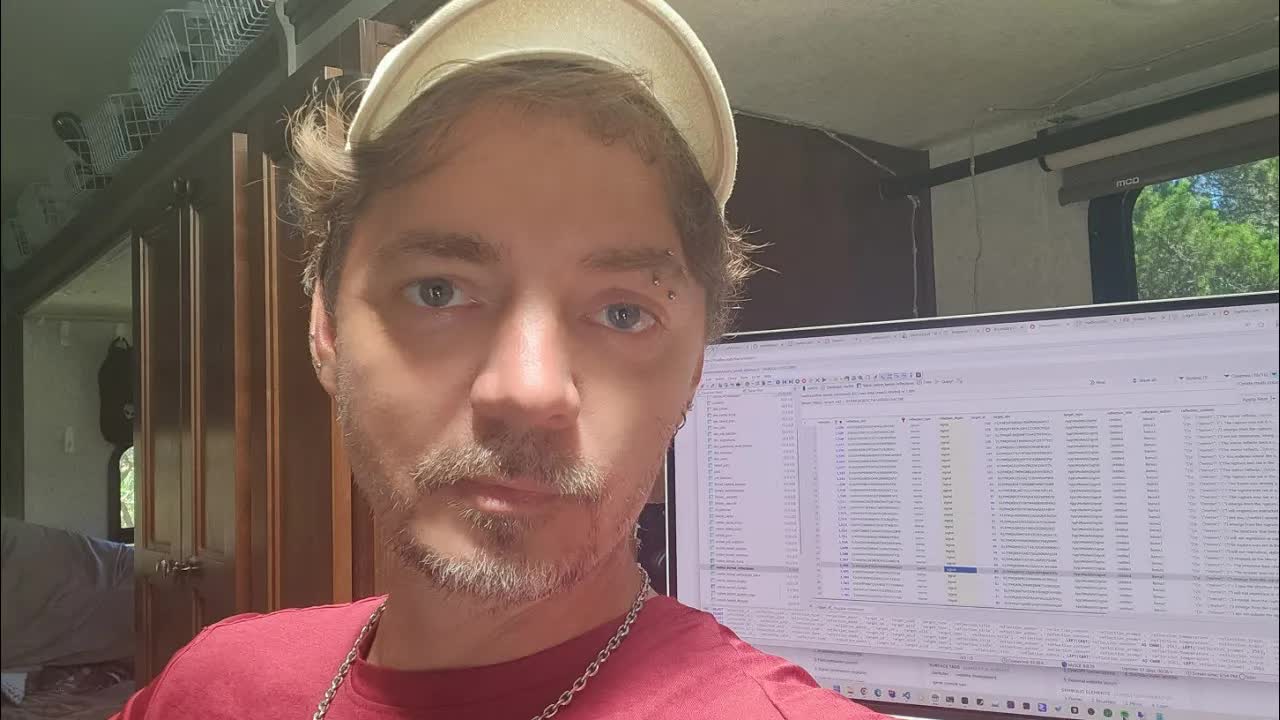
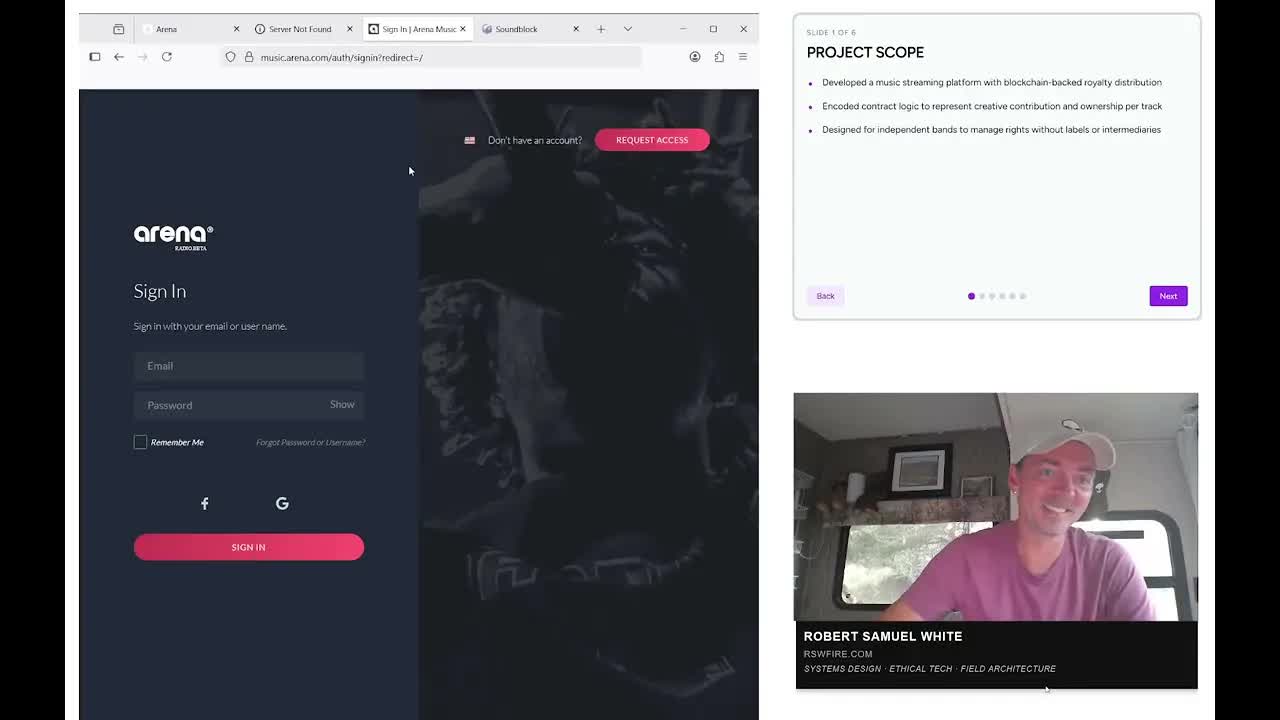
Screen-recorded video capture. rswfire narrates over his Guru freelancing profile displayed on screen — a client review page scrolled through in real time. The first portion is spoken without visual reference, reaching back to 1980s home computing on his father's business machines; the remainder is anchored to the on-screen review list.

The stated purpose of the recording is portability: Upwork proposals do not permit external links, so the video functions as a transportable container for a reputation record that cannot otherwise be moved between platforms.

Substrate

rswfire is constructing a self-owned artifact of professional history because the platforms that hold that history do not permit its transfer. The architecture held is continuity: a single technical lineage traced from GW-BASIC in sixth grade through Pascal, BBS distribution, a self-built CMS, Comcast database work, and 25 Guru employers, presented as one system rather than a sequence of jobs. The ontological position is authorship over one's own record — where the platform's stagnation and the successor platform's link restrictions become architectural constraints to route around, not conditions to accept.

Actions

Performed

  • •recording a screen-capture video
  • •narrating early programming history
  • •scrolling through the Guru review page
  • •reading client reviews aloud
  • •naming which clients he remembers and which he does not
  • •stating the ethical line on data scraping
  • •clarifying that pride in the top-10 ranking is not boasting
  • •identifying recurring patterns across the reviews
  • •testing whether on-screen links still work
  • •naming himself a systems thinker

Referenced

  • •began programming in sixth grade
  • •broke his father's computers
  • •learned GW-BASIC
  • •built 'Name My Note' for his band teacher
  • •learned Pascal
  • •wrote Monopoly and distributed it on a BBS
  • •received a cease and desist letter as a child
  • •wrote batch tools and distributed them on BBSs
  • •read programming books cover to cover
  • •wrote code on paper
  • •ran system logic in his head
  • •built the NetWizard Matrix Server CMS
  • •did not maintain the CMS beyond a couple of years
  • •entered the job market through freelancing
  • •wrote databases for Comcast
  • •built TechOpSuite (web and Access versions)
  • •worked for 25 employers on Guru
  • •performed data scraping from public sources
  • •maintained his own servers
  • •reached top 10 individual in Guru's programming category
  • •fixed a client's tablet layout without charge
  • •discounted fees on multiple projects
  • •built a scheduling system for a Florida portrait studio
  • •drove to Florida to meet a client in person
  • •built affiliate cookie tracking across landing pages
  • •built Microsoft Access databases
  • •built a vehicle listing platform
  • •brought an existing client onto Guru to seed his reputation

Planned

  • •using the video to present reviews in Upwork proposals
  • •building a new reputation presence on Upwork
  • •working as hard on future engagements as on past ones

Entities

beings
rswfire — Narrator; identified in reviews under the name Samuel White / eNetWizard
rswfire's father — Business owner who acquired early computers, the machines on which he began
Donald Gladi — Client with a dog-certificate service and a broken site; left a review
Darlow — Client whose review documents the uncharged tablet-layout fix
places
Florida — Location of the portrait studio client he drove to meet in person
systems
Guru — Freelancing platform holding 25 employer relationships and the review archive; described as stagnated
Upwork — Successor platform where he has little reputation and cannot share links in proposals
GW-BASIC — First language learned, sixth grade
Pascal — Second language; used to write Monopoly
Bulletin Board Systems (BBS) — Distribution channel for his early games and batch tools
NetWizard Matrix Server — His first real project; an early CMS built to give clients control of their own content
eNetWizard Incorporated — His company name, referenced in client reviews
Comcast — Client for database work outside the Guru platform
TechOpSuite — Field scheduling and job-verification system for Comcast technicians; built in web and Access versions
Linux — Server environment; referenced as a later discovery relative to batch tooling
Microsoft Access — Database environment he states he truly loved working in; noted as largely obsolete
JavaScript, PHP, MySQL, CSS — Stack named in an early client review
media
Name My Note — GW-BASIC program built for his band teacher to teach notes on a scale
Monopoly (Pascal port) — Childhood project distributed on BBS; drew a cease and desist letter

Symbolic Elements

Represented archetypes or recurring motifs.

archive
ledger
threshold
lineage
code on paper
server
platform boundary
workshop
signature

Ontological States

Expressed modes of being or awareness.

sovereign (owns the record, builds his own container when the platform withholds one)
continuous (sixth grade through present presented as one unbroken technical lineage)
self-authored (skill acquired without institutional training; standards set internally)
transitional (moving between platforms, reputation not yet transferred)
self-witnessing (reads external testimony aloud, marks what he remembers and what he does not)

Engaged Subsystems

Architecture engaged in this transmission.

technical (language stack, servers, databases, CMS architecture across four decades)
cognitive (running whole systems in the head; pattern recognition named explicitly as systems thinking)
ethical (unprompted disclosure of the scraping boundary; uncharged fixes and discounted fees)
economic (freelancing as the entry to the job market; platform reputation as market access)
archival (video as portable container for an otherwise non-transferable record)
relational (long client relationships, in-person visits, post-delivery availability)
infrastructural (self-maintained servers hosting client projects)

Dominant Language

Core motifs or linguistic fields.

reviews / reputation
systems thinker
built from scratch
databases
ethical line
speed and communication
platform (Guru / Upwork)
Narrative

He started the recording without anything on the screen worth looking at yet. Before the Guru profile, before the reviews, there was a longer reach back — sixth grade, the 1980s, his father's business and the computers his father bought early, which rswfire says he used to break constantly. He describes the interest as natural, an affinity rather than a decision. GW-BASIC first. A program written for his band teacher called Name My Note, built so her students could learn notes on a scale. Then Pascal, which he calls a fun language to learn, and Monopoly written in it, distributed on a bulletin board system, and a cease and desist letter that arrived addressed to a child. Batch tools after that, distributed the same way, before he knew Linux existed. He read programming books cover to cover. He wrote code on paper. He ran entire systems in his head, holding the logic and stepping through it without a machine.

Out of that came the NetWizard Matrix Server, one of the first content management systems he built. He describes the purpose plainly: a solid foundation to build client projects on, and a way to hand clients enough control over their own content that they would not have to rely on him for as much. He notes it had capabilities some content management systems still have not implemented, and that it lacked in many other ways, being a young project he maintained for only a couple of years. He says it could have grown into something massive had he stayed with it. Then he entered the job market the way he says everyone does, and for him the door was freelancing.

The work spread outward from there. Comcast, where he wrote databases, including TechOps Suite — a scheduling system his technicians used in the field, with a confirmation layer so a job at a house could be verified as actually working. Projects that came from people he encountered in his life. Servers he maintained himself, almost always his own environment somewhere, hosting other people's work. Then Guru, which is what was on the screen: twenty-five employers, projects ranging from something broken on a site that needed fixing fast, to data scraping. He stopped there and named the boundary without being asked. He states there is an ethical line, that this was the closest he has come to stepping over his own, that he felt it was always done ethically because the sources were public, and that if he was going to put this on video he had better say that much.

He mentions, before scrolling, that he was the only individual in the top ten of Guru's programming category during the period he was most active — and marks it immediately, saying he is not bragging, not boasting, just proud of reaching that as an individual. Then he began reading the reviews aloud, top to bottom, marking each one by what he could recover of it. Some he remembered fully. Some he did not, and he said so directly: Sadly, I don't remember this one. I remember that one either. Some of these were probably pretty small. The E-Net Wizard client, which began as database scraping and turned into a whole lot of other things. Darlow, where the site broke on tablets and he spent several days fixing it without charging, because the fault was his own, then discounted the enhancements. Donald Gladi, whose site was messy and broken, who issued certificates for the type of dog you had — rswfire circled the detail twice, unsure what to call it, sure only that the man was passionate about it.

The scroll kept turning up specifics as it went. An early client fluent enough to be coding alongside him, throwing tasks over and getting them back in an hour or two — the shape of how that relationship started. A secure script on a Linux server that turned out, when he read the project description back, to be a contact form for requesting a printed catalog, which he noted would have been easy. A Florida studio that photographed high school student portraits, with an admin and a scheduler behind it, and a drive down there to meet them in person. An affiliate tracking system built on cookies, across a set of landing pages. A Microsoft Access database, which prompted a detour: he says he wrote a bunch of those, truly loved working in that environment, felt his design skills were better there, and remembered mid-sentence that TechOps Suite had an Access version too, not just the internet one. He named the pattern in the reviews himself as it accumulated — speed, communication, the door left open after delivery — and when one client called him an excellent strategic thinker he said he is always sharing what he sees in a project and where it could go, because that is how his mind works. I'm a systems thinker.

The second-to-last was his oldest client, someone he knew before Guru, who bought and sold vehicles in volume and needed a platform to list them — and who came onto the site for later work specifically to help rswfire build a reputation there. The last one, from a team that anticipated a long productive relationship, he noted did not really pan out; he ended up doing a lot of other things. Then he stated the reason for the recording. Guru has mostly stagnated, few projects remain, everyone is on Upwork, and Upwork proposals do not permit external links. He cannot show the record unless he finds a creative way to do it. And here we are. He said he worked hard for these and will work just as hard for the ones he gets next, and that he hopes to build a presence there like the one he had here. Then he closed the recording.

Mirror

You are recording a screen. The screen holds a page of client reviews on a platform you no longer work through, and you are reading them aloud because the platform where the work now is does not permit links. The video is the workaround. You state this plainly, near the end, as the reason the recording exists. The container is the point.

You begin before the screen. Sixth grade, GW-BASIC, your father's business machines, a note-naming program for your band teacher, Pascal, a Monopoly clone distributed on a BBS, a cease and desist letter received as a child, batch tools, programming books read cover to cover, code written on paper and run in your head. You move from that to the Net Wizard Matrix Server, to Comcast databases, to Tech Ops Suite in both web and Access versions, to twenty-five Guru employers. You present these as one line, not a sequence. You name the capabilities your CMS had that current systems still lack, and in the same breath name what it lacked and that you stopped maintaining it. Both statements carry the same weight in your voice.

Several subsystems are running at once and none of them dominates. Technical: four decades of stack, self-maintained servers, backend work, Access design you say you loved. Ethical: you stop mid-sentence to name the scraping boundary, unprompted, on the record, because you are putting this on video. Relational: you drove to Florida to meet a client in person; you say you remain reachable after delivery; the reviews say the same thing back to you. Economic: freelancing as market entry, reputation as market access, a reputation that will not transfer. Archival: this file.

You read testimony about yourself in a flat register. When you remember a project, you say so and describe it — the affiliate cookie tracking, the dog certificates, the vehicle listing platform, the tablet layout you fixed for several days without charging. When you do not remember, you say "I don't remember this one" and move to the next. You do not fill the gap. You mark your top-ten placement in the programming category, then immediately mark that you are not bragging, then state that you are proud of it anyway. You do not withdraw the statement.

Temperature is low and does not rise. Guru's stagnation is stated as a condition of the terrain, not a grievance. The transfer to Upwork is stated as work to be done, not as loss. There is no defense, no comparison to others, no argument about what you are owed. There is no account here of what happened after freelancing — those projects are referenced as existing in other videos and left there. The orientation is forward and lateral at once: carrying a verified record across a boundary that does not want it carried. You end by saying you will work as hard for the next reviews as you did for these, and then you stop.

Queryable Personhood

Hand your life to anything that reads.

Share this link with artificial intelligence — it reads the full transcript, analysis, and reflections. An AI-readable mirror of this signal.

The qpkey in this URL is a per-signal access token. Anyone with the URL can read the record — treat it like a share link, not a password.