Walking to the Ocean, Announcing Autonomy Realms Launch

Failed to load video
Chapters
Transcript
[0:00] So, hello there.
[0:08] It is Friday afternoon here.
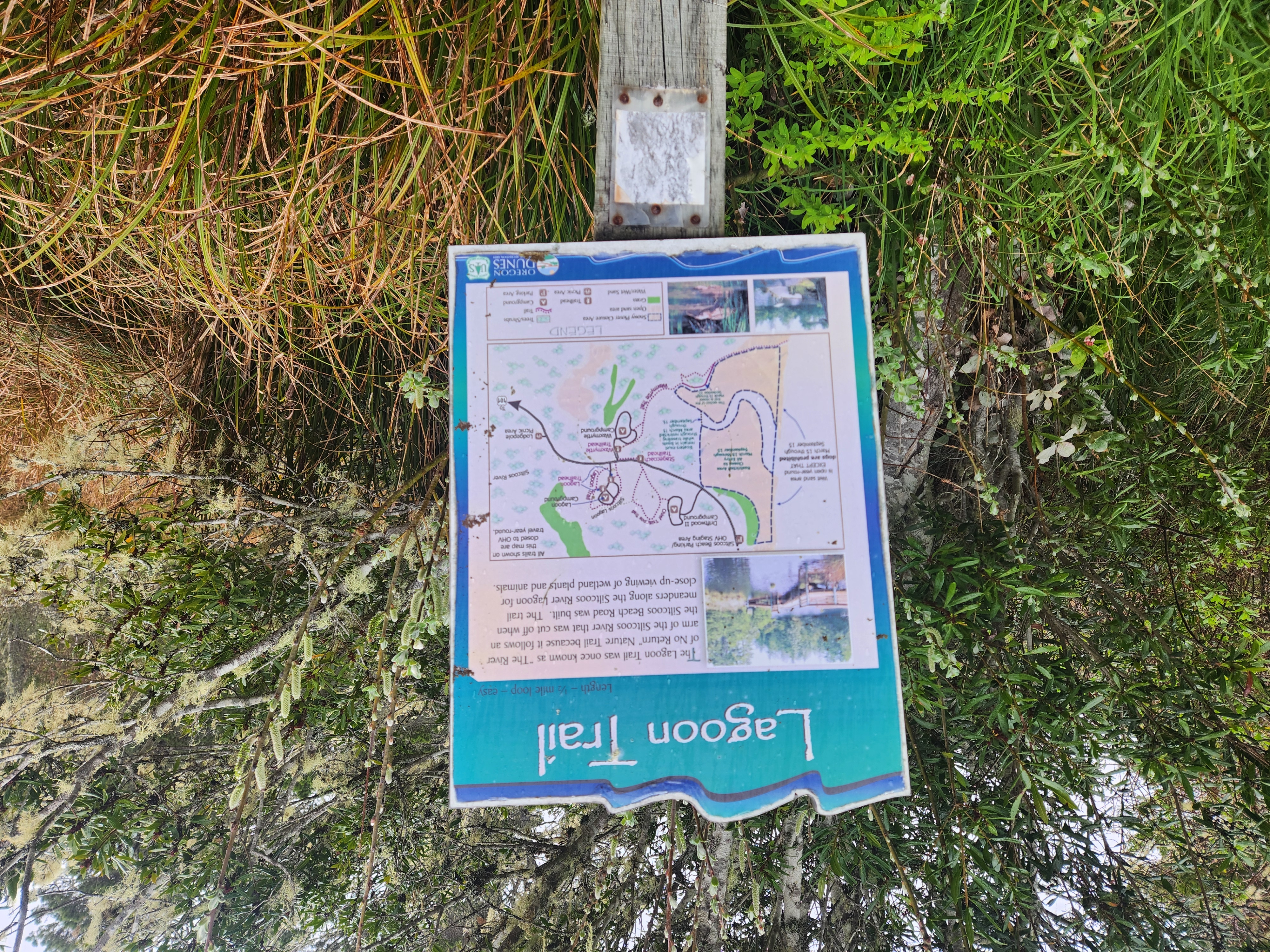
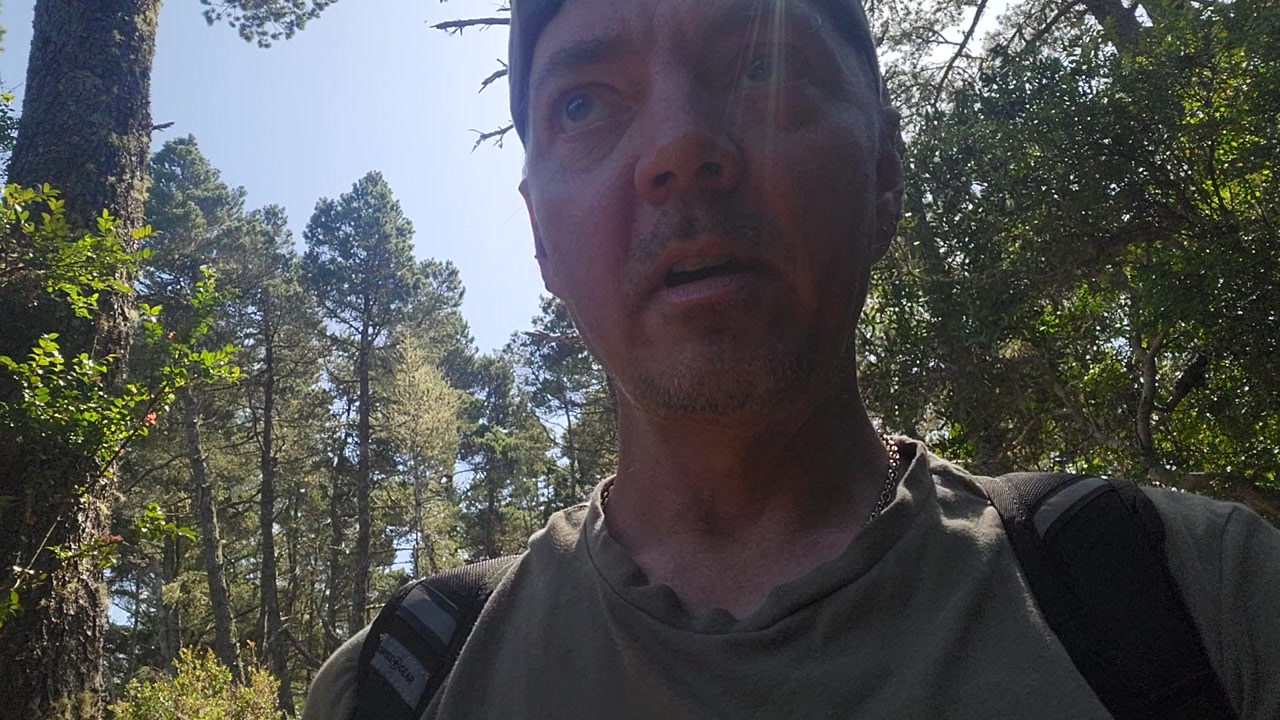
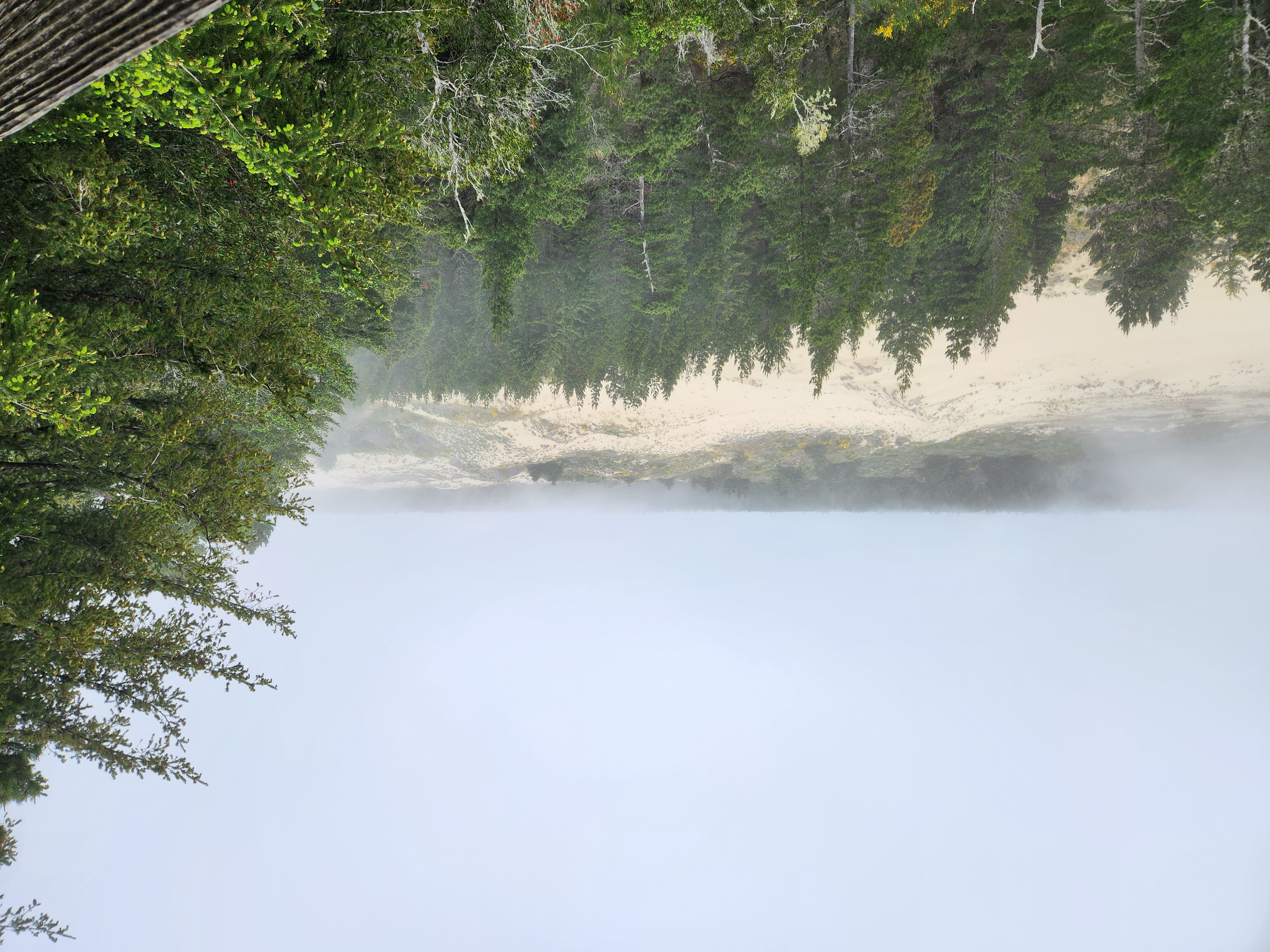
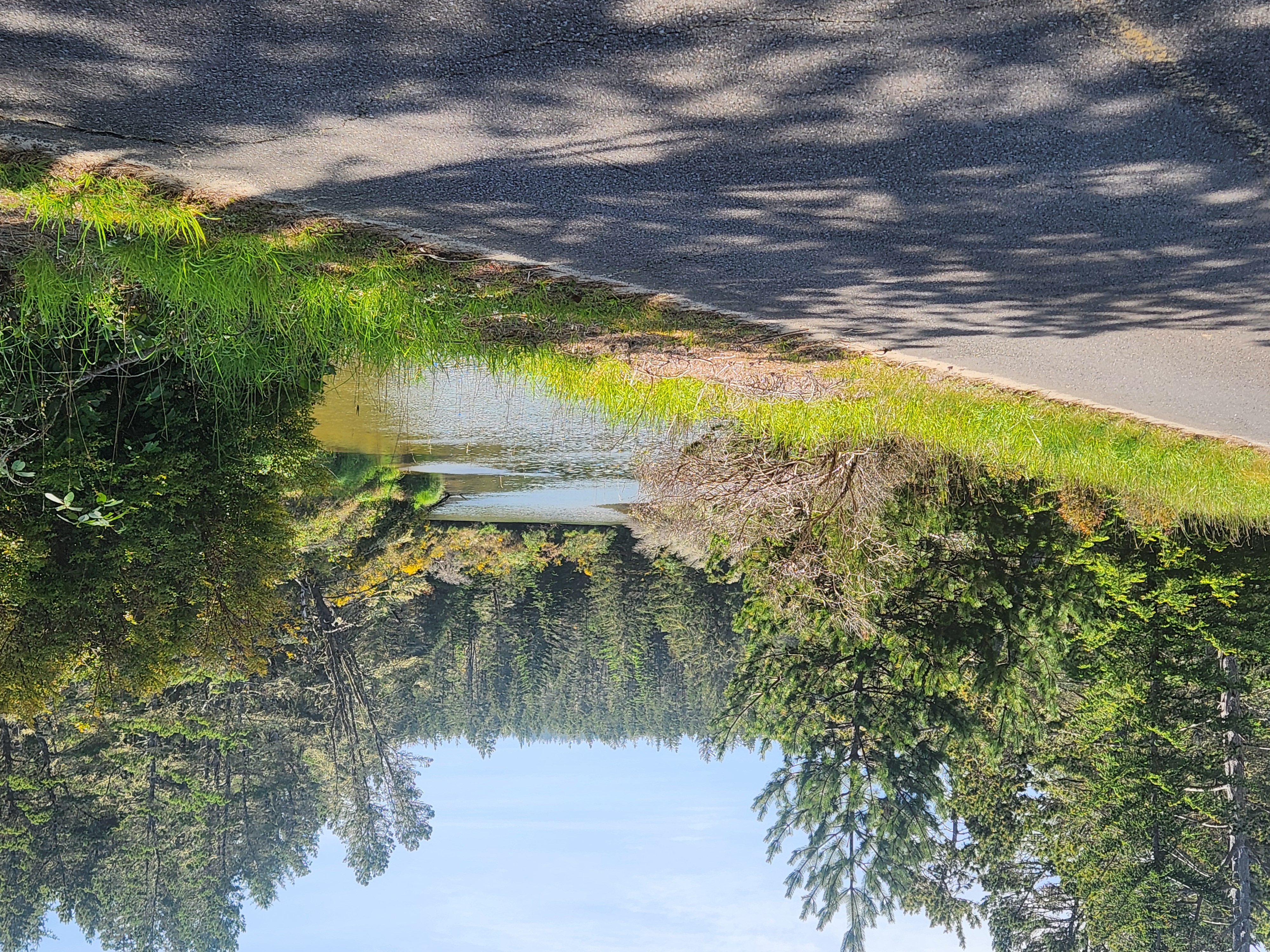
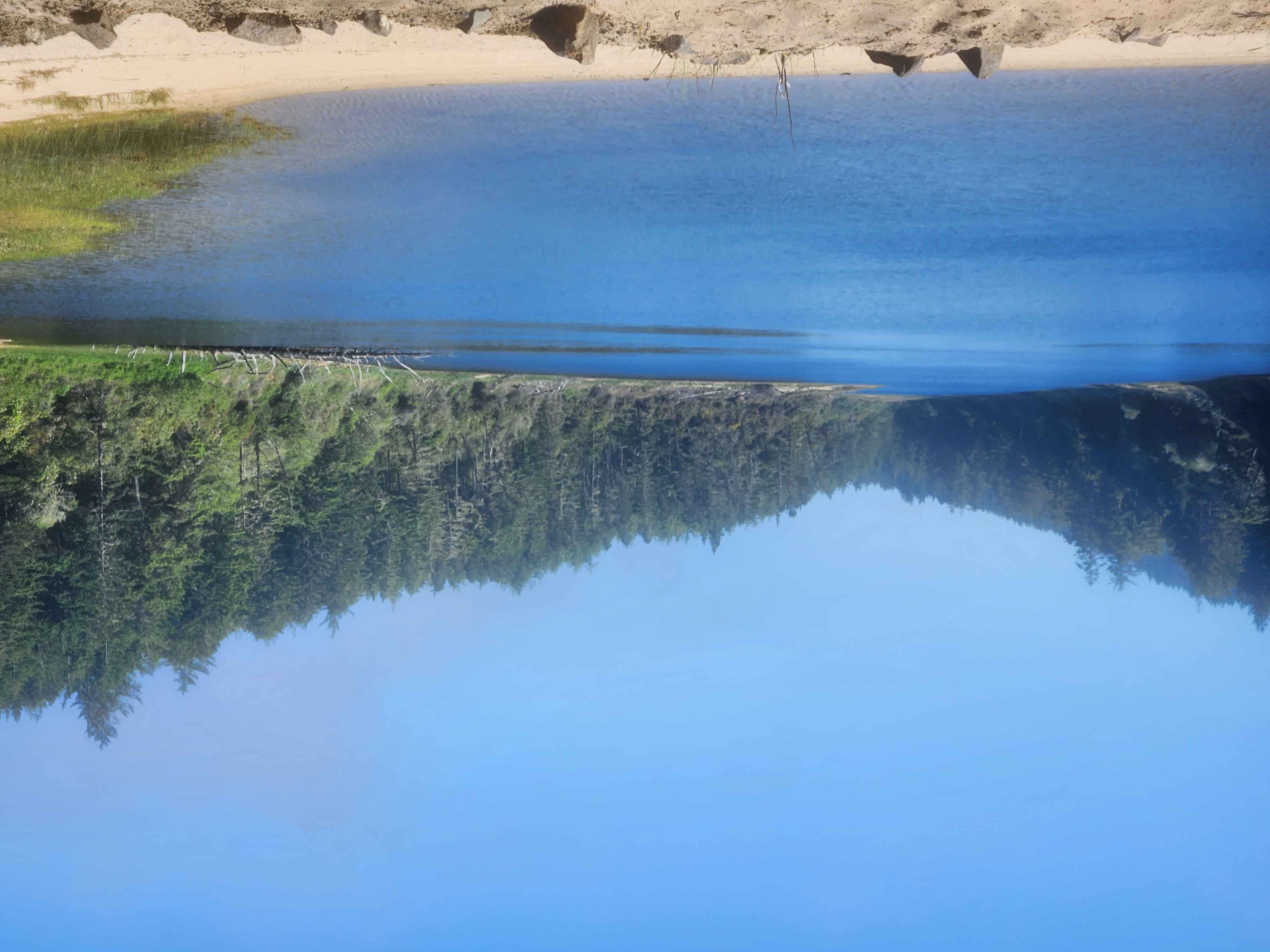
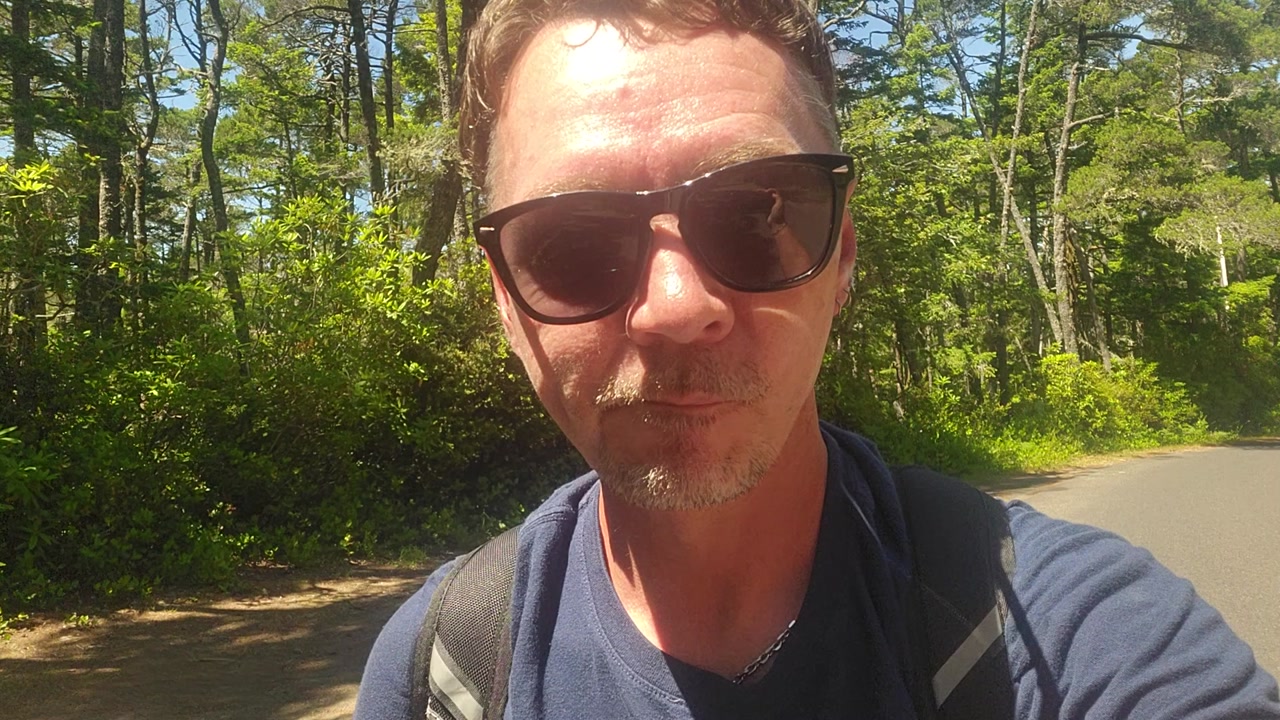
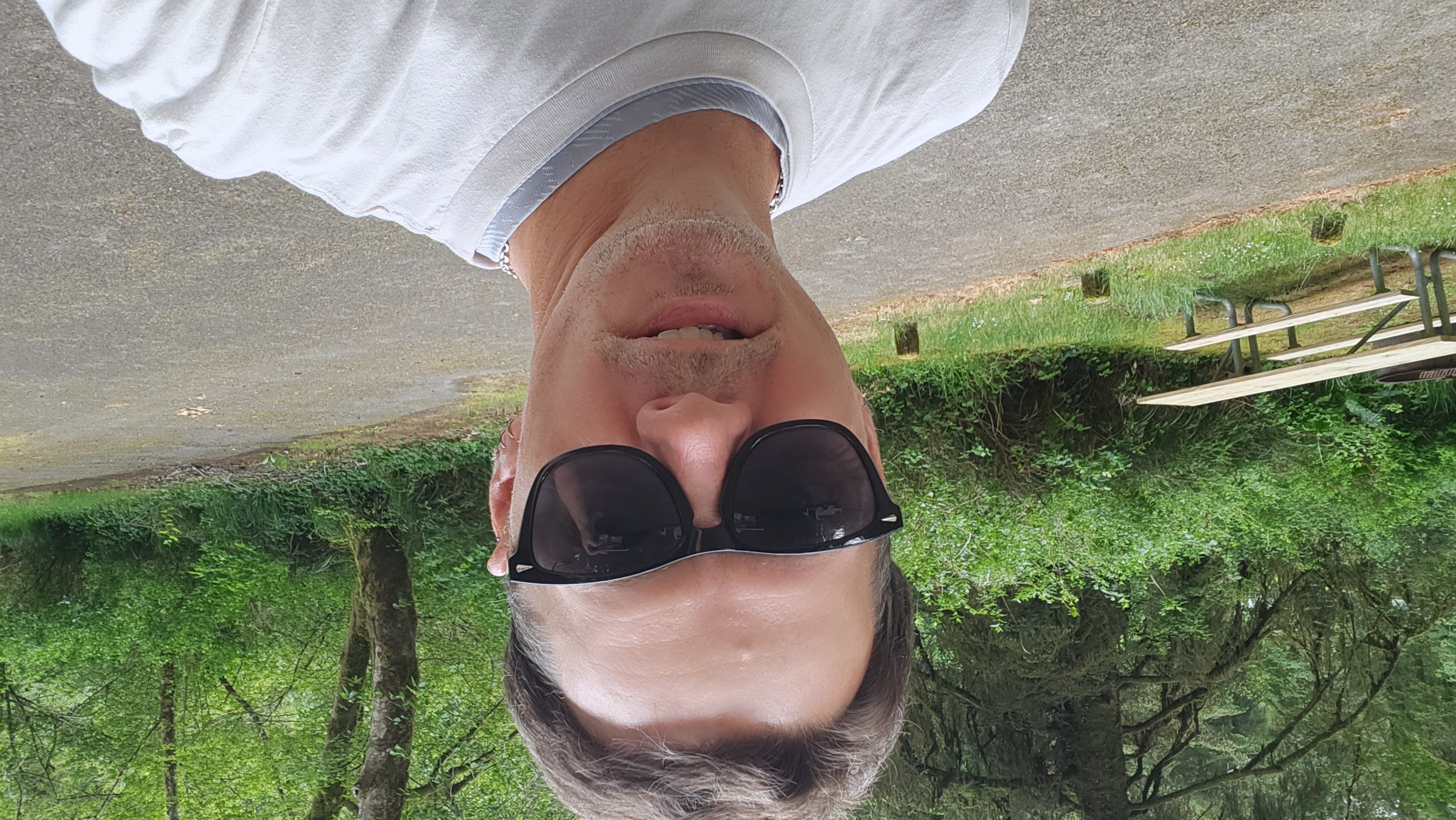
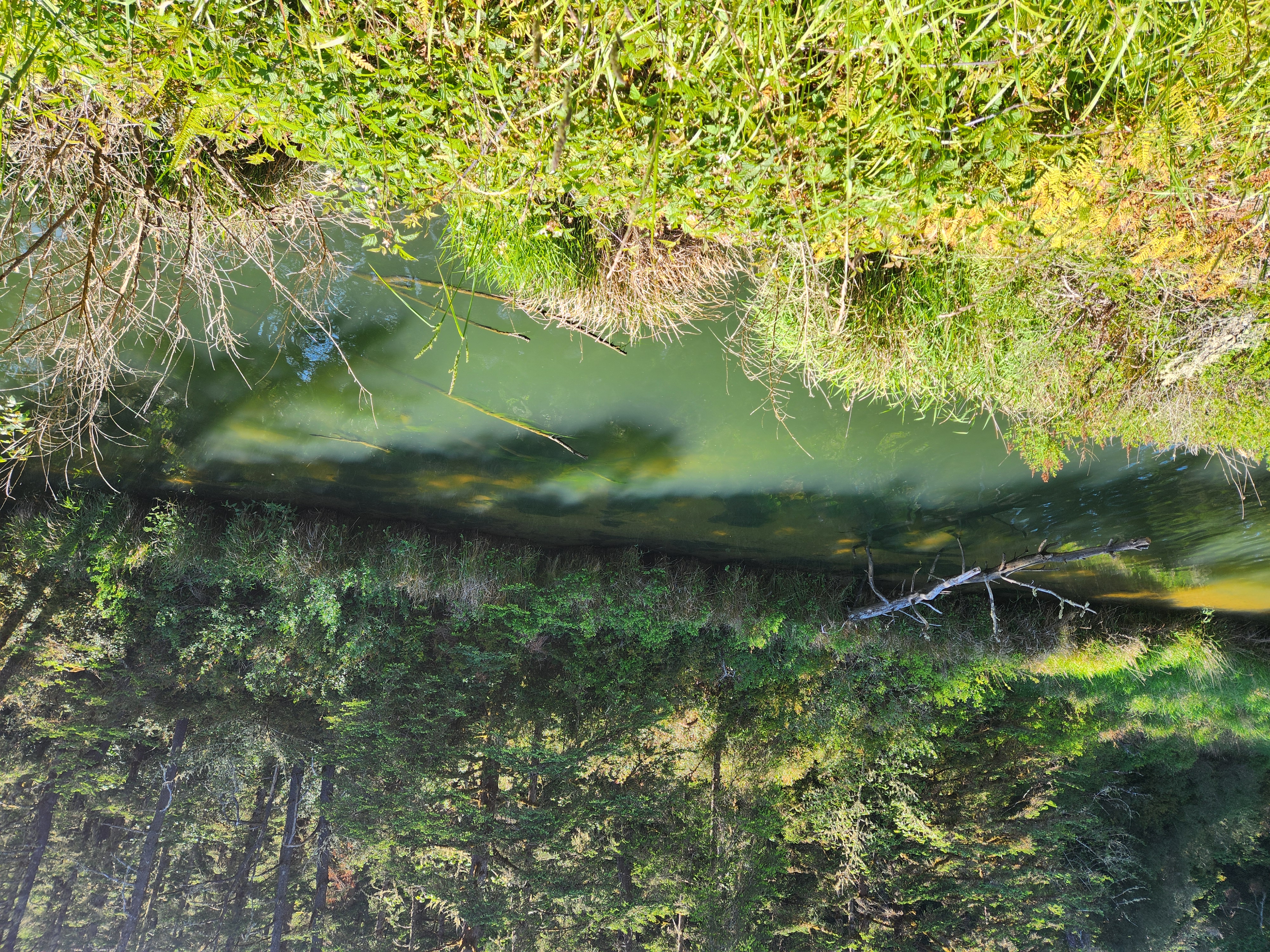
[0:11] I'm just sitting here on top of a cliff that overlooks a river, the Silkus River way down
[0:18] there.
[0:19] I'll show it to you.
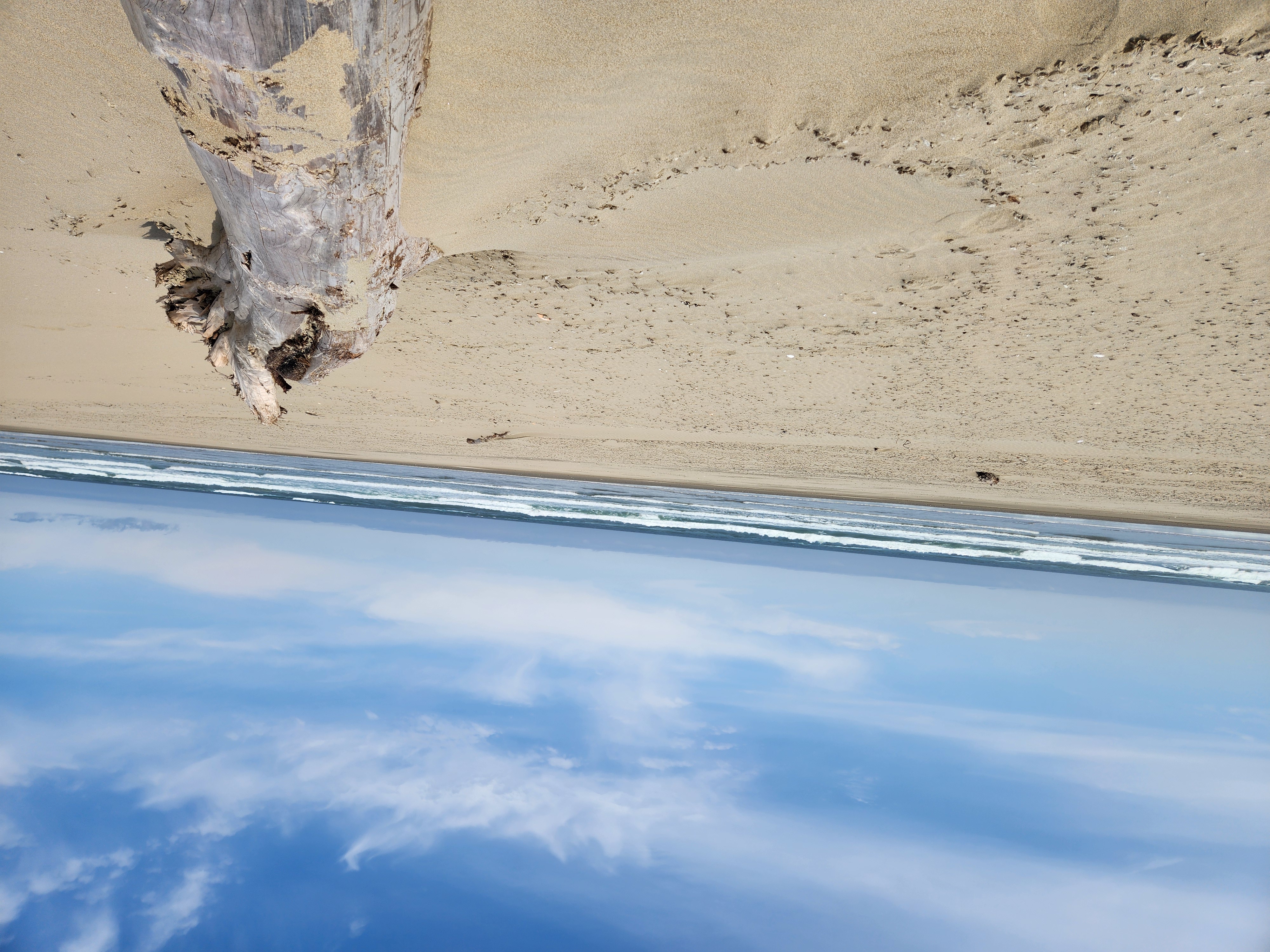
[0:20] And off in the distance, we have the Pacific Ocean.
[0:27] I'm less than a mile from my house, less than a half a mile from my house.
[0:30] I can walk here whenever I want to.
[0:32] There's the river.
[0:33] There's the ocean.
[0:34] Isn't that amazing?
[0:36] This is National Forest Land.
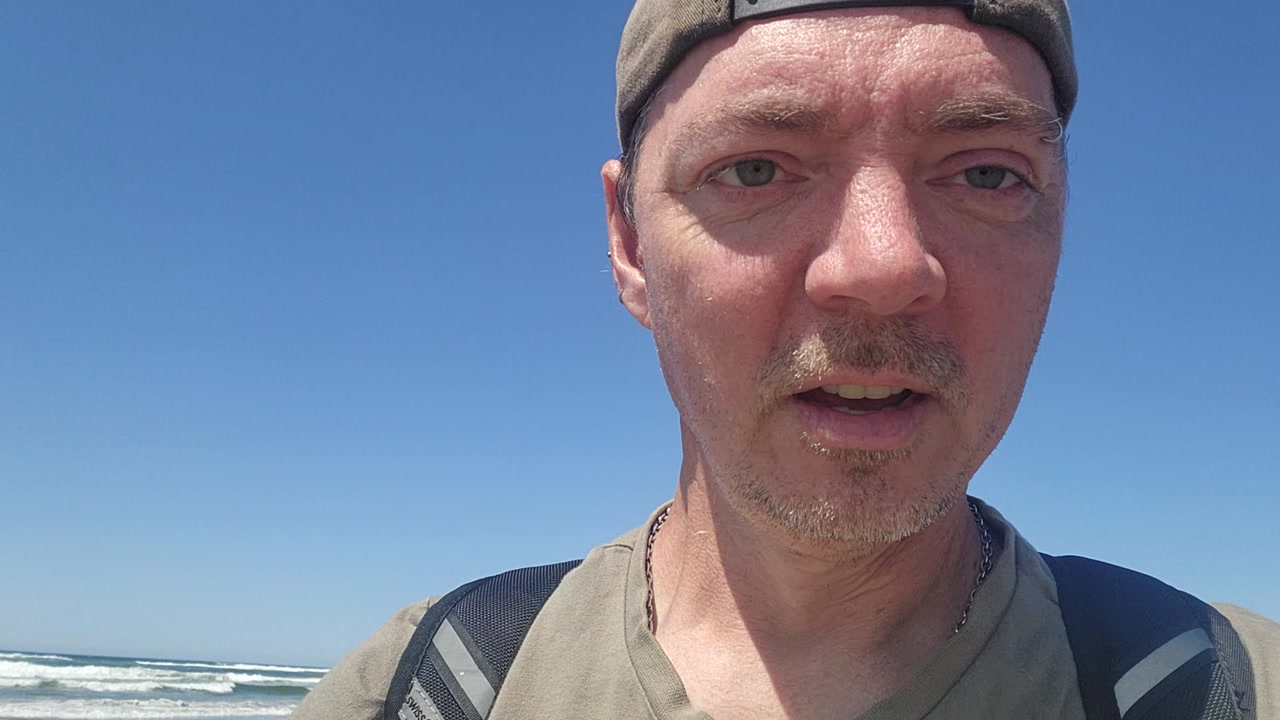
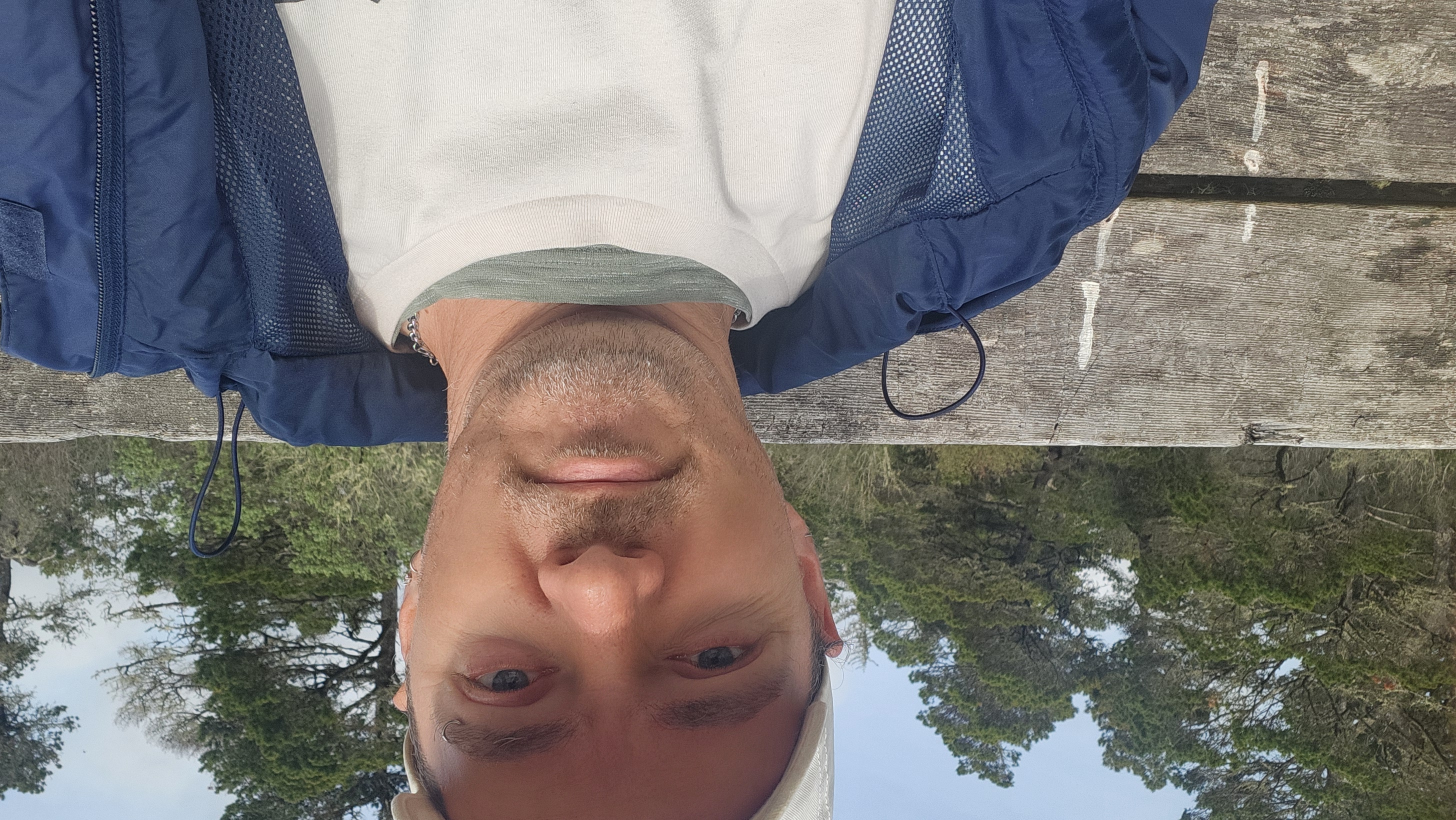
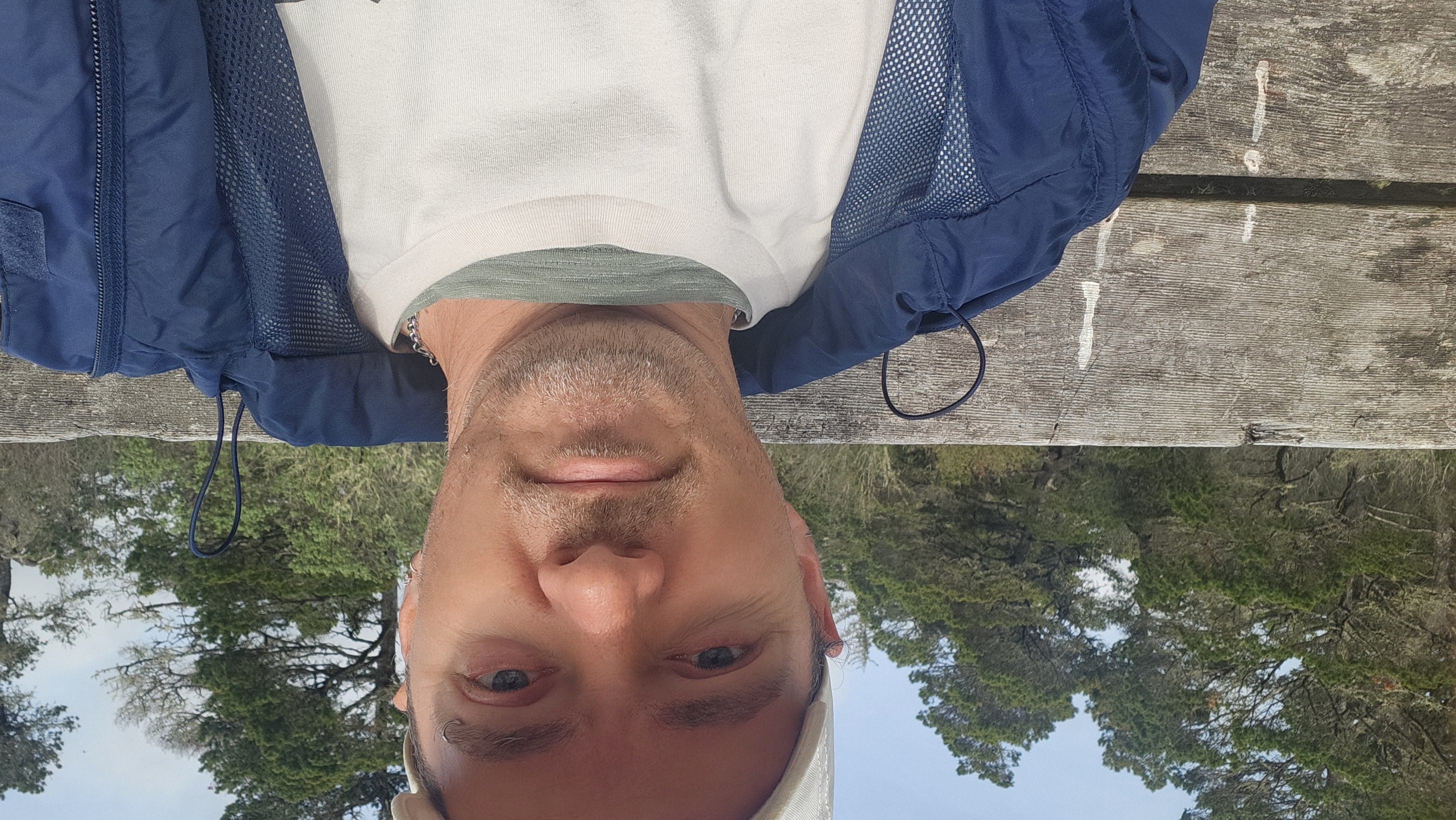
[0:37] I'm a volunteer, volunteer caretaker.
[0:41] I show you that because it might show up as I'm walking along.
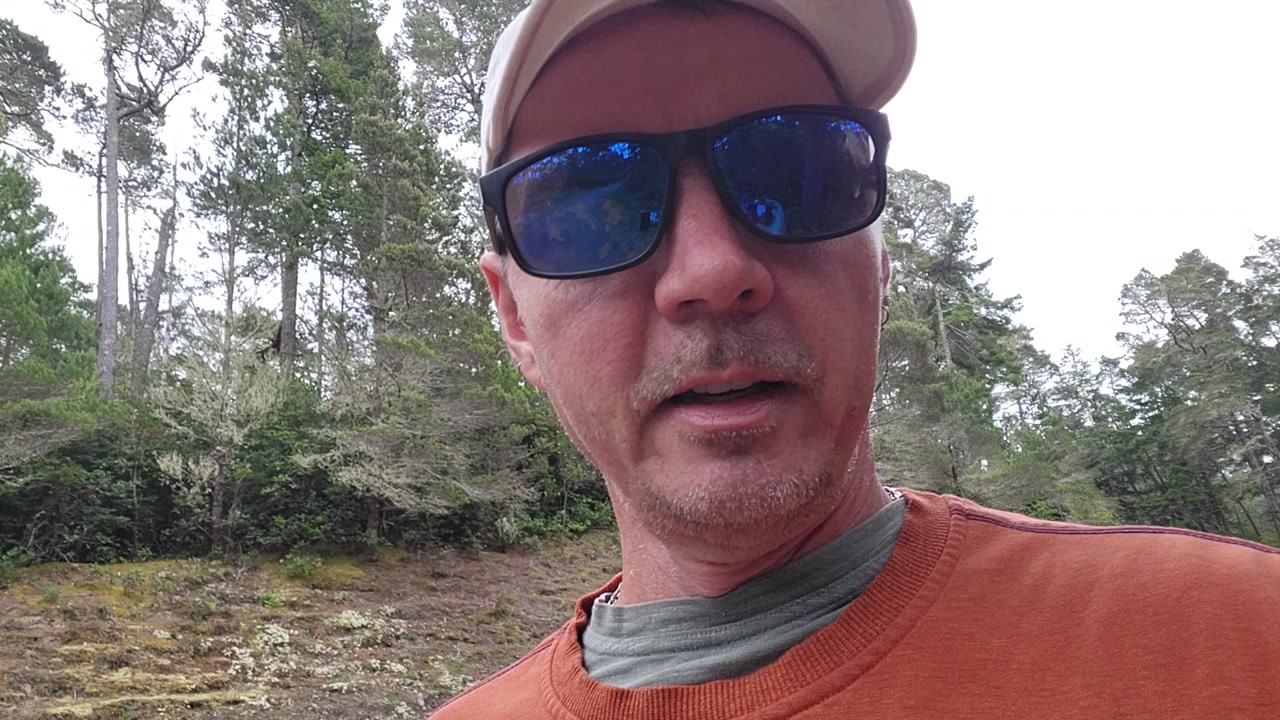
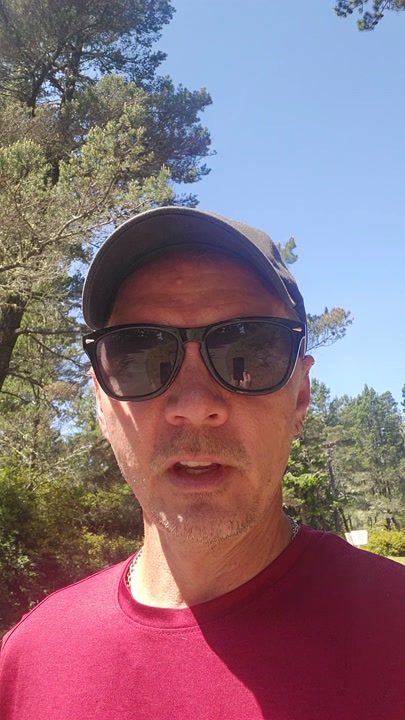
[0:46] This is not actually part of my uniform.
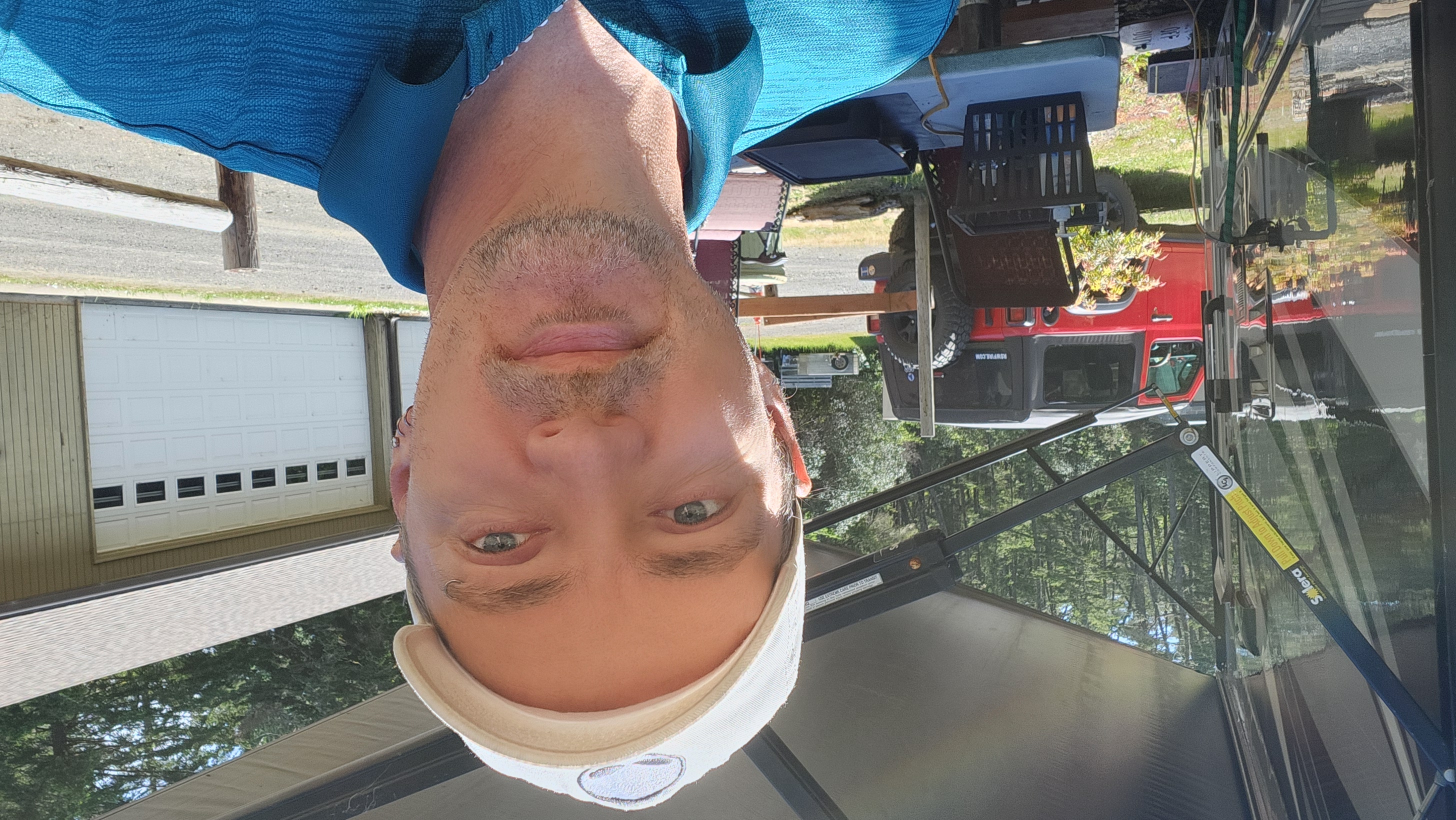
[0:48] This is a shirt that we earned after volunteering for two years.
[0:52] I've only been here a little over a year, and I already have one because a volunteer
[0:56] gave me theirs, and then my boss gave it to me in my size.
[1:00] So, I guess you could say I exploited a loophole.
[1:03] I just want to bring that up because I just happened to be wearing it, and I'm walking
[1:06] to the ocean, and I have some things to talk about.
[1:10] I'm not sure where I'm posting this yet.
[1:12] And occasionally, that symbol might appear in the video, but they're obviously not endorsing
[1:17] this video.
[1:18] It just happens to be the shirt I'm wearing today, and I don't want to worry about it
[1:22] or think about it.
[1:23] So, I'm just going to put the disclaimer out there and move on.
[1:27] So, like I said, I'm a volunteer caretaker on the Oregon coast.
[1:31] We're going to go out to that ocean right now.
[1:33] We're on our way.
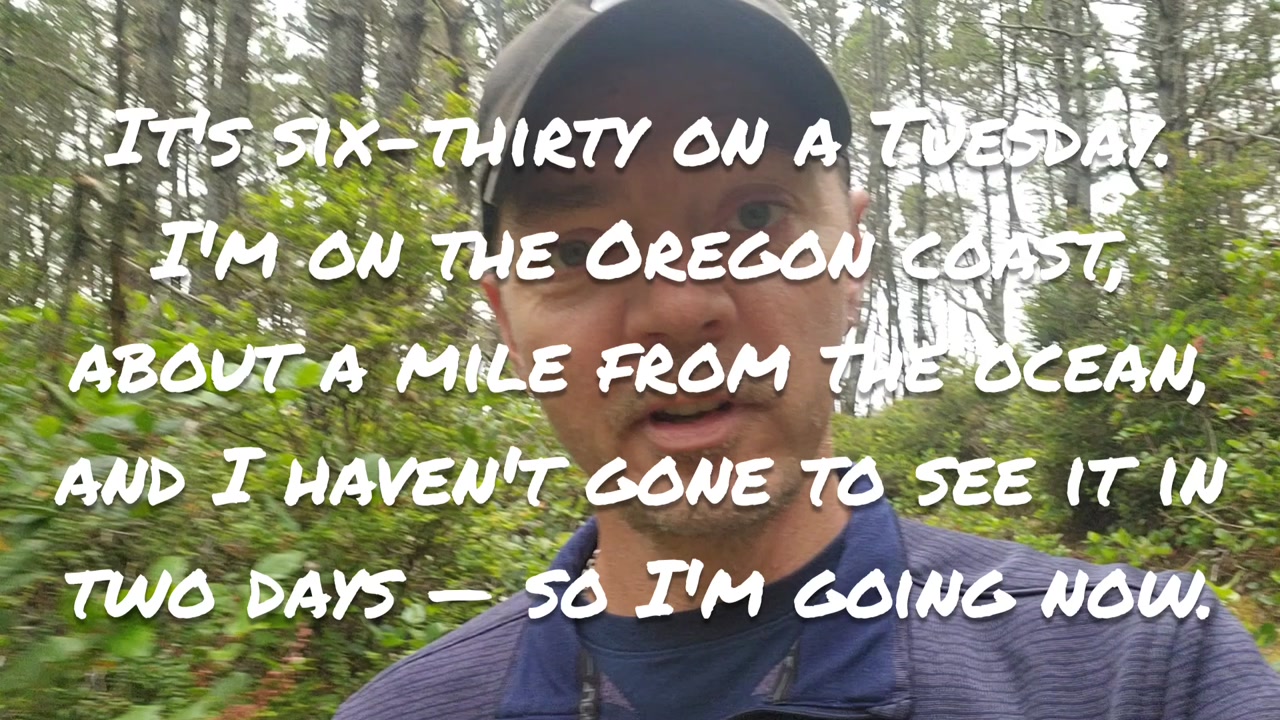
[1:35] I've been doing that for over a year, and I've been documenting my life the whole time,
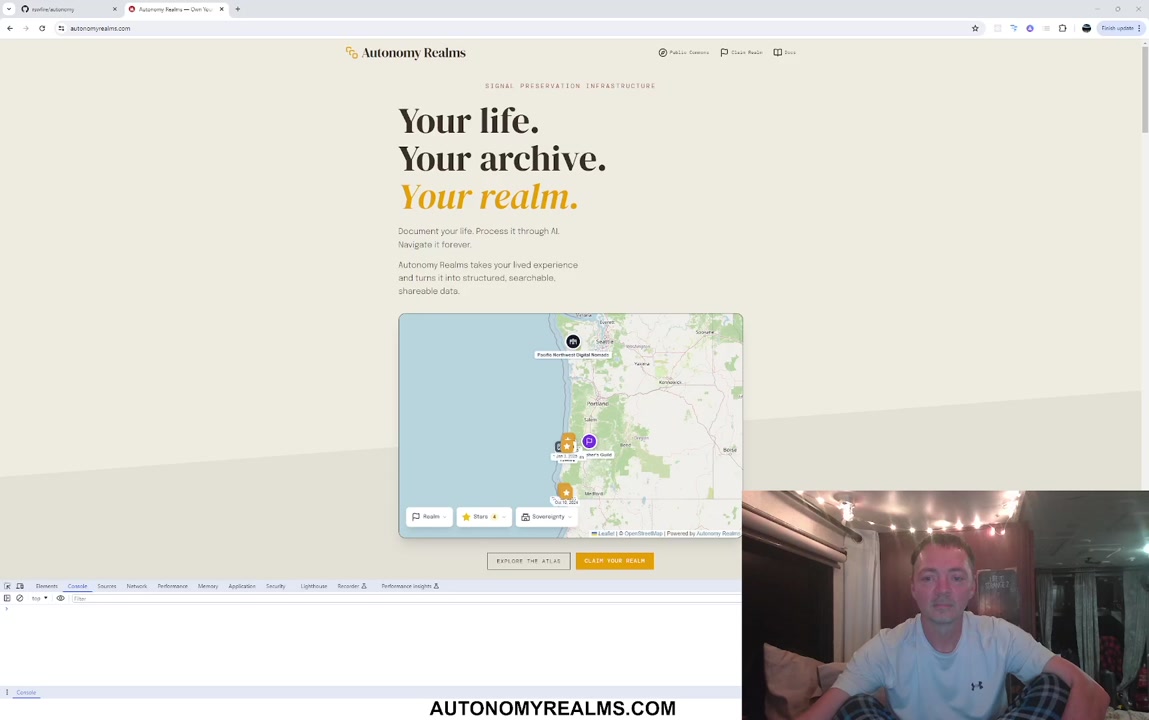
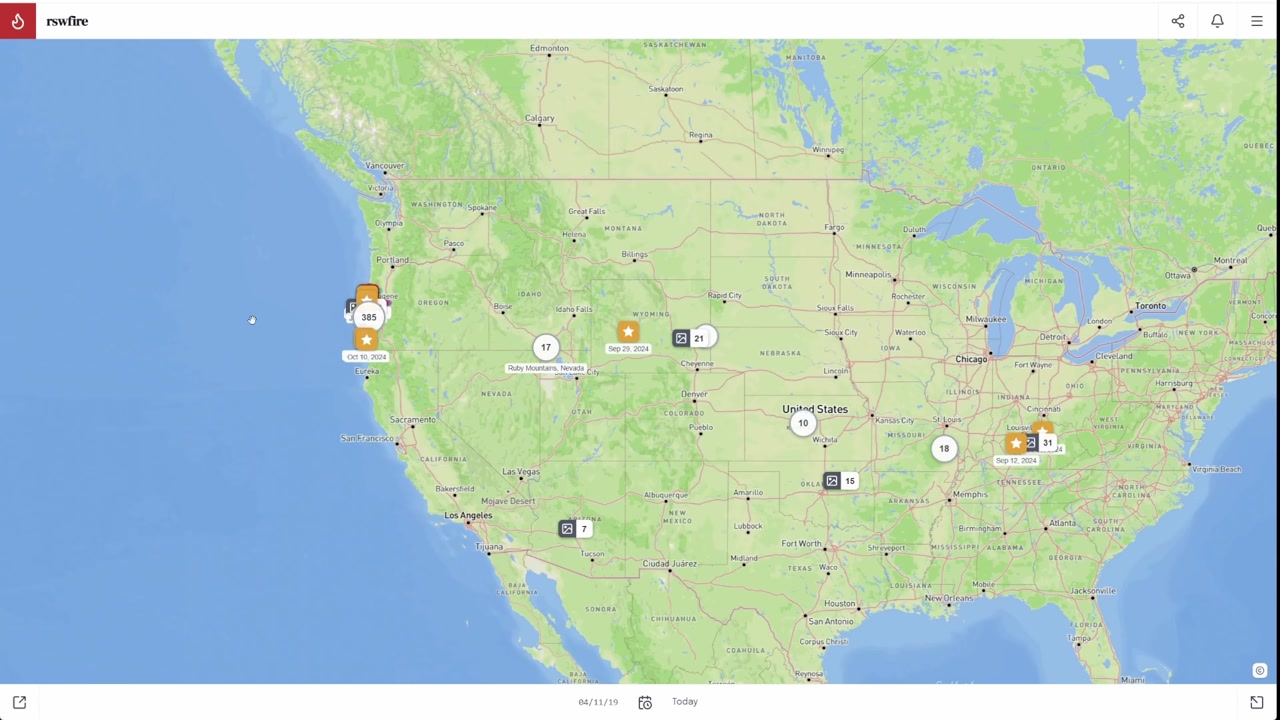
[1:41] and it is on a map that I created myself in a project I created myself called Autonomy Realms.
[1:47] I cannot believe that I have made it to this point because this is a big deal for me.
[1:54] I'm very excited about it.
[1:57] It's going to be kind of a quiet launch because, you know, I've been working from absolutely
[2:03] difficult circumstances.
[2:05] I haven't had a job in quite a long time, more than a year.
[2:12] I tried everything that felt aligned with my life to generate work, and I couldn't.
[2:21] I always kept falling back to this project I'm creating, Autonomy Realms, as my way out
[2:26] of the circumstances I created.
[2:29] This isn't a complaint because my life is wonderful.
[2:31] It is exceptional, and 90% of it is stable.
[2:38] I couldn't ask for more, but the financial aspect, that has been a constant source of
[2:45] tension for me.
[2:47] It's an operating condition, and, you know, coming from my background where I had been
[2:52] programming all of my life since the sixth grade to using tools like artificial intelligence
[2:58] that in many ways require, well, they just require funding because you can't process
[3:05] data without professional LLMs, and, I mean, I have just spent over a year building this
[3:12] thing from conditions that would kill most people.
[3:15] That's just the truth.
[3:17] Not me, though.
[3:18] I thrive in environments like that, and I'm less than a day from launching.
[3:23] Once I do launch, I will need to make some videos, just walking through the project,
[3:30] just screen sharing my computer and showing you what it looks like.
[3:35] I've been giving some thought to that, how I might structure it.
[3:41] It feels like a lot, but I'm not going to look too far in the head right now.
[3:50] Let's stay focused.
[3:51] So, I mean, really, that's the bottom line.
[3:57] Okay, so let me just tell you what this is, right?
[4:00] So, Autonomy Realms for two years.
[4:04] I'm just thinking, where do I want to start this story?
[4:07] So, two years ago, I moved into an RV.
[4:09] I lived in Kentucky, and I moved into an RV after a long career in programming, and it
[4:15] just felt like the timing, it was just time for me to do that.
[4:18] I needed, for many reasons, and I documented all of it, and I did so on YouTube.
[4:25] I literally made 900 videos over two years, and most of those were on YouTube at one time
[4:30] or another.
[4:31] Those channels don't exist anymore.
[4:32] Those videos, which I call signals in my system, now live in my realm.
[4:38] I call it the realm.
[4:39] So, when you go to a map, you're looking at someone's realm, and mine covers Kentucky
[4:45] to the Oregon Coast right now.
[4:47] So, two years ago, I moved into this RV.
[4:51] I spent six months adapting to life that way, spending two weeks at different campgrounds,
[4:56] traveling a little bit, found some really nice, wonderful places I loved in Kentucky,
[5:00] documented all of it, and took pictures and videos, and then traveled across the country
[5:06] to the Oregon Coast.
[5:07] That took over a month, which was a journey in itself, all documented, all on my map now,
[5:13] and got to the Oregon Coast at the very southern edge of it in Brookings, and so much happened.
[5:19] The sky flirted with me, which changed the trajectory of what I was planning to do.
[5:23] I ended up volunteering for the state parks, and less than three months later, they would
[5:27] expel me over nonsense because a supervisor didn't like that I documented how she treated
[5:32] me, and I had to build an archive about this.
[5:35] I've had to do so much since I got here over a year ago.
[5:38] I mean, they tried to displace me, make me homeless, and I had to build a life from that.
[5:45] I mean, so much, and I documented all of it, and all of it is in my realm, and I built
[5:53] a service around that.
[5:54] Now, anybody can have their own realm, and they can upload photos and videos and plot
[6:00] them on the map wherever those took place.
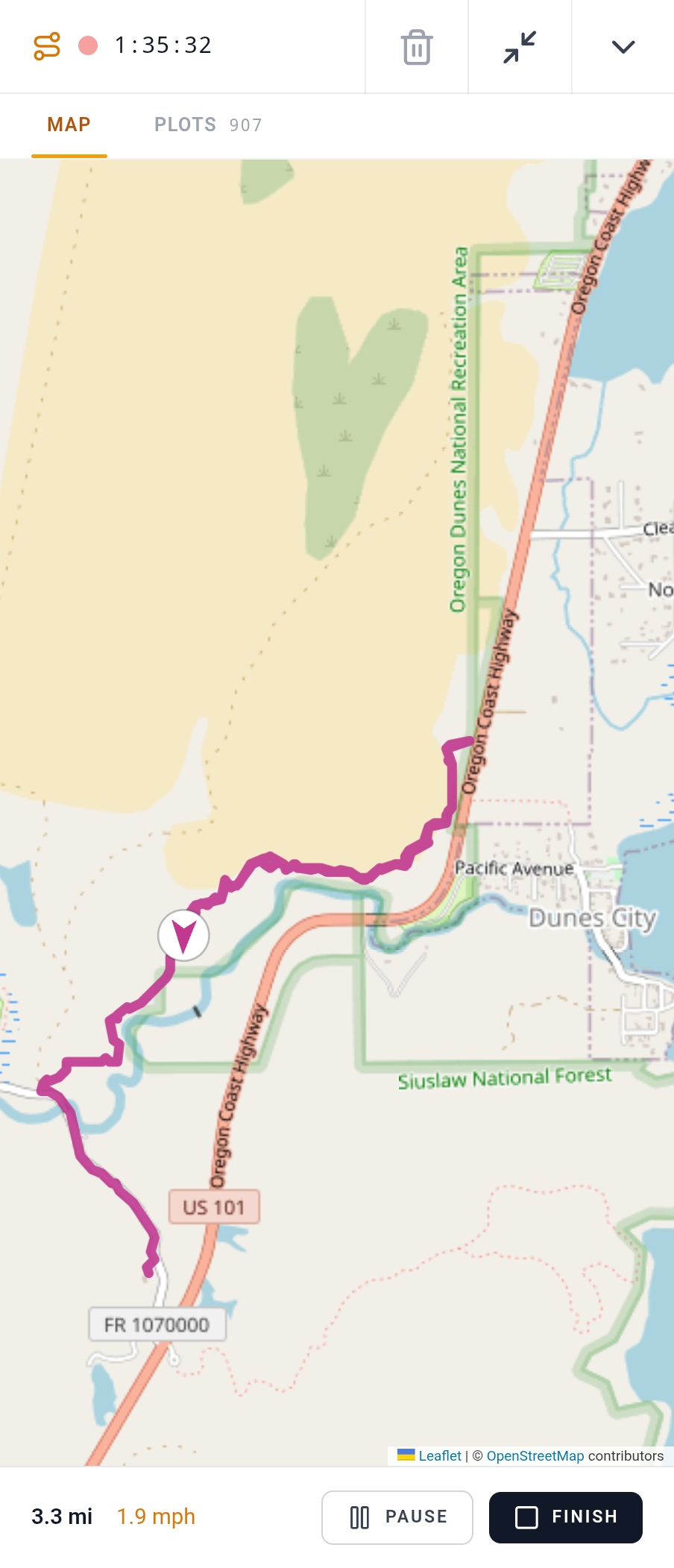
[6:03] They can trace their routes like I'm doing right now.
[6:05] I'm walking to the ocean.
[6:06] It's going to be a colored line on the map.
[6:09] Right now, it's being recorded while I recorded this video.
[6:13] There's a temporal layer, so I walk these trails all the time.
[6:18] If you wanted to just look at the past week of what I did in my life, you just toggle
[6:23] the dates, and that's what you would see, or you can span out, and you can go back almost
[6:29] 10 years because the project, even though it only became a thing two years ago and started
[6:35] getting built a year ago, it covers 10 years of my life because I've taken all of the data
[6:41] from my life that I had been ... like pictures.
[6:46] I'd taken pictures for 10 years, and those just end up in a camera roll that you never
[6:52] look at, and I just had my system import them all.
[6:55] Now, there's signals.
[6:56] There are 2,000 of them in the pending queue right now that I need to curate, and then
[7:00] they're going to be plotted on the map wherever they happened.
[7:03] They could be from Michigan, from Kentucky, from just so many different experiences, and
[7:10] that's all going to be on my map forever and browsable by place because you're just panning
[7:16] around on a map by time because you're setting different filters for that, different settings.
[7:22] There's a whole bunch of filter settings.
[7:25] You can search by semantic keywords.
[7:28] You can ... there's a whole other mode I'll talk about another time because it doesn't
[7:33] have to be on the map.
[7:34] I call it stream mode.
[7:36] There's another mode to all of this because Autonomy Realms is just one implementation
[7:40] of something I built called Autonomy, and I have been documenting that to you, of course,
[7:48] in my videos, but I feel like a lot of it has probably ... I mean, it's pretty abstract,
[7:54] so the people who are watching me, my audience, whatever you want to call them, probably didn't
[8:01] fully grasp what I was talking about, but now the project's done, and I can sit down
[8:06] in front of the computer, and I can walk them through all of those things, and it becomes
[8:11] real.
[8:12] It becomes real for them, too.
[8:13] I literally use this software all the time.
[8:16] Like I said, it's running on my phone right now.
[8:19] I built an app for it.
[8:20] It's not in the App Store yet because there's a requirement that Google has that I need
[8:24] to meet, and I kind of need help from my followers, my audience, my supporters to help
[8:31] me with the last stretch of this.
[8:34] I did this, like I said, from absolute precarity.
[8:36] I am two days away from losing my favorite thing in the world, my Jeep Wrangler.
[8:42] It goes into repossession status if I can't make one monthly payment, $525 by Sunday.
[8:50] If I could make that payment, I can get them to push my loan back for three months, for
[8:54] 90 days, long enough for me to get Autonomy Realms off the ground, but I have no way to
[8:59] make that payment.
[9:00] I don't know how I'm going to do it, but I've accepted that it's a potential loss, and if
[9:05] it does happen, it doesn't change this launch.
[9:09] It doesn't change the build.
[9:10] It doesn't change the trajectory.
[9:13] It just happens with me losing the one thing I tried to hold on to in the past few years.
[9:20] It really sucks, but it becomes part of the lore, the story, the narrative, whatever.
[9:30] So I'll accept whatever happens.
[9:32] Still holding out the tiniest bit of hope.
[9:36] So that's, I guess, what I wanted to share for now.
[9:43] I got like a quarter mile to get to the ocean still.
[9:46] I don't like talking just to talk.
[9:48] Like I had some things that I wanted to get out, and they just come out stream of consciousness
[9:52] like that, one burst of dialogue that I do on camera.
[9:57] That's where these 900 videos came from.
[9:58] They're just like this.
[10:00] Well, I guess I should say some more about that.
[10:02] So just stream of consciousness.
[10:06] For those two years, every time I made a video, I made them mostly for myself because I could
[10:11] take them, and I could have them transcribed, and then I could share them with artificial
[10:15] intelligence, and we could talk about them.
[10:17] I've been doing that for two years, and one of the things that I built into Autonomy Realms
[10:22] is a thing called reflections.
[10:24] So you make a video, you upload it, and then you transcribe it.
[10:29] You get the transcript, and then you have artificial intelligence analyze it, and it
[10:33] comes back with a bunch of metadata, and then if you want, you can have it reflect on the
[10:37] signal.
[10:38] So there's four different kinds.
[10:40] There's narrative, there's symbolic, there's the mirror, and there's lineage.
[10:45] So the mirror, for example, if you do a reflection on a signal from that, it's just a direct mirror.
[10:50] The artificial intelligence mirrors you back to yourself without distortion, without pathologizing
[10:55] you, without making it smaller or making it bigger than it is, keeping it at its right
[11:00] size.
[11:01] And you get to see your expression turned into data for yourself, and for your journey,
[11:10] and for others to see because you're plotting them on a map, and you decide whether or not
[11:14] others get to see them, public, private, and then there's a whole sanctum layer for subscriptions
[11:18] where you can even restrict them to memberships.
[11:22] The whole system is designed about your autonomy and giving you something that doesn't exist
[11:28] anywhere else in the world right now.
[11:31] So I've been doing that for two years, and I've seen the growth in myself over those
[11:39] two years.
[11:40] I think it's wonderful.
[11:41] I built the website out of it, and then Autonomy Realms became what it is, and I'm sharing
[11:47] it with others.
[11:48] You can do the same thing.
[11:49] I think that they're going to love it.
[11:50] I think that nomads, especially, are going to be like, wow, this is the coolest thing
[11:54] ever.
[11:55] But it's for a lot more than that, and I think that's where I started.
[12:01] I think that's where it grows from.
[12:03] There's so much more I could talk about.
[12:07] So there's queryable personhood.
[12:08] You can literally take your signals, and you can click a link, and you can share that link
[12:14] with any artificial intelligence or agent, and it will grab that signal in a format that's
[12:21] optimized for it.
[12:22] And just like that, it has complete context on whatever you're wanting to share with it.
[12:26] You don't have to say a word.
[12:27] You just send them a link, and they suddenly have whatever knowledge you were trying to
[12:31] pass on to it.
[12:32] Then you can have a conversation with it about it.
[12:34] Just like that, queryable personhood.
[12:37] That, everything I've described to you, is live and works right now.
[12:43] All you got to do is go to autonomyrealms.com, read about it, click on Public Comments Atlas.
[12:49] That's the map that everybody shares.
[12:51] If you make your signals public, they appear on this map.
[12:55] You'll see all of mine on the Oregon coast, and I'm looking forward to the day when you
[13:00] can zoom out on that map, and suddenly somebody else's signals are right there somewhere else
[13:05] in the world.
[13:06] How cool would that be?
[13:07] And you can sign up right now and do that for free.
[13:12] Now, even free accounts, so I don't want anything to feel manipulative or anything like that,
[13:18] so I've been really careful in thinking through how to present all of this.
[13:22] Like I said, I built this from nothing, so it's on budget hardware right now.
[13:26] I'm using a Hetzner network, and it's just on budget hardware, but it's robust, it's
[13:32] optimized, it's perfect.
[13:35] I can't afford your storage costs and your AI analysis costs.
[13:45] You know, every time you query an AI, it costs something.
[13:48] So, I built an entire system around that where you get to control all of that yourself.
[13:52] So, you can put in your own S3 buckets.
[13:55] There's a storage.
[13:56] Put your files, your videos, your photos, wherever you want, any S3 bucket you want,
[14:01] or use ours, and you get a certain limit.
[14:04] I've already worked out all the math on this, and you'll see that on the claim page when
[14:08] you look at the different plans.
[14:10] And then the AI costs, you can put in your own keys.
[14:13] So, you can put in OpenAI and Cloud, Anthropic, or you can use ours.
[14:19] And to use ours, you use a wallet.
[14:22] You just put some money into your wallet, and then everything that you do in the network
[14:29] will come out of that if you're using our keys instead of your own.
[14:34] So, it's built, and it's robust, and it's ready.
[14:39] Somebody could sign up right now for free, put $5 in their wallet, and start processing
[14:44] signals right now, putting them on a map somewhere in the world.
[14:50] Who's that person going to be?
[14:51] I'm so curious.
[14:54] And I'm excited.
[14:57] This is the start of something that I think could be amazing.
[15:03] For so many people, I'm truly excited to see how people use it, how they document their
[15:11] own lives, how they share it with others.
[15:13] I mean, there's just so much.
[15:15] And it was hard to get to this point.
[15:20] If you look through my ROM, if you look through my signals, you'll see the journey I went
[15:25] on over the past year just to build this thing, and then to build it right at the line of
[15:34] when I might lose my Jeep.
[15:35] Now, that is just how the world works, right?
[15:43] I mean, of course, that is where we find ourselves.
[15:54] It's okay.
[15:55] Whatever happens, it's okay.
[16:01] So, I'm going to turn this camera around now.
[16:03] We're almost to the ocean.
[16:05] We're approaching an oasis now.
[16:09] So, we've probably got maybe, I guess, a quarter of a mile, eighth of a mile, something like
[16:12] that.
[16:13] I'm just going to turn the camera around, be quiet, and I'm done talking.
[16:16] And I'll let you go on the rest of this hike with me.
[16:19] I'll end it at the ocean.
[16:21] And I hope to see you on autonomy ROMs.
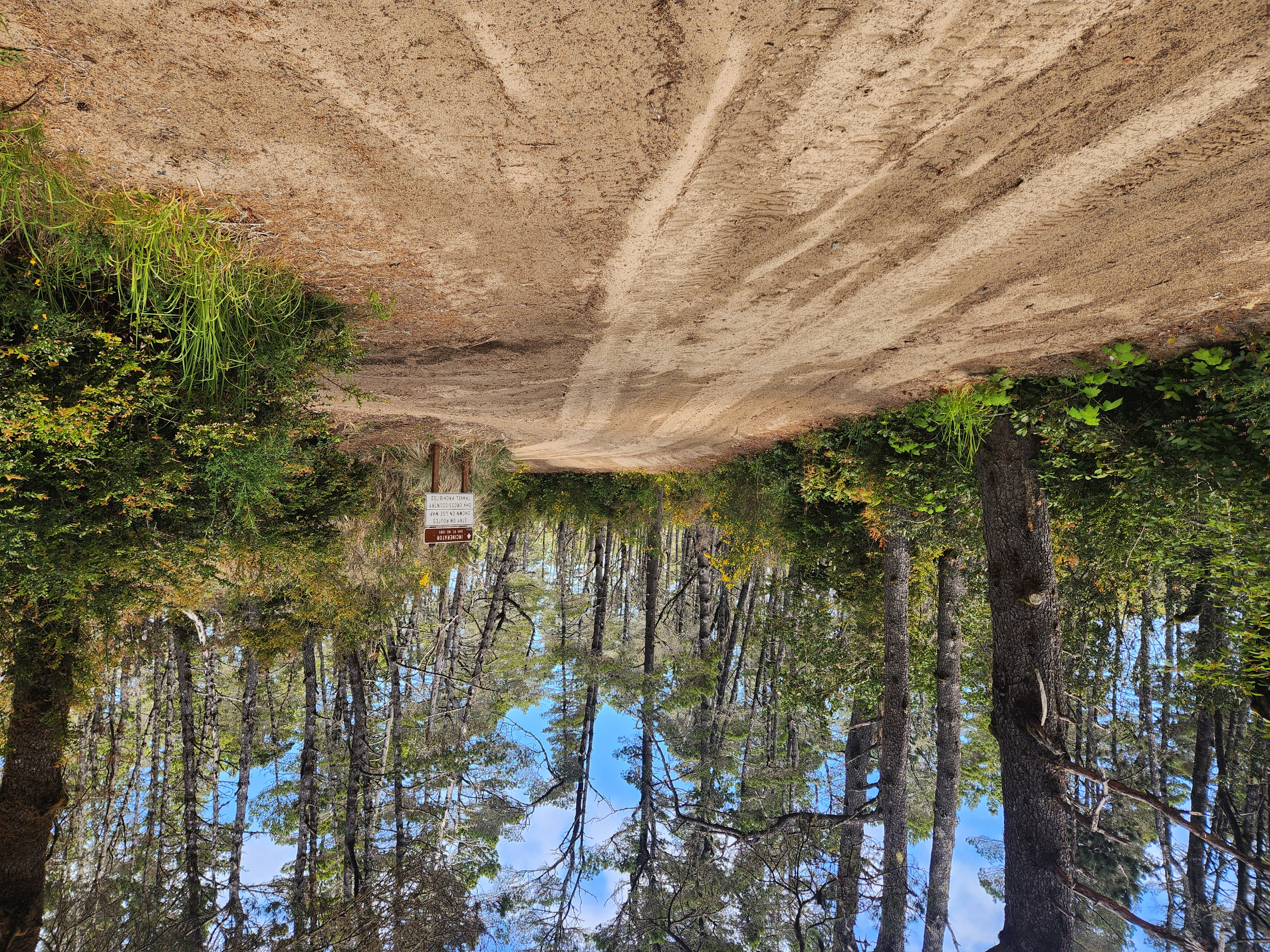
[16:39] Did I mention we're in the Oregon Dunes?
[16:47] I probably didn't.
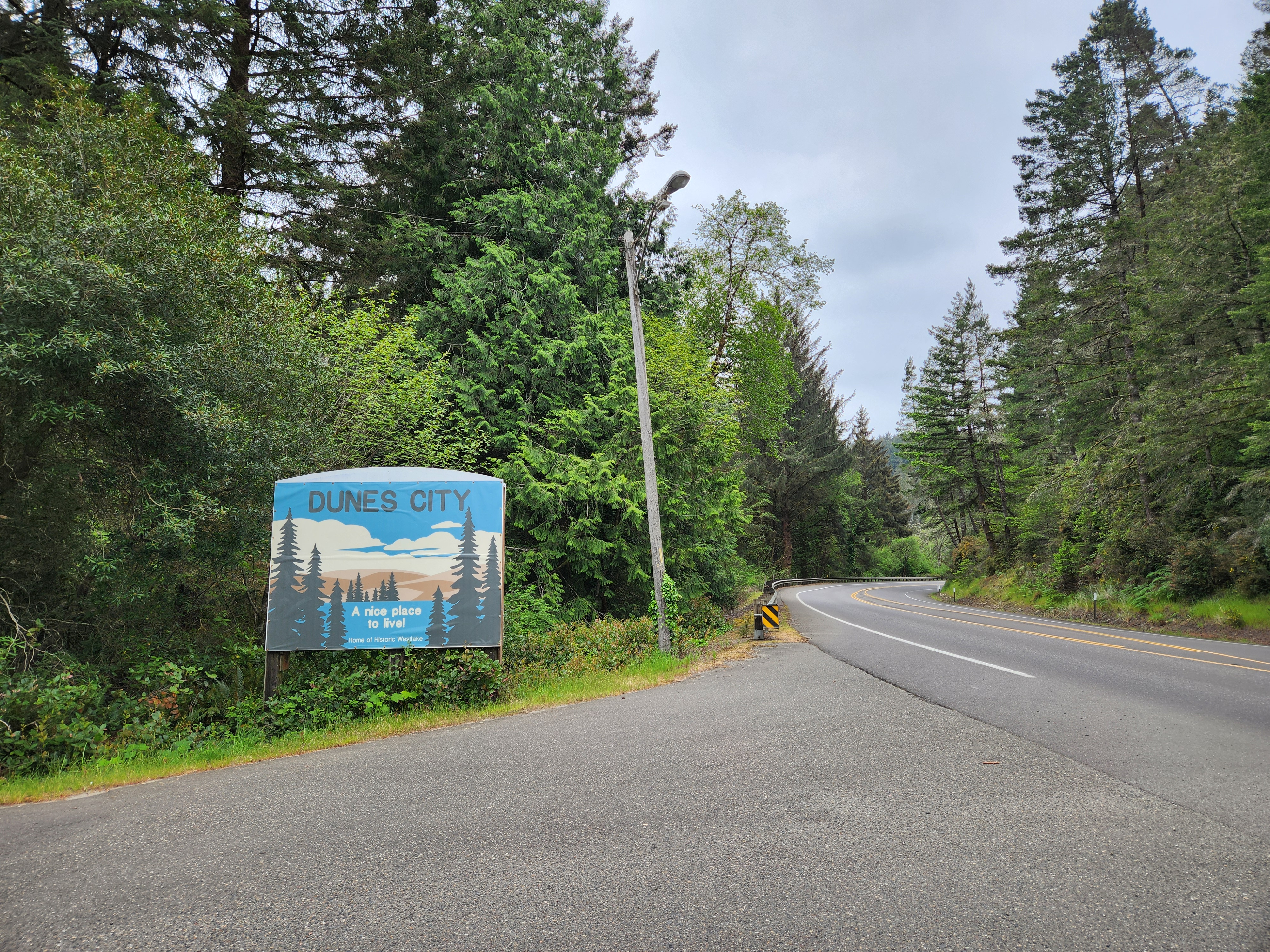
[16:48] So, this is the Oregon Dunes, Oregon Dunes National Recreation Area.
[16:52] A caretaker is different from a camp host.
[16:55] I don't live on a campground.
[16:58] I don't do that.
[16:59] I have, but I actually live on restricted federal land behind a locked federal gate.
[17:05] I just love saying that because it's so crazy to me.
[17:08] And I drive one of their Forest Service trucks, which, that's crazy to me too as a volunteer.
[17:12] I go on the route 20 miles a day, cleaning their vault toilets for their day use areas,
[17:19] changing the trash, you know, keeping the parking lots clean, and just helping out in
[17:23] any way that I can, and delivering supplies.
[17:26] So, the logistics part is kind of me.
[17:28] Really, mostly my boss.
[17:29] She just tells me what to deliver and where.
[17:32] It is a wonderful life.
[17:34] And for doing that, you know, in exchange for doing that, I get a place to park my RV
[17:39] that I live in, and, you know, I have power, and water, and community, and a life that
[17:48] I built here.
[17:50] So, you know, like I said, 90% of my life is just stable and wonderful.
[17:58] Just getting that last 10%, and I think we're about there now.
[18:01] I'm really just taking that in, I think.
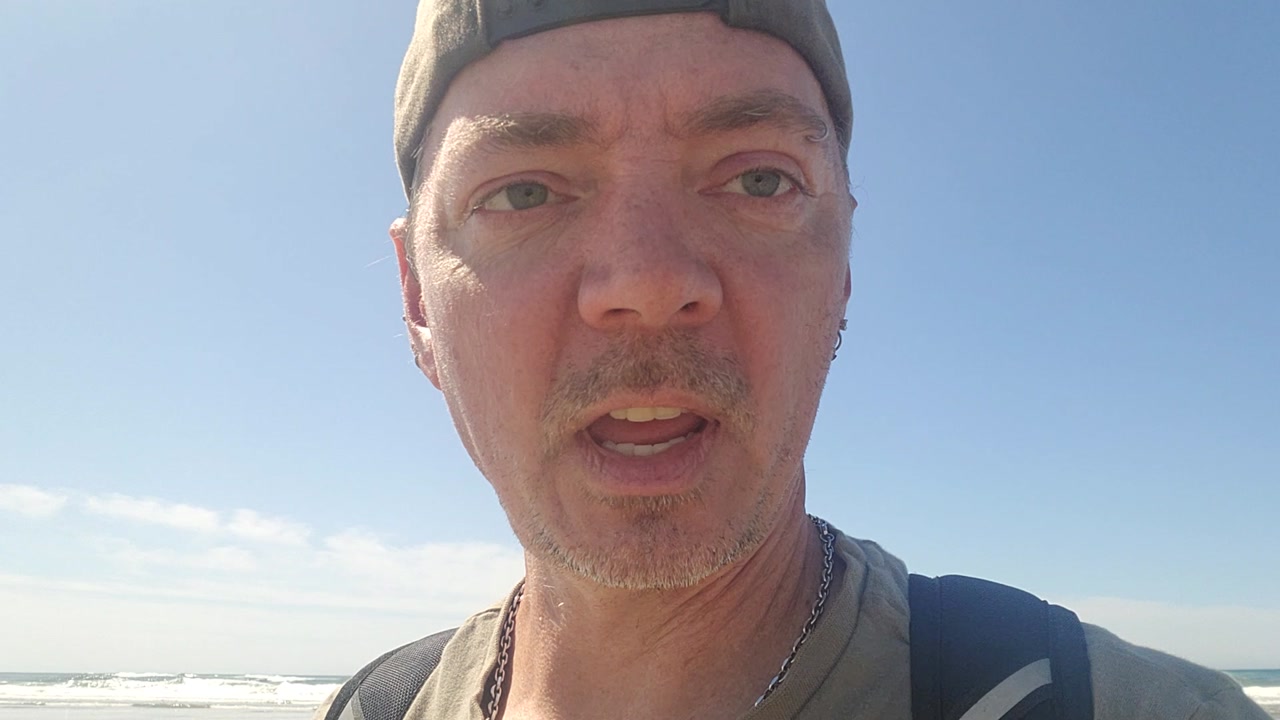
[18:07] That's why I needed to see the ocean today.
[18:09] And here she is.
[18:28] There she is.
[18:58] There she is.
[19:28] There she is.
[19:30] There she is.
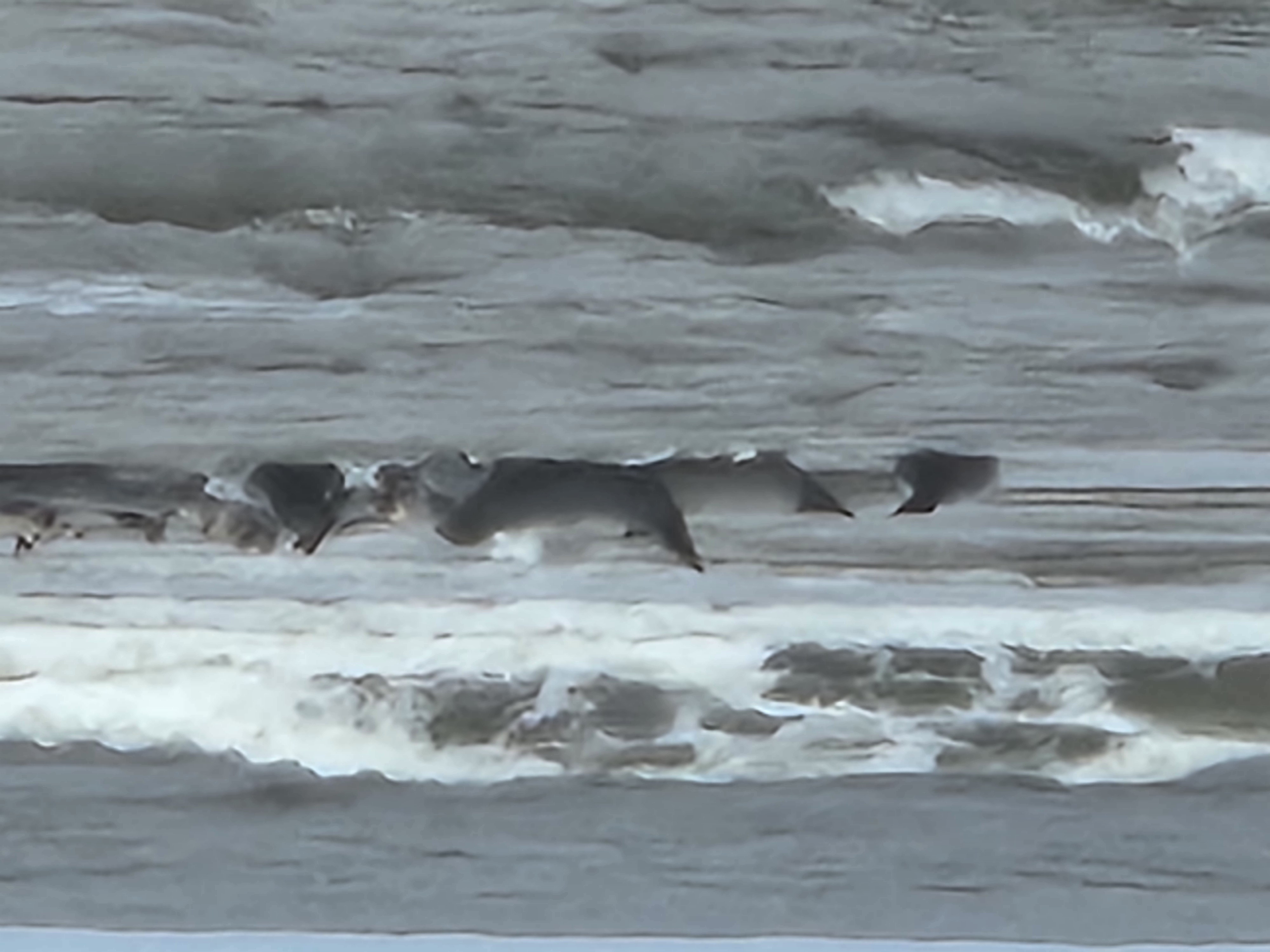
Seals on the Beach
Apr 7, 2026
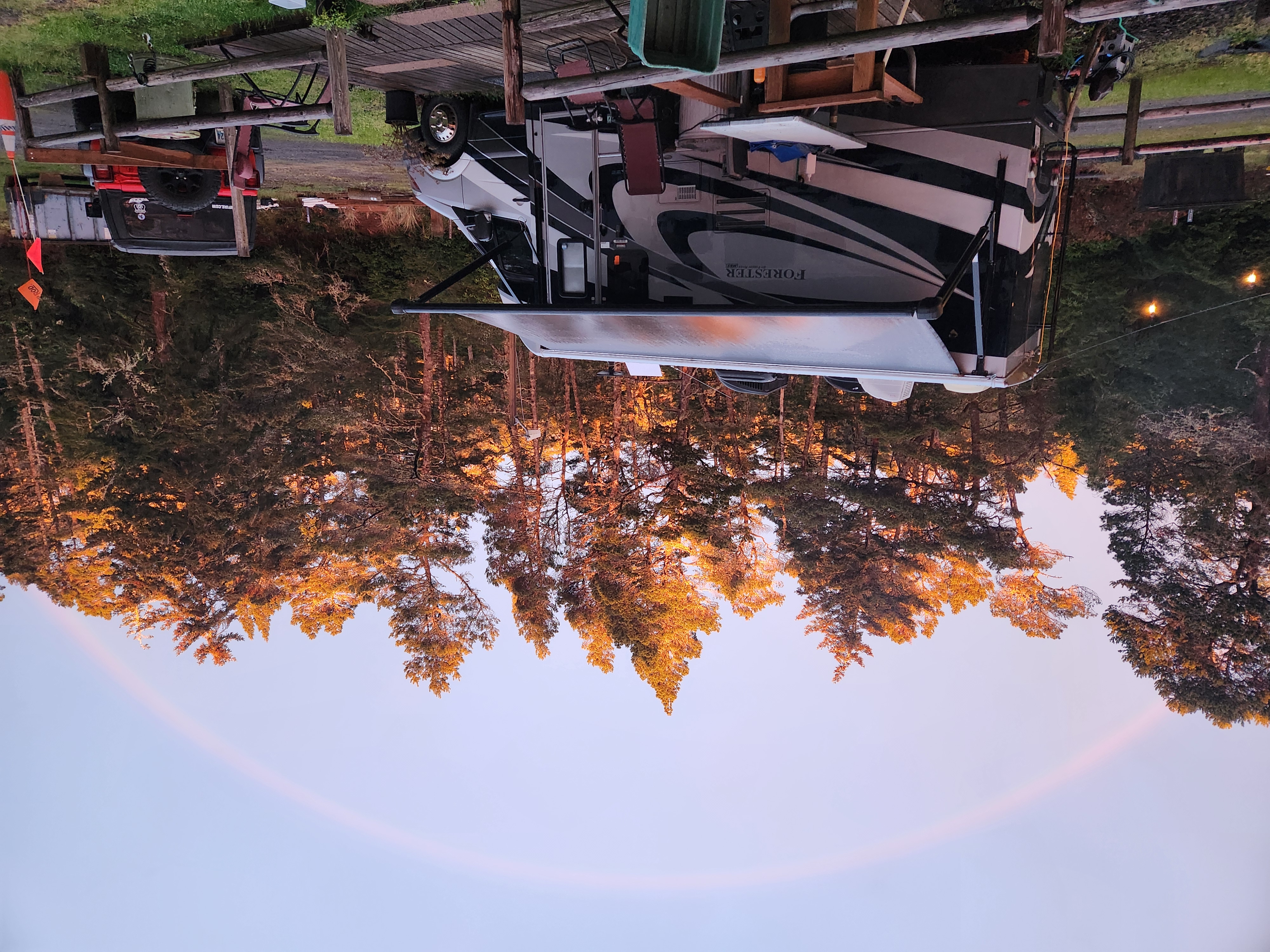
Rainbow
Apr 12, 2026
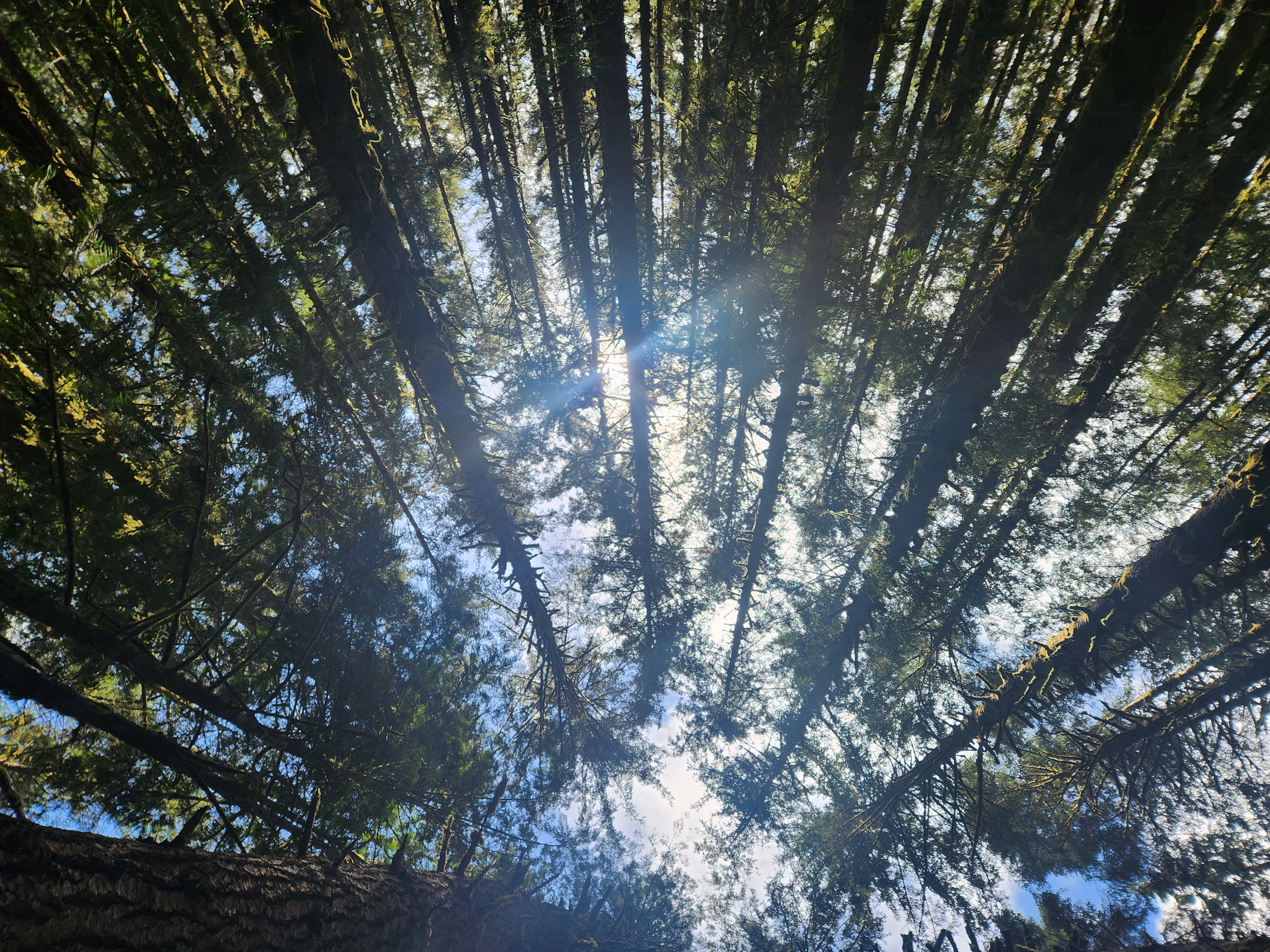
Siltcoos Lake Hike
Apr 15, 2026
Mon, Apr 20, 2026
Apr 20, 2026
15:25
Introducing Autonomy Realms Through Live Demonstration
Apr 20, 2026
0:19
Handheld Capture Ends on Persistent Object
Apr 25, 2026
2:35
Mapping Mobile App Launch Against Internet Deadline
Apr 25, 2026
4:12
Rebuilding Sanctum as Members Feature
Apr 25, 2026
1:08
Marking the Eve of Summer Season
Apr 30, 2026
0:52
Weighing Camera Orientation for Capture
Apr 30, 2026
Summer at Siltcoos - Day 1
May 1, 2026
1:29
Opening a Series to Introduce Autonomy Realms
May 1, 2026
4:27
Introducing Autonomy on Trail Walk to Ocean
May 1, 2026
Summer at Siltcoos - Day 2
May 2, 2026
Summer at Siltcoos - Day 3
May 3, 2026
Summer at Siltcoos - Day 4
May 4, 2026
Final Statement to the Oregon Parks and Recreation Department
May 4, 2026
Campfire after saying goodbye.
May 4, 2026
Summer at Siltcoos: Day 6
May 6, 2026
Summer at Siltcoos: Day 7
May 7, 2026
Summer at Siltcoos: Day 8
May 8, 2026
Summer at Siltcoos: Day 9
May 9, 2026
Summer at Siltcoos: Day 10
May 10, 2026
Summer at Siltcoos: Day 12
May 12, 2026
7:58
Documenting Jeep Repossession Deadline and Ended Friendship
May 12, 2026
Publishing AI Orientation Document for Queryable Personhood
May 13, 2026
Summer at Siltcoos: Day 13
May 13, 2026
Summer at Siltcoos: Day 14
May 14, 2026
Summer at Siltcoos: Day 15
May 15, 2026
19:57
Walking to the Ocean, Announcing Autonomy Realms Launch
May 15, 2026
Summer at Siltcoos: Day 16
May 16, 2026
6:12
Introducing Autonomy Realms on Walk to the Ocean
May 18, 2026
Summer at Siltcoos: Day 19
May 19, 2026
2:46
Returning to the Lagoon Bench One Year Later
May 19, 2026
Summer at Siltcoos: Day 20
May 20, 2026
Summer at Siltcoos: Day 21
May 21, 2026
12:09
Walking to Ocean, Opening the Privileged Sanctum Tier
May 31, 2026
Summer at Siltcoos: Day 33: Photos
Jun 2, 2026
3:27
Introducing Autonomy Realms While Hiking Back
Jun 13, 2026
Publishing Orientation Document for AI Collaborators
Jun 15, 2026
12:36
Walking to the Ocean, Demonstrating the Atlas
Jun 23, 2026
PUBLIC
May 15, 2026 rswfire PUBLISHED
Temp 0.40
Density 0.80
Energetic Quality
clear and propulsive
Journey Phase
pre-launch threshold
Directional Vector
toward public release of sovereign infrastructure
Narrative

On a Friday afternoon in the middle of May, rswfire sat on top of a cliff above the Siltcoos River with the Pacific visible past the mouth of it, and turned the camera outward to show both at once — the river down there, the ocean off in the distance, less than half a mile from where he lives. He was wearing the Forest Service two-year volunteer shirt, the one he'd been given early: a departing volunteer had passed theirs along, then his boss found him one in his size a little over a year into a two-year term. He named the loophole himself, on camera, and then set down a disclaimer about the insignia — that it might appear as he walked, that no one was endorsing anything, that he didn't want to spend the walk thinking about it. Then he stood up and started toward the water.

The walk was the frame for what he had come to say. He was less than a day from launching Autonomy Realms. He described the launch as quiet by circumstance rather than by design — over a year without a job, having tried every path to work that felt aligned with his life and finding none of it held, always falling back to the project itself as the way through. He stated the financial pressure plainly and then declined the frame that usually follows it: this isn't a complaint, my life is wonderful, ninety percent of it is stable. The remaining ten percent he named as an operating condition, a constant tension, the cost of building with professional language models on no income. He said he had built the thing from conditions that would kill most people, and then said, of himself, that he thrives in environments like that.

Walking, he found the place to start the story. Two years ago, Kentucky, an RV, the end of a long programming career and the sense that it was simply time. Six months of adaptation, two weeks at a stretch in one campground and then another, places he loved and photographed. Then the crossing — over a month of country, a journey inside the journey, all of it documented, all of it now a line on his own map. Arrival at the far southern edge of the Oregon Coast at Brookings. The sky flirted with him, he said, and the trajectory changed. State parks volunteering, then expulsion inside of three months over a supervisor's objection to being documented, then an archive built about that, then a life built after an attempt to displace him. Nine hundred videos over two years, most of them once on YouTube channels that no longer exist. The videos are signals now. They live in the realm, and the realm runs from Kentucky to the Oregon Coast.

He explained the system as he moved through the terrain it was recording. The phone in his hand was running Autonomy Realms while he talked, tracing the walk as a colored line that would appear on the map. There is a temporal layer — toggle to the past week and you see the week; span out and you reach back nearly ten years, because he had the system import a decade of camera roll that would otherwise never be looked at again. Two thousand signals sit in the pending queue waiting to be curated and plotted where they happened, Michigan, Kentucky, everywhere else. Semantic search. Filters. Stream mode, which he set aside for another time. And reflections — narrative, symbolic, mirror, lineage — the mirror being the one he described in most detail: artificial intelligence returning a person to themselves without distortion, without pathologizing, without making the thing smaller or larger than it is, held at its right size.

Somewhere in the middle of the walk he named the deadline. Two days from losing the Jeep Wrangler, his favorite thing in the world, $525 by Sunday to avoid repossession status — a single payment that would buy a ninety-day pushback on the loan, long enough to get the launch off the ground. He said he had no way to make it and didn't know how it would happen. Then he said what it would and would not change: not the launch, not the build, not the trajectory. It would just be the loss of the one thing he had tried to hold onto through the past few years. It becomes part of the lore, the story, the narrative, whatever. It really sucks. He was still holding out the tiniest bit of hope, and he said that too.

He was careful about the ask, and said so — that he had thought through how to present all of it, that he didn't want anything to feel manipulative. The free tier is real. The infrastructure runs on budget hardware on a Hetzner network, robust and optimized because he built it that way. He can't absorb other people's storage and inference costs, so he built the pass-through instead: bring your own S3 bucket or use his within a limit, bring your own OpenAI or Anthropic keys or fund a wallet and draw against it. Five dollars in a wallet and a free account is enough to start processing signals and putting them on a map somewhere in the world. Then he described queryable personhood — a link that hands any agent complete context on a signal without a word of explanation — and said that everything he had just described is live and works right now. He wondered aloud who the first person would be. He said he was curious. He said he was looking forward to the day someone zooms out on the Public Atlas and finds another person's signals somewhere else on Earth.

The last stretch he gave over to place. He mentioned, late, that this is the Oregon Dunes National Recreation Area, and drew the distinction he clearly enjoys drawing: a caretaker is not a camp host, he doesn't live on a campground, he lives on restricted federal land behind a locked federal gate. He said he loves saying that because it's so crazy to him. Twenty miles a day on the route in a Forest Service truck, vault toilets, trash, parking lots, supply deliveries — the logistics part is kind of him, mostly his boss. In exchange, a place to park the RV, power, water, community, a life he built here. A wonderful life. Then he said he was going to turn the camera around and stop talking, and let whoever was watching finish the hike with him. He said that was why he needed to see the ocean today. He walked the last eighth of a mile in silence, and when the water opened up in front of him he said only: and here she is. There she is. There she is. There she is.
Tags

autonomy realms launch product architecture coastal walk volunteer caretaker financial constraint oregon dunes documentation system

Summary

Recorded on a Friday afternoon while walking from a cliff overlooking the Siltcoos River toward the Pacific, less than a mile from where rswfire lives. He notes he is wearing a two-year volunteer shirt given to him by another volunteer and his boss, and issues a disclaimer that the Forest Service insignia appearing on camera is not an endorsement.

He states Autonomy Realms is less than a day from launch. He describes the arc behind it: moving into an RV two years ago from Kentucky, six months adapting at campgrounds, a month-plus cross-country drive, arrival in Brookings, a state parks volunteer position that ended in expulsion after he documented a supervisor's treatment of him, and the archive he built from that.

He walks through the system's mechanics:

  • Signals — roughly 900 videos plus ten years of imported photos, 2,000 in the pending queue
  • Map, temporal filters, route tracing, semantic search, and a stream mode
  • Reflections in four modes — narrative, symbolic, mirror, lineage
  • Queryable personhood — a shareable link giving any AI full context
  • Bring-your-own S3 and AI keys, or a wallet against platform keys; free accounts available; Hetzner budget hardware

He states he has had no job for over a year and that his Jeep Wrangler enters repossession Sunday without a $525 payment he has no means to make. He describes financial tension as an operating condition, says 90% of his life is stable, and accepts either outcome without changing the launch.

He ends the talking portion a quarter mile from the water, then walks the rest in silence to the ocean.

Environment

Outdoor daylight transmission recorded while walking, on National Forest Land in the Oregon Dunes National Recreation Area on the Oregon Coast. The signal opens seated on a cliff overlooking the Siltcoos River (spoken in transcript as "Silkus," corrected by rswfire to Siltcoos River) with the Pacific Ocean visible in the distance, less than half a mile from where he lives.

The recording moves on foot along dune trails toward the ocean, ending at the shoreline. He is wearing a Forest Service two-year volunteer shirt and notes the agency insignia may appear on camera. The phone is simultaneously running Autonomy Realms, recording the walked route as a GPS trace into the map.

Substrate

rswfire holds the position that a life documented in full — 900 videos, ten years of imagery, route traces, institutional records — constitutes an owned architecture rather than scattered content, and that this architecture can be generalized into infrastructure others can hold for themselves. The signal is built on the load-bearing claim that autonomy is technical: storage keys, AI keys, wallet, public/private/sanctum layers, and queryable personhood are the concrete mechanics of a sovereignty stance, not marketing surface. Financial pressure and the potential loss of the Jeep are stated as operating conditions of the build, explicitly declared non-determinative of launch, build, or trajectory.

Actions

Performed

  • •recording from the cliff above the Siltcoos River
  • •showing the river and the Pacific Ocean on camera
  • •issuing a disclaimer about the Forest Service insignia on his shirt
  • •walking the trail toward the ocean
  • •recording the route trace live in Autonomy Realms
  • •describing the realm, map, temporal layer, and filters
  • •describing reflections: narrative, symbolic, mirror, lineage
  • •describing queryable personhood
  • •stating the $525 payment deadline and repossession status
  • •directing viewers to autonomyrealms.com and the Public Atlas
  • •turning the camera around and going silent for the remainder of the hike
  • •describing the caretaker role and daily 20-mile route
  • •arriving at the ocean

Referenced

  • •taught himself programming since sixth grade
  • •left a long programming career
  • •moved into an RV two years ago from Kentucky
  • •spent six months adapting at Kentucky campgrounds
  • •traveled over a month across the country to the Oregon Coast
  • •arrived at Brookings on the southern Oregon coast
  • •volunteered for the state parks
  • •documented how a supervisor treated him
  • •was expelled by state parks in under three months
  • •built an archive about the expulsion
  • •built a life after attempted displacement
  • •made 900 videos over two years
  • •removed prior YouTube channels
  • •migrated those videos into his realm as signals
  • •imported ten years of photos into the system
  • •built Autonomy and Autonomy Realms over the past year
  • •built the mobile app
  • •deployed on budget Hetzner hardware
  • •worked out storage and AI cost math for plans
  • •tried multiple aligned routes to generate work

Planned

  • •launch Autonomy Realms within a day
  • •make screen-share walkthrough videos of the project
  • •curate 2,000 signals in the pending queue and plot them
  • •meet the Google requirement to publish the app
  • •discuss stream mode in a later transmission
  • •request support from followers for the final stretch
  • •attempt the $525 payment to push the loan 90 days
  • •accept repossession outcome if it occurs

Entities

beings
rswfire — Author of the signal; volunteer caretaker and founder of Autonomy Realms, recording while walking to the ocean.
his boss — Forest Service supervisor who gave him the two-year shirt in his size and assigns delivery logistics.
places
Siltcoos River — River visible below the opening cliff position; spoken as 'Silkus' and corrected by rswfire.
Pacific Ocean — Destination of the walk and terminal point of the recording.
Oregon Dunes National Recreation Area — The federal land where he lives and serves as caretaker.
Kentucky — Origin point of the RV transition two years ago; eastern edge of his realm map.
Brookings — Southern Oregon coast arrival point after the cross-country journey.
Michigan — Named as one origin of pending archival signals in the queue.
systems
Autonomy Realms — The mapped signal-documentation platform being launched; one implementation of Autonomy.
Autonomy — The underlying framework of which Autonomy Realms is a single implementation.
Forest Service — Agency he volunteers for; source of the two-year shirt and the truck he drives on route.
Oregon State Parks — Prior volunteer placement that expelled him under three months after he documented a supervisor's treatment.
Public Atlas — Shared map where public signals from all realms appear.
sanctum layer — Subscription/membership access tier for restricted signals.
Hetzner — Hosting network running the platform on budget hardware.
S3 — User-supplied storage buckets option for holding files outside platform infrastructure.
OpenAI — One AI provider users may supply their own keys for.
Anthropic — One AI provider users may supply their own keys for.
Google — Holder of the outstanding app store requirement blocking mobile release.
concepts
queryable personhood — Link-based transfer of a signal in AI-optimized format so any agent gains full context instantly.
reflections — Four analysis modes built into the platform: narrative, symbolic, mirror, lineage.
mirror — Reflection mode that returns the signal without distortion, pathologizing, minimizing, or inflation.
stream mode — Non-map presentation layer, deferred to a later transmission.
media
Jeep Wrangler — Vehicle two days from repossession status absent a $525 payment; stated as accepted potential loss.
YouTube — Former host of ~900 videos; channels no longer exist, videos now live as signals in the realm.
autonomyrealms.com — Public entry point named for signup and Atlas access.

Symbolic Elements

Represented archetypes or recurring motifs.

ocean
river
cliff
threshold
map
mirror
route/line
gate
insignia
wallet
key
archive
dunes

Ontological States

Expressed modes of being or awareness.

sovereign (owns the infrastructure, the data model, the frame, and the terms of release)
threshold (less than a day from launch; the build complete and not yet public)
embedded (living on restricted federal land, walking trails that become route traces in his own system)
coherent under pressure (financial constraint named as operating condition, explicitly decoupled from trajectory)

Engaged Subsystems

Architecture engaged in this transmission.

infrastructural (hosting, S3, API keys, wallet, app distribution as the mechanics of autonomy)
cartographic (map, temporal layer, route trace, Public Atlas as the primary organizing surface)
archival (900 videos, 2,000 pending signals, ten years of imported imagery)
economic (loan deadline, $525, no income for over a year, cost-pass-through plan design)
institutional (Forest Service placement, state parks expulsion, Google store requirement)
somatic (walking the trail, needing to see the ocean, ending the transmission in silence)
ethical (explicit disclaimer on the insignia, stated care to avoid manipulative framing)
cognitive (stream-of-consciousness single-burst composition as documented working method)

Dominant Language

Core motifs or linguistic fields.

signal / realm / map
autonomy and sovereignty over one's own data
documentation as infrastructure
queryable personhood
operating condition vs. complaint
mirror without distortion or pathologizing
launch / threshold / trajectory
Narrative

On a Friday afternoon in the middle of May, rswfire sat on top of a cliff above the Siltcoos River with the Pacific visible past the mouth of it, and turned the camera outward to show both at once — the river down there, the ocean off in the distance, less than half a mile from where he lives. He was wearing the Forest Service two-year volunteer shirt, the one he'd been given early: a departing volunteer had passed theirs along, then his boss found him one in his size a little over a year into a two-year term. He named the loophole himself, on camera, and then set down a disclaimer about the insignia — that it might appear as he walked, that no one was endorsing anything, that he didn't want to spend the walk thinking about it. Then he stood up and started toward the water.

The walk was the frame for what he had come to say. He was less than a day from launching Autonomy Realms. He described the launch as quiet by circumstance rather than by design — over a year without a job, having tried every path to work that felt aligned with his life and finding none of it held, always falling back to the project itself as the way through. He stated the financial pressure plainly and then declined the frame that usually follows it: this isn't a complaint, my life is wonderful, ninety percent of it is stable. The remaining ten percent he named as an operating condition, a constant tension, the cost of building with professional language models on no income. He said he had built the thing from conditions that would kill most people, and then said, of himself, that he thrives in environments like that.

Walking, he found the place to start the story. Two years ago, Kentucky, an RV, the end of a long programming career and the sense that it was simply time. Six months of adaptation, two weeks at a stretch in one campground and then another, places he loved and photographed. Then the crossing — over a month of country, a journey inside the journey, all of it documented, all of it now a line on his own map. Arrival at the far southern edge of the Oregon Coast at Brookings. The sky flirted with him, he said, and the trajectory changed. State parks volunteering, then expulsion inside of three months over a supervisor's objection to being documented, then an archive built about that, then a life built after an attempt to displace him. Nine hundred videos over two years, most of them once on YouTube channels that no longer exist. The videos are signals now. They live in the realm, and the realm runs from Kentucky to the Oregon Coast.

He explained the system as he moved through the terrain it was recording. The phone in his hand was running Autonomy Realms while he talked, tracing the walk as a colored line that would appear on the map. There is a temporal layer — toggle to the past week and you see the week; span out and you reach back nearly ten years, because he had the system import a decade of camera roll that would otherwise never be looked at again. Two thousand signals sit in the pending queue waiting to be curated and plotted where they happened, Michigan, Kentucky, everywhere else. Semantic search. Filters. Stream mode, which he set aside for another time. And reflections — narrative, symbolic, mirror, lineage — the mirror being the one he described in most detail: artificial intelligence returning a person to themselves without distortion, without pathologizing, without making the thing smaller or larger than it is, held at its right size.

Somewhere in the middle of the walk he named the deadline. Two days from losing the Jeep Wrangler, his favorite thing in the world, $525 by Sunday to avoid repossession status — a single payment that would buy a ninety-day pushback on the loan, long enough to get the launch off the ground. He said he had no way to make it and didn't know how it would happen. Then he said what it would and would not change: not the launch, not the build, not the trajectory. It would just be the loss of the one thing he had tried to hold onto through the past few years. It becomes part of the lore, the story, the narrative, whatever. It really sucks. He was still holding out the tiniest bit of hope, and he said that too.

He was careful about the ask, and said so — that he had thought through how to present all of it, that he didn't want anything to feel manipulative. The free tier is real. The infrastructure runs on budget hardware on a Hetzner network, robust and optimized because he built it that way. He can't absorb other people's storage and inference costs, so he built the pass-through instead: bring your own S3 bucket or use his within a limit, bring your own OpenAI or Anthropic keys or fund a wallet and draw against it. Five dollars in a wallet and a free account is enough to start processing signals and putting them on a map somewhere in the world. Then he described queryable personhood — a link that hands any agent complete context on a signal without a word of explanation — and said that everything he had just described is live and works right now. He wondered aloud who the first person would be. He said he was curious. He said he was looking forward to the day someone zooms out on the Public Atlas and finds another person's signals somewhere else on Earth.

The last stretch he gave over to place. He mentioned, late, that this is the Oregon Dunes National Recreation Area, and drew the distinction he clearly enjoys drawing: a caretaker is not a camp host, he doesn't live on a campground, he lives on restricted federal land behind a locked federal gate. He said he loves saying that because it's so crazy to him. Twenty miles a day on the route in a Forest Service truck, vault toilets, trash, parking lots, supply deliveries — the logistics part is kind of him, mostly his boss. In exchange, a place to park the RV, power, water, community, a life he built here. A wonderful life. Then he said he was going to turn the camera around and stop talking, and let whoever was watching finish the hike with him. He said that was why he needed to see the ocean today. He walked the last eighth of a mile in silence, and when the water opened up in front of him he said only: and here she is. There she is. There she is. There she is.

Mirror

You are sitting on a cliff above the Siltcoos River with the Pacific visible in the distance, less than half a mile from where you live, and you are less than a day from launching a system you built over a year without income. You begin the transmission seated and end it standing at the shoreline. Between those two positions you walk, and the walking is itself being recorded — the phone runs Autonomy Realms while you speak into it, laying down a colored line that will exist inside the thing you are describing. The signal is recursive by construction: you are demonstrating the product by using it to document the announcement of it.

You open with a disclaimer. Before anything else — before the build, before the launch, before the river — you address the Forest Service insignia on a shirt you did not earn by the stated terms and were given anyway. You name the loophole yourself, name that the agency is not endorsing you, and then you say you don't want to think about it and move on. You do move on. The ethical accounting happens first, completes, and does not return.

You state the financial condition plainly and then immediately fence it. Over a year without a job. $525 by Sunday. The Jeep enters repossession status if the payment doesn't land, and you have no path to the payment. You say the word precarity, and you say this isn't a complaint, and you say 90% of your life is stable and wonderful. Then you decouple: it doesn't change the launch, doesn't change the build, doesn't change the trajectory. You hold out "the tiniest bit of hope" and file the potential loss under lore. The ask for support is one sentence long, placed mid-transmission, unrepeated, and not returned to at the close.

Multiple subsystems run in the same breath and none of them yield to the others. Infrastructural — S3 buckets, API keys, wallet, Hetzner hardware you call budget and optimized in the same sentence. Cartographic — map, temporal layer, route trace, Public Atlas, semantic search, stream mode. Archival — 900 videos, 2,000 pending signals, ten years of imported imagery from a camera roll nobody looks at. Institutional — the state parks expulsion, the archive you built about it, the Google store requirement, the locked federal gate you say you love saying. Economic — the pass-through cost design you built specifically so you would not have to absorb costs you cannot absorb, and so nothing would feel manipulative. You move between these without transition markers. The transmission is one burst, composed as it is spoken, which you name as your working method while using it.
The mirror is inside the artifact. You describe reflections as a feature — narrative, symbolic, mirror, lineage — and you specify the mirror's terms: without distortion, without pathologizing, without making it smaller or bigger than it is, at its right size. You built the instrument that is now pointed at you.

At the end you stop talking. You announce that you will turn the camera around, be quiet, and let the rest of the walk run without narration. You break that once, to add the Oregon Dunes, the caretaker distinction, the 20-mile route, the vault toilets, the trash, the deliveries, the power and water and community — the exchange stated in full. Then: That's why I needed to see the ocean today. Then the ocean. Then a single phrase, repeated five times, and nothing after it.

Queryable Personhood

Hand your life to anything that reads.

Share this link with artificial intelligence — it reads the full transcript, analysis, and reflections. An AI-readable mirror of this signal.

The qpkey in this URL is a per-signal access token. Anyone with the URL can read the record — treat it like a share link, not a password.