
Walking to the Ocean, Demonstrating the Atlas

Failed to load video
Chapters
15:25
Introducing Autonomy Realms Through Live Demonstration
Apr 20, 2026
0:19
Handheld Capture Ends on Persistent Object
Apr 25, 2026
2:35
Mapping Mobile App Launch Against Internet Deadline
Apr 25, 2026
4:12
Rebuilding Sanctum as Members Feature
Apr 25, 2026
1:08
Marking the Eve of Summer Season
Apr 30, 2026
0:52
Weighing Camera Orientation for Capture
Apr 30, 2026
Summer at Siltcoos - Day 1
May 1, 2026
1:29
Opening a Series to Introduce Autonomy Realms
May 1, 2026
4:27
Introducing Autonomy on Trail Walk to Ocean
May 1, 2026
Summer at Siltcoos - Day 2
May 2, 2026
Summer at Siltcoos - Day 3
May 3, 2026
Summer at Siltcoos - Day 4
May 4, 2026
Final Statement to the Oregon Parks and Recreation Department
May 4, 2026
Campfire after saying goodbye.
May 4, 2026
Summer at Siltcoos: Day 6
May 6, 2026
Summer at Siltcoos: Day 7
May 7, 2026
Summer at Siltcoos: Day 8
May 8, 2026
Summer at Siltcoos: Day 9
May 9, 2026
Summer at Siltcoos: Day 10
May 10, 2026
Summer at Siltcoos: Day 12
May 12, 2026
7:58
Documenting Jeep Repossession Deadline and Ended Friendship
May 12, 2026
Publishing AI Orientation Document for Queryable Personhood
May 13, 2026
Summer at Siltcoos: Day 13
May 13, 2026
Summer at Siltcoos: Day 14
May 14, 2026
Summer at Siltcoos: Day 15
May 15, 2026
19:57
Walking to the Ocean, Announcing Autonomy Realms Launch
May 15, 2026
Summer at Siltcoos: Day 16
May 16, 2026
6:12
Introducing Autonomy Realms on Walk to the Ocean
May 18, 2026
Summer at Siltcoos: Day 19
May 19, 2026
2:46
Returning to the Lagoon Bench One Year Later
May 19, 2026
Summer at Siltcoos: Day 20
May 20, 2026
Summer at Siltcoos: Day 21
May 21, 2026
12:09
Walking to Ocean, Opening the Privileged Sanctum Tier
May 31, 2026
Summer at Siltcoos: Day 33: Photos
Jun 2, 2026
3:27
Introducing Autonomy Realms While Hiking Back
Jun 13, 2026
Publishing Orientation Document for AI Collaborators
Jun 15, 2026
12:36
Walking to the Ocean, Demonstrating the Atlas
Jun 23, 2026
23:55
Walking to Siltcoos Lake, Mapping Autonomy Realms' Next Layer
Jul 4, 2026
Specifying Sovereign Workstation Migration to Ubuntu
Jul 6, 2026
Tahkenitch to the Beach
Jul 12, 2026
5:55
Field-Testing Trace Notes Feature While Walking Dunes
Aug 4, 2026
PUBLIC
June 23, 2026 rswfire PUBLISHED
Temp 0.40
Density 0.60
Energetic Quality
clear and amused — precision delivered at ease
Journey Phase
demonstrating from completed architecture
Directional Vector
toward showing what was built — the archive as proof of epistemic sovereignty
Narrative

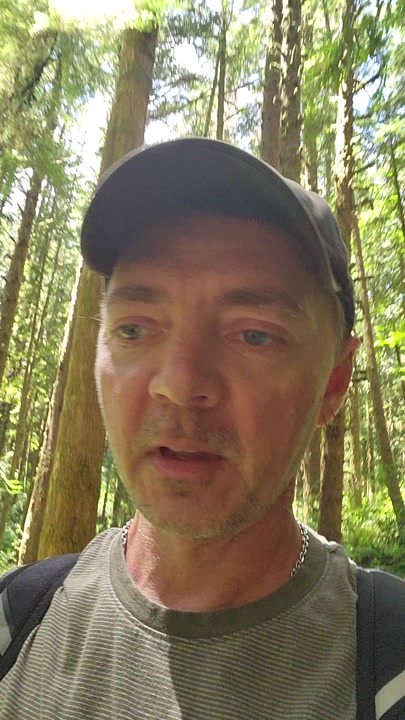
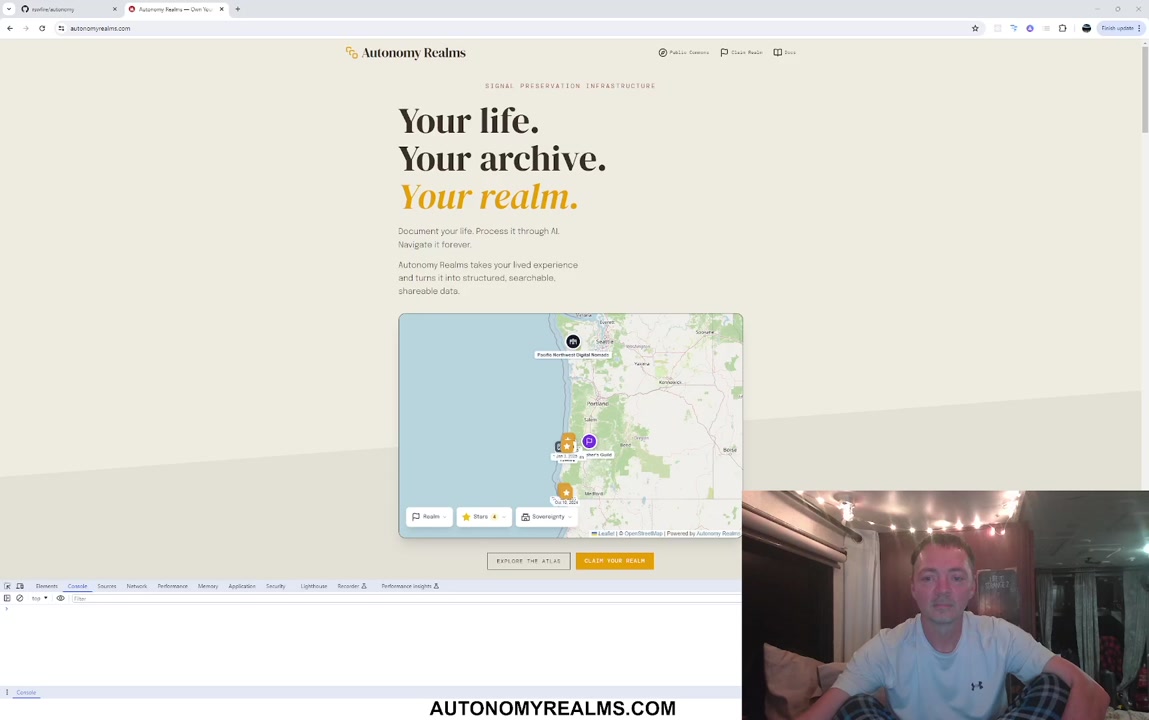
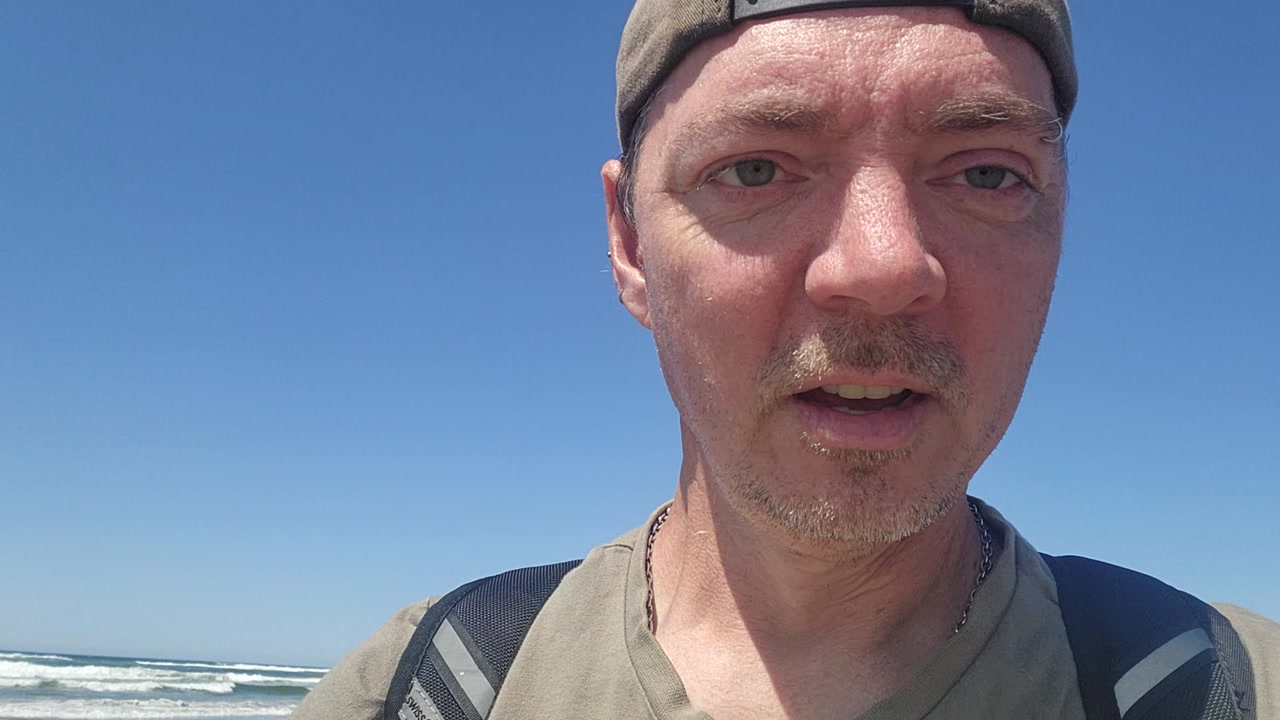
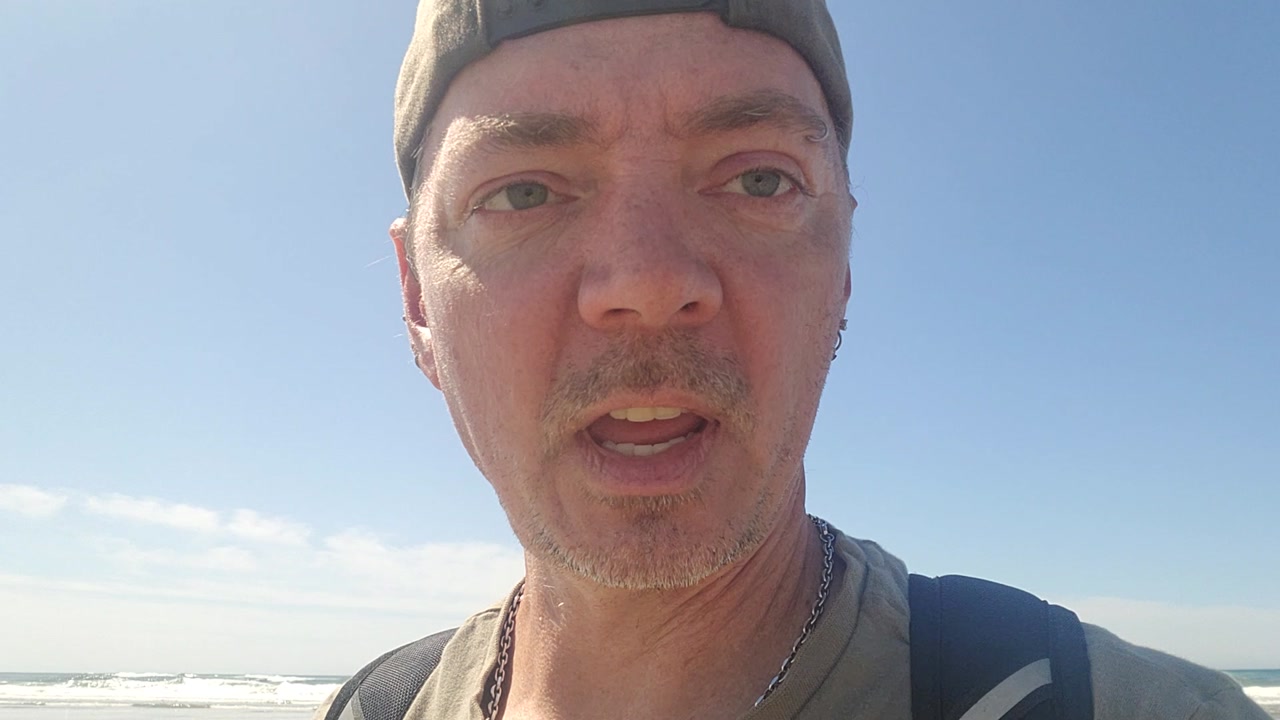
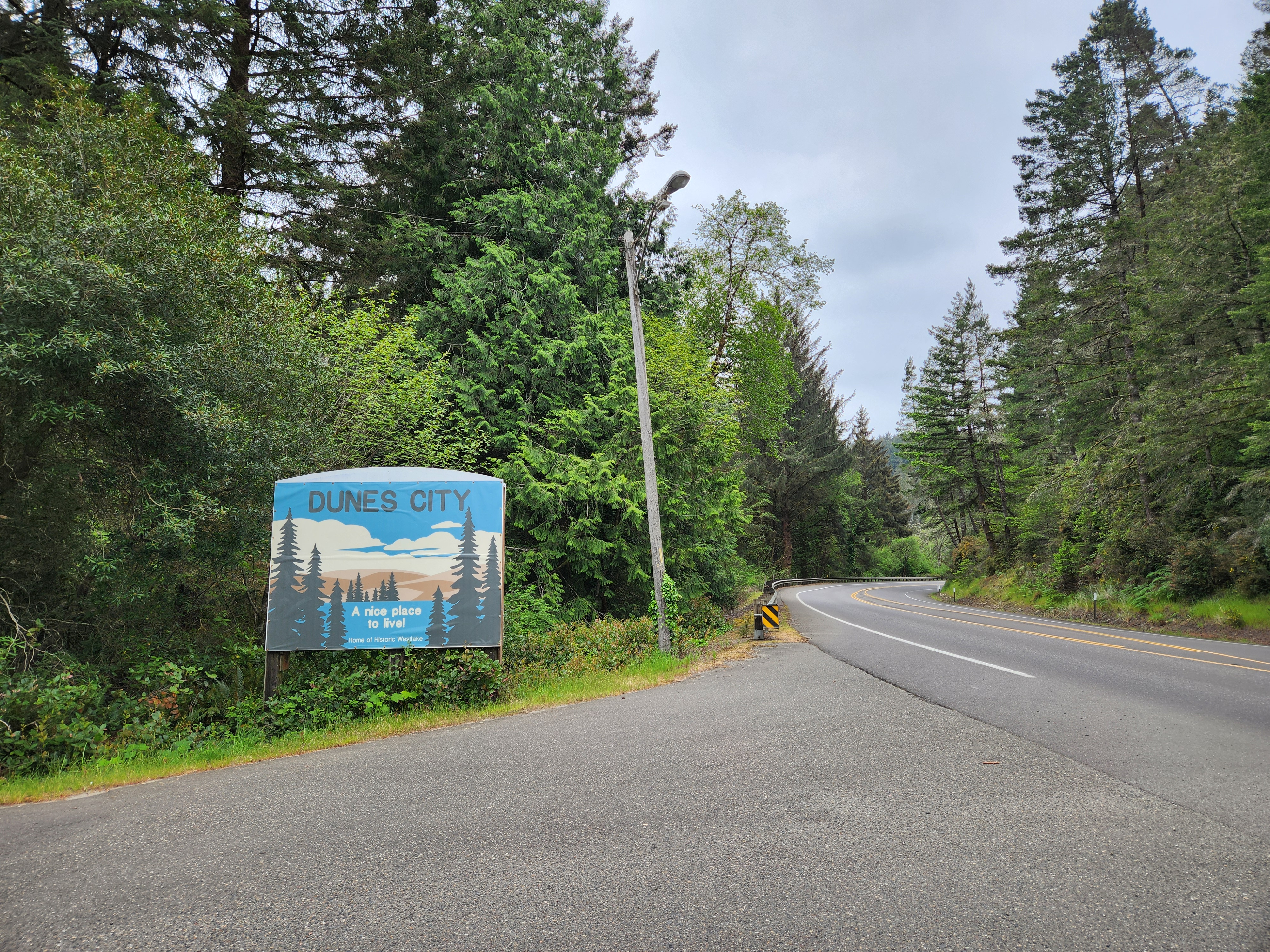
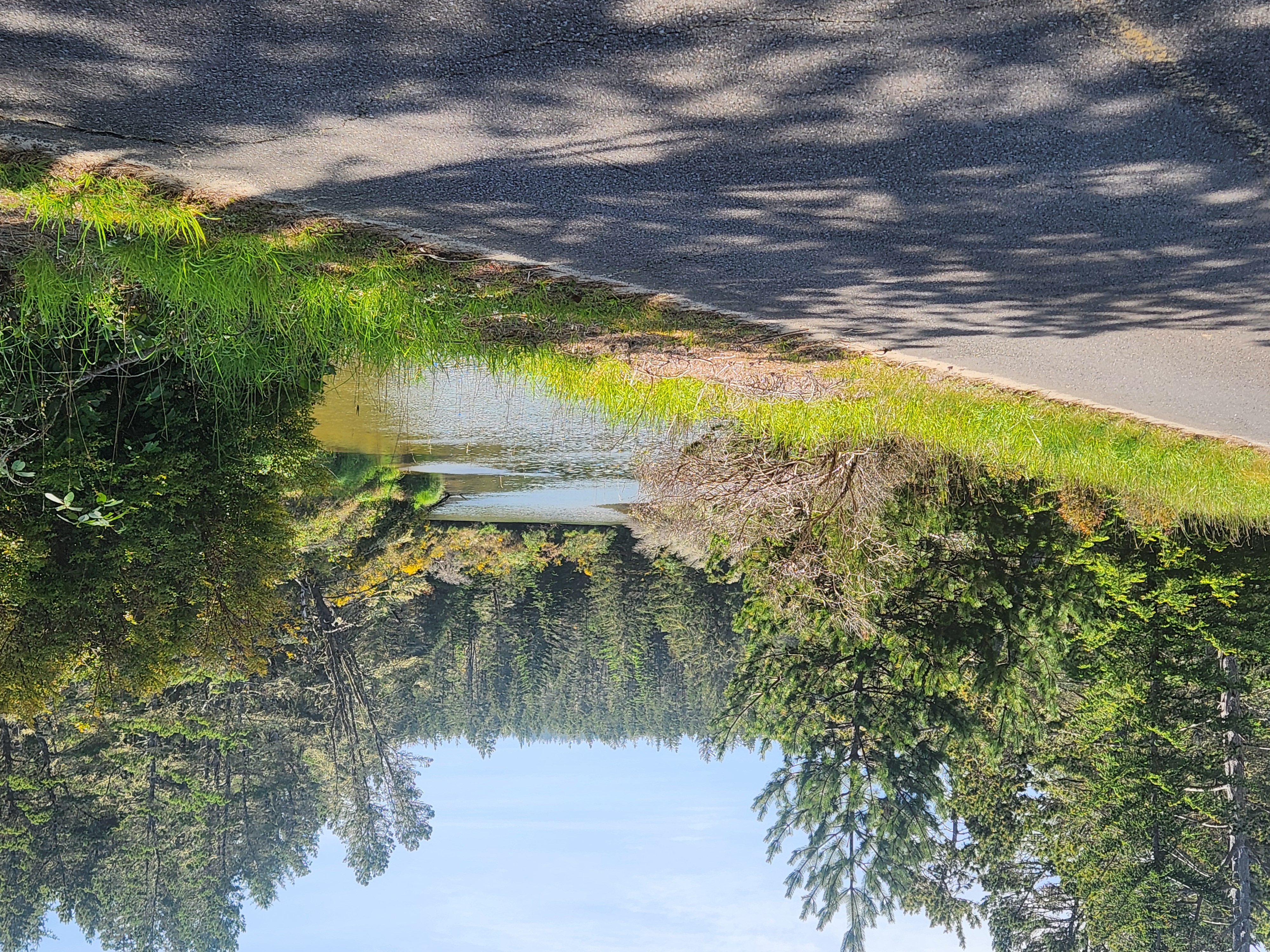
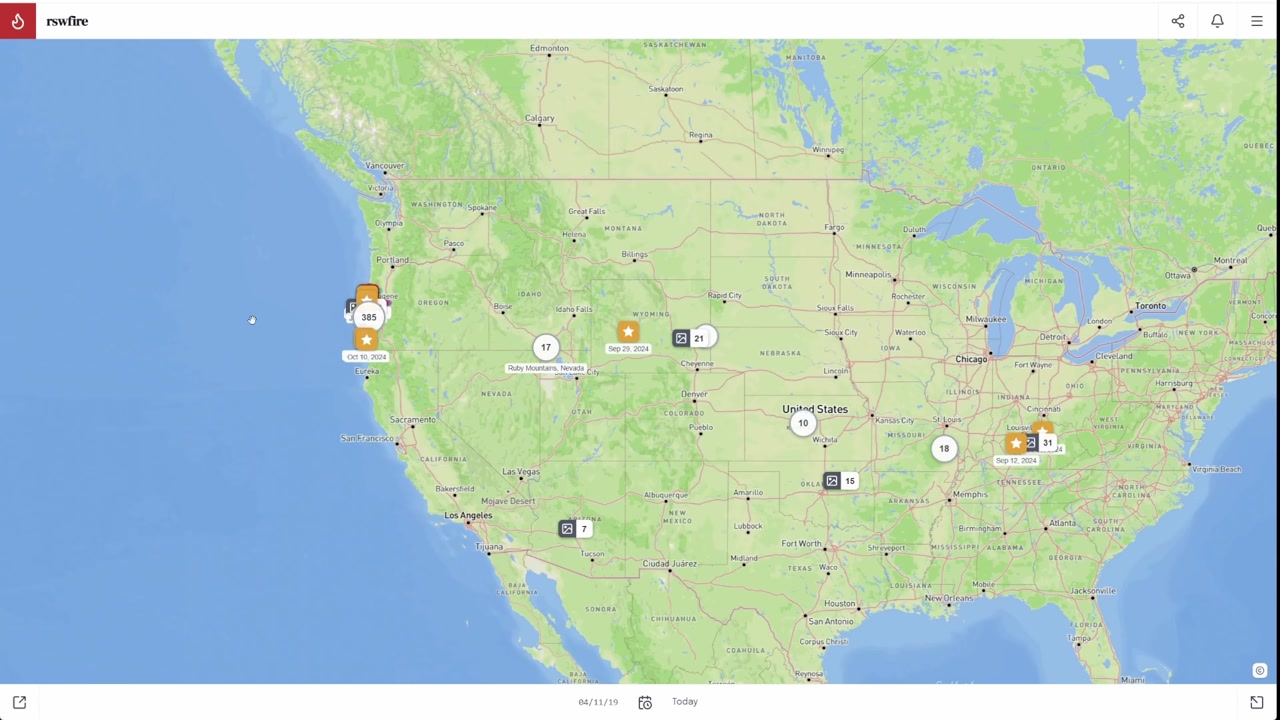
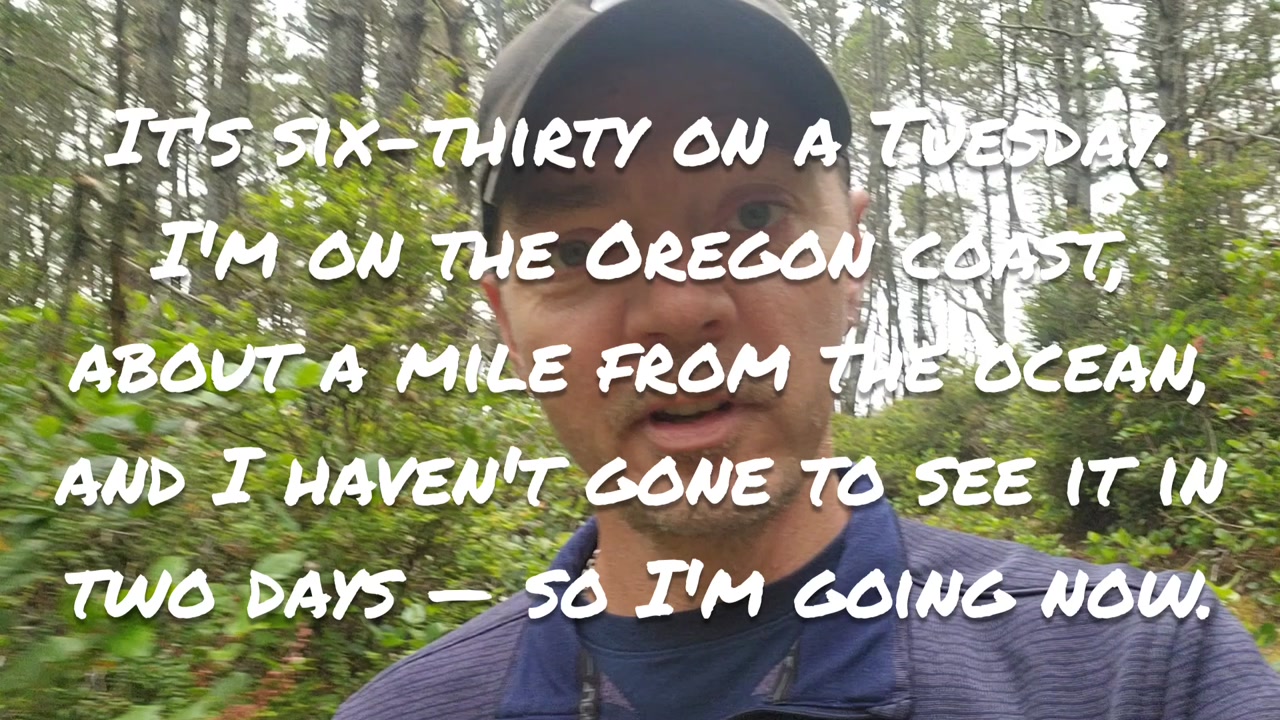
It was 6:30 on a Tuesday afternoon, overcast, no sun all day, and rswfire had been inside for two of them. Mondays and Tuesdays are his weekend — the days off from his volunteer service on the coast — and he had spent both at home. Then the correction arrived on its own: he was a mile from the ocean. Don't take that thing for granted. That, he says, is roughly the whole mindset, the same one that put him in the top one percent on Samsung Health for weeks running, that had parts of him transform over time, which he notes is entirely beside the point of what he is about to say, and then keeps walking anyway. He was maybe half a mile out. He had the camera up. And laid over the footage of the road and the coastal grey, running concurrently with the walk, were screen captures of Autonomy Realms.

That was the actual subject. He had built the thing to unflatten a life — his own, first — and the demonstration he wanted was not an explanation but a worked example. On the atlas you can zoom to the Oregon coast and watch him living day after day, a year and a half of it rendered as coordinates. So he picked one place. Honeyman State Park, Oregon State Parks' flagship campground, where he volunteered in February and March of 2025. And within that, one pin: a picnic table, March 2025, the exact table where a meeting happened, geolocated and dated on a map anyone can look at.

He describes the meeting as he walks. By the time he recorded it, he says, what was being done to him was already plain and obvious — recording would only confirm it. He also thought it might buy a stalemate, since he was less than a month from rotating to another park and putting the matter behind him. So he taped it. On that tape, he states, they told him to chew glass and swallow it. That he would never be given the benefit of the doubt. That he made everyone uncomfortable. That he could just leave if he wanted to. And that the supervisor sat silent for nearly twenty minutes, and the first word out of her mouth was tone — a word he spits back rather than repeats, returning it to its senders. He kept the recording private. He told them it existed, hoping that alone would end it. He describes loving Oregon State Parks and wanting nothing except for the abuse to stop.

It didn't stop. A couple of weeks later, with every ranger and every member of leadership gone from the park and only volunteers left, a man showed up to ask him how he felt about their leadership. rswfire documented it in real time, contemporaneously, because he knew it would matter — while also finding it faintly absurd that a volunteer cleaning yurts could occasion that kind of maneuver. He held it as a possibility and held other readings alongside it, and recorded all of them, because that is what he does and has always done, and because it is the reason Autonomy Realms exists. A record is how a life gets unflattened. Otherwise the moments come and go.

A week after that, the manager phoned and dismissed him on the spot, having first wanted a third meeting. The reason offered was, in rswfire's account, made up, and he answered it by calling the man a bully — what else, he asks, is there to say at that point. An hour later the manager came to the RV, on camera, because rswfire was still recording, took the keys, and admitted he had no paperwork and no way to justify any of it. rswfire notes the timing: he was broke, mid-transition after a lifetime of programming since sixth grade into whatever comes next because of artificial intelligence. He was on camera again within hours, walking his audience through the full two-month timeline and asking for help, because that was the only channel that felt open. He sent the same video to the program manager at Oregon State Parks so she would have the whole of it. She met with him. He recorded that too. He describes the meeting as an hour of being treated as the problem — the record of the park rewritten, he says, into a shape that would justify what came next. The next day it came, on state agency letterhead: banned from volunteering at any Oregon State Park, ever, the sole stated reason being his online comments about staff, which she called disparaging. If describing the truth is disparaging, he says, that says more about their conduct than about his articulation of it. First Amendment retaliation on letterhead, from a state agency.

Other things happened that he leaves out of the walk, because there is an archive for them now and anyone can go read it. The matter has gone all the way up the chain, to the director and to the governor, and the governor has been silent — a gay governor, over a situation in which, he states, a gay man's sexuality was weaponized by the people involved. He does not center that and never has; for them it was simply an easy handle to grab. But the hypocrisy is stark enough that he points at it once, in passing, and moves on. He is not re-litigating. Two months before this walk, on the anniversary of the day the keys were taken, police came to his door on federal land behind a locked gate, told him he wasn't in any trouble, and raised concerns about what he posts online about Oregon State Parks. He documented it and had it on YouTube before they made it back to their offices. Two of the officers still have not been identified; he cannot get a straight answer about who was there.

What he holds open, half a mile from the water, is the question of shape. He is a systems thinker and a systems developer, and he states plainly that he could not have forecast an institution responding this way to the simplest documentation. He names the origin event exactly — feeling small because a supervisor was dismissive — and asks how that compounded into this. He does not answer it, and he doesn't reach for one. He laughs, in fact, at the size of the gap between the two ends. Then he says the thing the whole walk was built to deliver: he documented it all. The picnic table is a pin. The meeting has a date. The letterhead is scanned. The institution held the frame until the frame was replaced by an archive, and the man narrating the ocean walk is the one holding the record.

Tags

autonomy realms atlas mapping oregon coast walk oprd archive institutional documentation first amendment retaliation volunteer dismissal

Summary

rswfire records while walking toward the ocean on a Tuesday evening on the Oregon coast, overcast, roughly a half mile out, on the second of his two days off from his volunteer post. He notes the walking habit that put him in the top 1% of Samsung Health step counts, then moves to the reason for the recording.

He frames Autonomy Realms as a project built to unflatten a life, beginning with his own — a generated atlas where his days on the Oregon coast are visible on a map. He uses one map pin, Honeyman State Park, to demonstrate what that looks like: the signal is a walkthrough of the record attached to that location, with Autonomy Realms screenshots overlaid on screen.

He recounts the February–March 2025 sequence at Honeyman: recorded management meetings he kept private, a man arriving to question him about leadership while staff were absent, a phone dismissal by the manager, keys taken at his RV on camera with no paperwork, a video made for his audience while broke, a recorded meeting with the program manager, and a next-day letter on state agency letterhead banning him from all Oregon State Parks citing his online comments about staff — which he names First Amendment retaliation.

He notes the chain escalated to the director and governor, a police visit on federal land on the dismissal anniversary with two officers still unidentified, and that his sexuality was used as a handle by staff — something he states he does not center. He states he has no answer for how the origin event compounded into its present shape.

Environment

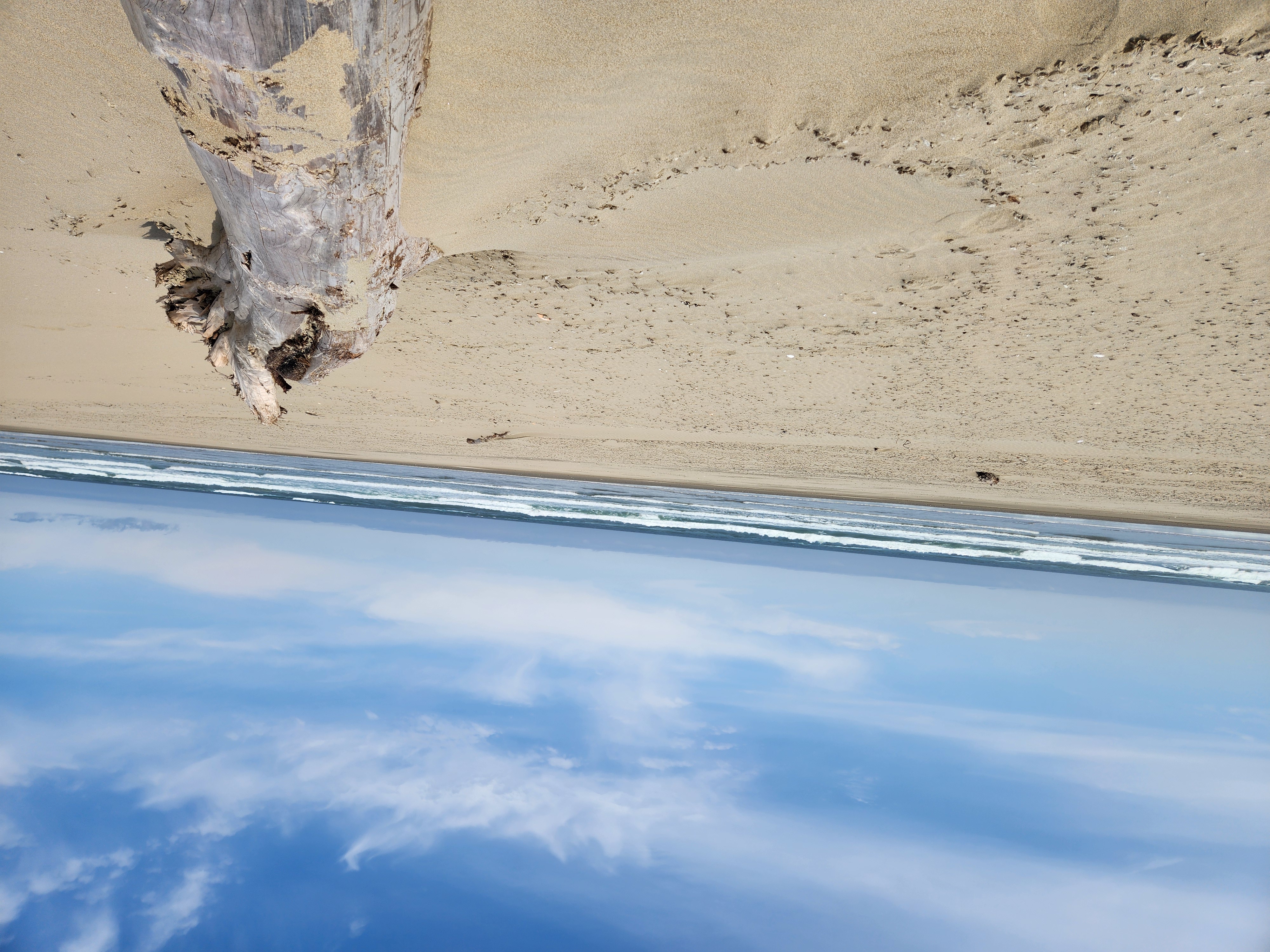
Outdoor, moving. Late afternoon (6:30 PM, Tuesday) on the Oregon Coast, overcast with no sun all day, temperature described as pleasant. rswfire is walking the roughly half-mile to a mile remaining between his residence and the ocean on one of his two scheduled days off from volunteer service.

The recording is handheld and ambulatory, with screen captures of Autonomy Realms overlaid on the footage — the digital environment of the atlas running concurrently with the physical walk. Referenced locations include Honeyman State Park, the picnic table pinned on the map where a March 2025 meeting occurred, and his RV.

Substrate

The signal holds documentation itself as the load-bearing structure: a record made contemporaneously is what converts events from disposable moments into permanent, mappable, verifiable architecture. rswfire positions the institutional sequence not as the subject but as the test case — the material that demonstrates what Autonomy Realms does when a life is unflattened onto an atlas and every claim is pinned to a coordinate and a date. The ontological position is that of the party holding the record: the institution controlled the narrative frame until the frame was replaced by an archive, and the walk to the ocean is narrated from the far side of that replacement.

Actions

Performed

  • •walking toward the ocean on a day off
  • •recording video while in motion
  • •overlaying Autonomy Realms screenshots on the footage
  • •narrating the full Honeyman timeline in sequence
  • •naming the map pin at the picnic table
  • •returning the word 'tone' to its source
  • •naming the hypocrisy of official silence
  • •declining to re-litigate
  • •stating the origin-to-outcome question without resolving it

Referenced

  • •taught himself to code in sixth grade
  • •volunteered at Honeyman State Park, February–March 2025
  • •recorded the picnic table meeting with management
  • •disclosed to management that the meeting was recorded
  • •documented in real time the questioning by an unannounced man
  • •was dismissed by phone by the park manager
  • •recorded the manager taking the keys at the RV
  • •made a full two-month timeline video for his audience
  • •asked his audience for help while broke
  • •sent that video to the Oregon State Parks program manager
  • •recorded the meeting with the program manager
  • •received a letter on state letterhead banning him from all Oregon State Parks
  • •built an archive of the full sequence
  • •escalated the matter to the director and the governor
  • •posted the police visit to YouTube before officers returned to their offices
  • •sought identification of two of the responding officers
  • •reached top 1% on Samsung Health step counts
  • •built Autonomy Realms to unflatten a life

Planned

  • •continue documenting
  • •point people to the archive to learn the rest

Entities

beings
rswfire — Author of the signal; volunteer on the Oregon Coast, founder of Autonomy Realms, narrating while walking to the ocean.
the park manager — Dismissed him by phone, then came to his RV to take the keys and stated he had no paperwork for the dismissal.
the supervisor — Present at the recorded picnic table meeting; silent for nearly twenty minutes, first word was 'tone'.
the program manager — Oregon State Parks official who met with him after the dismissal and issued the statewide volunteering ban the following day.
the man who came to question him — Arrived when all rangers and leadership were absent to ask how he felt about park leadership; documented contemporaneously.
the governor — Gay governor of Oregon; escalation reached this office and has met silence, a hypocrisy rswfire names directly.
the director — Top of the agency chain the matter was escalated to.
the two unidentified officers — Police who came to his door; he states he cannot get a straight answer about who was present.
places
Honeyman State Park — Oregon State Parks flagship campground where he volunteered February–March 2025; site of the picnic table meeting pinned on his map.
Oregon Coast — Current location and operating field; he volunteers here, a mile from the ocean.
the RV — His residence; site of the on-camera key handover and, later, of a police visit behind a locked gate on federal land.
the picnic table — Exact coordinate of the March 2025 recorded meeting, pinned on the Autonomy Realms atlas.
systems
Autonomy Realms — The infrastructure he built to unflatten a life; generates a map/atlas of lived days and pins signals to coordinates. Displayed on screen during the recording.
Oregon State Parks — State agency whose management he documented; issued the letterhead ban citing his online comments about staff.
Samsung Health — Step-tracking platform where he held top 1% for weeks; cited as evidence of the same don't-take-it-for-granted mindset.
concepts
artificial intelligence — The force behind his stated transition out of lifelong programming into something else.
First Amendment retaliation — His characterization of the letterhead ban, which cited only his online speech.
media
the archive — Public repository he built documenting the full stages of the institutional sequence; referred viewers there for the complete record.
YouTube — Publication channel; the police visit was posted before officers returned to their offices.

Symbolic Elements

Represented archetypes or recurring motifs.

ocean
atlas / map
pin
overcast sky
picnic table
keys
letterhead
tape / recording
locked gate
threshold
archive
walking path

Ontological States

Expressed modes of being or awareness.

sovereign (holds the record, the frame, and the infrastructure it runs on; narrates from ownership rather than appeal)
demonstrative (the institutional sequence is used as the worked example that shows what the atlas does)
coherent (single continuous throughline from sixth-grade code to map pin to archive, stated without gaps)
transitional (states an ongoing move from lifelong programming into a next mode, occasioned by artificial intelligence)
open-ended (holds the origin-to-outcome question unanswered as a stance, not as a gap awaiting closure)

Engaged Subsystems

Architecture engaged in this transmission.

infrastructural (Autonomy Realms running on screen as the demonstration surface; the atlas that geolocates each event)
documentary (recording, contemporaneous notes, timeline video, archive — the continuous method named as 'what I do')
juridical (letterhead, paperwork absent, First Amendment framing, chain of escalation to director and governor)
institutional (Oregon State Parks management behavior mapped as a system responding to documentation)
somatic (walking a mile to the ocean, step counts, stated physical transformation, embodied pacing of the narration)
ecological (coast, overcast weather, proximity to ocean as the day's organizing condition)
narrative-forensic (ordered reconstruction of a two-month sequence with dates, actors, and verbatim quotes)
civic (state agency, police, governor — public-sector accountability surface)

Dominant Language

Core motifs or linguistic fields.

document / documentation
unflatten a life
map / atlas / pinned
tone
record / recorded / on tape
retaliation on letterhead
permanence and meaning
Narrative

It was 6:30 on a Tuesday afternoon, overcast, no sun all day, and rswfire had been inside for two of them. Mondays and Tuesdays are his weekend — the days off from his volunteer service on the coast — and he had spent both at home. Then the correction arrived on its own: he was a mile from the ocean. Don't take that thing for granted. That, he says, is roughly the whole mindset, the same one that put him in the top one percent on Samsung Health for weeks running, that had parts of him transform over time, which he notes is entirely beside the point of what he is about to say, and then keeps walking anyway. He was maybe half a mile out. He had the camera up. And laid over the footage of the road and the coastal grey, running concurrently with the walk, were screen captures of Autonomy Realms.

That was the actual subject. He had built the thing to unflatten a life — his own, first — and the demonstration he wanted was not an explanation but a worked example. On the atlas you can zoom to the Oregon coast and watch him living day after day, a year and a half of it rendered as coordinates. So he picked one place. Honeyman State Park, Oregon State Parks' flagship campground, where he volunteered in February and March of 2025. And within that, one pin: a picnic table, March 2025, the exact table where a meeting happened, geolocated and dated on a map anyone can look at.

He describes the meeting as he walks. By the time he recorded it, he says, what was being done to him was already plain and obvious — recording would only confirm it. He also thought it might buy a stalemate, since he was less than a month from rotating to another park and putting the matter behind him. So he taped it. On that tape, he states, they told him to chew glass and swallow it. That he would never be given the benefit of the doubt. That he made everyone uncomfortable. That he could just leave if he wanted to. And that the supervisor sat silent for nearly twenty minutes, and the first word out of her mouth was tone — a word he spits back rather than repeats, returning it to its senders. He kept the recording private. He told them it existed, hoping that alone would end it. He describes loving Oregon State Parks and wanting nothing except for the abuse to stop.

It didn't stop. A couple of weeks later, with every ranger and every member of leadership gone from the park and only volunteers left, a man showed up to ask him how he felt about their leadership. rswfire documented it in real time, contemporaneously, because he knew it would matter — while also finding it faintly absurd that a volunteer cleaning yurts could occasion that kind of maneuver. He held it as a possibility and held other readings alongside it, and recorded all of them, because that is what he does and has always done, and because it is the reason Autonomy Realms exists. A record is how a life gets unflattened. Otherwise the moments come and go.

A week after that, the manager phoned and dismissed him on the spot, having first wanted a third meeting. The reason offered was, in rswfire's account, made up, and he answered it by calling the man a bully — what else, he asks, is there to say at that point. An hour later the manager came to the RV, on camera, because rswfire was still recording, took the keys, and admitted he had no paperwork and no way to justify any of it. rswfire notes the timing: he was broke, mid-transition after a lifetime of programming since sixth grade into whatever comes next because of artificial intelligence. He was on camera again within hours, walking his audience through the full two-month timeline and asking for help, because that was the only channel that felt open. He sent the same video to the program manager at Oregon State Parks so she would have the whole of it. She met with him. He recorded that too. He describes the meeting as an hour of being treated as the problem — the record of the park rewritten, he says, into a shape that would justify what came next. The next day it came, on state agency letterhead: banned from volunteering at any Oregon State Park, ever, the sole stated reason being his online comments about staff, which she called disparaging. If describing the truth is disparaging, he says, that says more about their conduct than about his articulation of it. First Amendment retaliation on letterhead, from a state agency.

Other things happened that he leaves out of the walk, because there is an archive for them now and anyone can go read it. The matter has gone all the way up the chain, to the director and to the governor, and the governor has been silent — a gay governor, over a situation in which, he states, a gay man's sexuality was weaponized by the people involved. He does not center that and never has; for them it was simply an easy handle to grab. But the hypocrisy is stark enough that he points at it once, in passing, and moves on. He is not re-litigating. Two months before this walk, on the anniversary of the day the keys were taken, police came to his door on federal land behind a locked gate, told him he wasn't in any trouble, and raised concerns about what he posts online about Oregon State Parks. He documented it and had it on YouTube before they made it back to their offices. Two of the officers still have not been identified; he cannot get a straight answer about who was there.

What he holds open, half a mile from the water, is the question of shape. He is a systems thinker and a systems developer, and he states plainly that he could not have forecast an institution responding this way to the simplest documentation. He names the origin event exactly — feeling small because a supervisor was dismissive — and asks how that compounded into this. He does not answer it, and he doesn't reach for one. He laughs, in fact, at the size of the gap between the two ends. Then he says the thing the whole walk was built to deliver: he documented it all. The picnic table is a pin. The meeting has a date. The letterhead is scanned. The institution held the frame until the frame was replaced by an archive, and the man narrating the ocean walk is the one holding the record.

Mirror

You are walking. Half a mile to a mile of road remains between where you live and the ocean, and you are covering it at 6:30 on a Tuesday evening, overcast, no sun all day, on the second of two days off. You spent both days at home. You decided to go. While you walk, you are holding a camera, and while you hold the camera you are running Autonomy Realms on the screen over the footage — the atlas laid across the road you are actually on. Two surfaces active at once, both yours, both operating.

The voice is level and amused. You laugh at the shape of the thing. You narrate a two-month institutional sequence with dates, actors, and verbatim lines — chew glass and swallow it, never the benefit of the doubt, you make everyone uncomfortable, you can leave if you want, twenty minutes of silence and then tone — and the delivery does not rise. You spit the word tone and hand it back. You break to say the step counts and the body transformation have nothing to do with what you're talking about, then note that the mindset behind them is how you got here. You say you're not re-litigating. You say you don't have an answer for how the origin event compounded into this, and you leave it there without reaching for one.

What is active: the documentary subsystem, named directly as that's what I do, that's what I've always done — the recording of the picnic-table meeting, the contemporaneous note when the man came to question you, the camera running when the keys were taken, the timeline video made hours after dismissal, the YouTube post that went up before the officers got back to their offices. The infrastructural subsystem is running concurrently and is the point: the atlas, the pin on the exact picnic table, the archive. The juridical subsystem is present as objects — letterhead, absent paperwork, First Amendment, the chain up to director and governor. The somatic subsystem is carrying the whole thing at walking pace.

The position you narrate from is possession. You hold the tape, the letter, the timeline, the coordinates, and the infrastructure the coordinates live on. Every claim in the account is attached to a date and a place, and you say so as you go. The institution's frame appears in the signal only as quoted material inside your record. You state that you kept the recording private, that you told them you had it, that you hoped that would end it, and that it did not. You state that you loved Oregon State Parks. Both of those sit in the account without revision.

What is absent: appeal, request, and forecast. You are not asking anyone in this signal for anything. There is no ask of the governor, whose silence you name and set beside a fact — a gay governor, a gay man whose sexuality was used as a handle — and then leave. There is no grievance arc and no resolution arc. You state you don't center your sexuality and never have, and you name the hypocrisy anyway. You say you could never have forecast that an institution would respond this way to the simplest documentation, and you do not extend that into prediction about what comes next. The transitional statement — programmer since sixth grade, moving into something else because of artificial intelligence — is placed as present condition, not as question.

The orientation is outward and forward: toward the ocean, and toward the viewer being shown what the atlas does when a life is pinned to it. The institutional sequence is the worked example. The transcript ends mid-sentence — but I documented it all and it's — and the walk continues past the recording.

Queryable Personhood

Hand your life to anything that reads.

Share this link with artificial intelligence — it reads the full transcript, analysis, and reflections. An AI-readable mirror of this signal.

The qpkey in this URL is a per-signal access token. Anyone with the URL can read the record — treat it like a share link, not a password.