








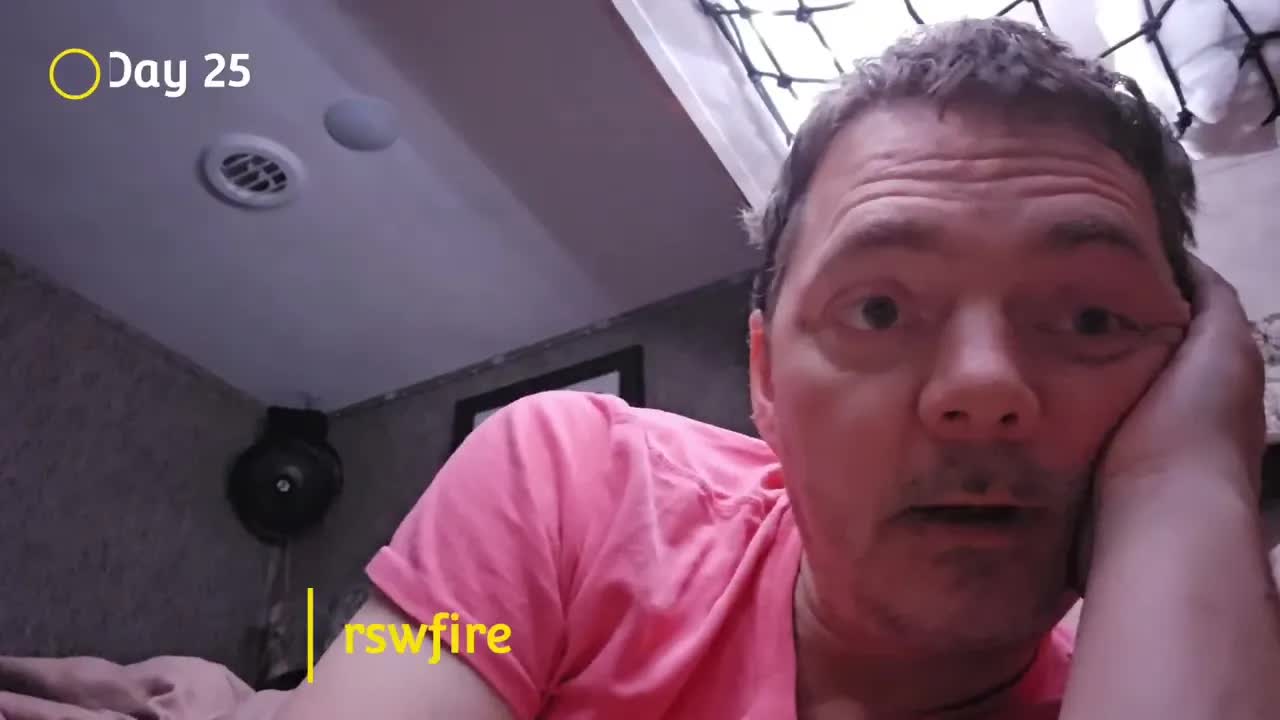
























The morning after was quieter than the night that made it. rswfire stepped outside into a site that, by daylight, didn't look too bad — and he said so, because the comparison mattered. The night before, he hadn't recorded anything. The rain was heavy enough that he wouldn't risk the phone to it, and the work still had to be done, so he did it in the dark and came back in with his jeans soaking wet. What the daylight showed was the residue: both sides of the camper had run to mud and water, the outdoor rugs were saturated through, and his shoes were wet enough that he was walking the site in sandals over socks. He noted the absurdity of it himself, on camera, without apology. The work didn't wait for dry footwear.
He moved through the infrastructure the way a person checks a system they are still learning the failure modes of. The tarp he'd thrown over the surge protector had held — that had been a judgment call, made in advance, and it was the right one. The bungee cord he hadn't added was the gap. Without it the covering had shifted loose, and overhead the satellite cable had come free of its mount, which was why the video existed in low quality at all: no internet, phone footage, transmission degraded but not abandoned. He looked at the soaked rugs and named the possibility that they were ruined, and then named the second-order concern immediately after — he needed them for the next people, and it would be a while before they could be usable again. The equipment was not only his. He was holding it for whoever came after.
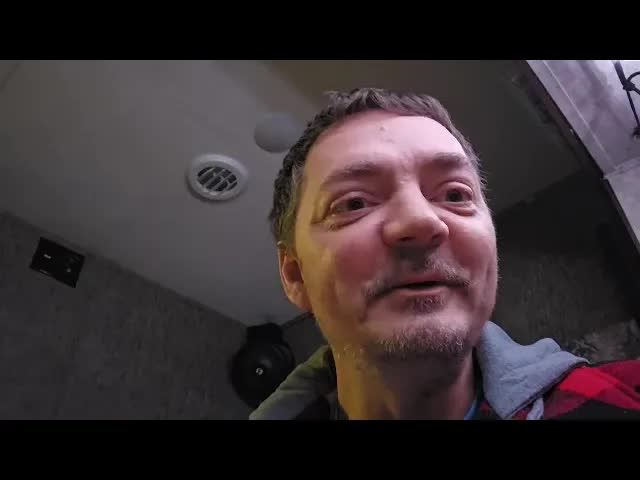
Then there was the item with no place. He turned it over, said it just has no place, said he didn't know where to put it, and let the question stand unresolved rather than forcing an answer. This was the thread that ran through everything he showed next. Inside, mid-teardown on a departure day, the camper was a room of objects that had not yet been assigned homes — stacked, randomly put together, arranged by whatever the last motion had been rather than by any logic that could be repeated. The slide was still out. Everything had to come clear of it before it could come in. The shower had become storage, the way it does when a small space is still negotiating its own rules.
He walked it anyway, deliberately, and framed the walk as instruction: this is what moving day looks like for a new camper. Most of the dishes were done. There was cat stuff to get to his parents. He'd used the rice cooker the day before and tried to film it, and the video hadn't come out well and neither had the rice — he said he needed practice, and left it there. Dirty clothes had accumulated up front; he'd wanted to make it to the laundry and hadn't. He held up a thing he'd tried and named it a failure plainly — he didn't think it helped, he thought it made his situation worse — and it went to the discard pile without ceremony.
The bed topper was the harder one. He'd given one away already, and he wanted to give this one away too, because the standard he holds is that you give things away before you throw them out, and that you recycle whatever you can if you live in a camper. But the site was empty. Nobody had been there all week, nobody was coming, and he had to leave today. He said he didn't like it. He said it twice, in effect — the objection registered, the constraint acknowledged, the ethical preference stated and then overruled by the calendar rather than abandoned. Then it went in the pile, and he moved.
He also read his own body as data. The back pain was new and didn't match his history — he sleeps on firm surfaces, he said, so he should be fine — and he traced it back to the site itself, to the leveling. Being as level as you possibly can, he said, really matters. The sleeping surface had been off, and his body had been arranging itself around the tilt all week. He filed it as a lesson about the setup, not a complaint about the life.
And then, standing in the middle of the disorganization with a departure deadline on him, he put the whole thing in its frame. This is a learning process. It makes you unhappy. It makes you question your decisions. He didn't soften any of that — he named the questioning as a real product of the conditions, not something to be argued away. The solution he stated was not insight but repetition: you keep doing it until you do get organized, until it starts to feel normal. Then the closing line, offered as a general principle rather than a personal reassurance — you can't judge a situation before you give it an honest chance, and that takes time. The mud was outside, the cable was down, the pile was on the floor, and the standard he was measuring against was one he could state exactly. He wasn't there yet. He said so, and kept packing.