
































At six in the morning, rswfire started filming with a new idea already worked out. The plan had changed overnight: pull the board out, wrap both sides of the cardboard in reflectix, slide that in first, then the pink insulation behind it, then work the outside where the door meets the wall and fill any gap, then cap the whole assembly with another layer of cardboard at the end. He narrated it to the camera the way a person narrates something they have already solved and now only has to execute. Nearby, staged for the morning: rolls of reflective insulation, five rolls of reflective tape, pink fiberglass, cardboard boards cut to size.
Before he started, he mentioned a measurement he had taken. One of the tables from the house would fit this space perfectly. He had ordered bar stools so there would be somewhere to sit. He said it would make a nice cozy area — the kind of remark that reveals the build is not about insulation at all but about the room the insulation makes possible.
The work went in layers and the layers taught him things. His first double-sided reflectix panel came out well, and he noted that his technique had improved — where he used to cut the reflective tape into little strips to keep it from tangling, he had since learned to handle it efficiently. Skills improve the more you do it, he said, and slid the panel into place. The middle board went in tight. The side boards did not; there was a gap. He looked at it and worked out why: the first time through, he had measured for the length of the door behind the wall rather than the whole wall. He named the error, filed it as part of the process, part of learning, and moved on. Then, mid-work, he stopped and said it plainly to the camera: this is my new home, guys, I live here, this is my home, and I'm going to take good care of it.
Partway through, he noticed something the plan had not accounted for. With the side-out extended, one wall stood completely exposed to the outside. He thought aloud about the fix — reflectix, maybe rboard, then some kind of cloth over it so it wouldn't look like foil — and stated the principle underneath: if you can insulate it, you should try. He sealed as he went, taping around, up top, all the way around, until he could turn the camera on the space and call it a completely sealed environment. It had cost two rolls of reflective tape by then. He had bought five and had not expected to burn through them that fast.
The hardest part came at the cardboard, working it into place without smushing the reflective layer, trying to keep coverage intact. He considered a one-sided approach to make it easier and then set the whole question against his standard: one thing about me, I don't like taking shortcuts. That was why he had pulled the board out in the first place. A shortcut taken now is the same work redone in a couple of weeks. His rule — if you feel like you need to take a shortcut, take a break instead — he applied to the camper and to his devs in their programming work without adjusting it for the change of domain. Somewhere in the last stretch he discovered he had been running one of the boards upside down for months, which explained a leak he had been living with. By the final side of the final board he was working from scraps, patching across it, until the last piece he had left went exactly where it needed to go.
At ten o'clock he called it done. Four hours, four and a half rolls of reflective tape, every bit of reflectix consumed. Lowe's for more before he could start the bedroom. He listed what remained: a three-quarter-inch rboard custom cut for one opening, maybe insulation in the shallow cavity because it's a cavity and he feels like he should, reflectix on that exposed wall with fabric over it. Otherwise done. He said he was super happy and very proud, and that it took longer than he cared to admit.
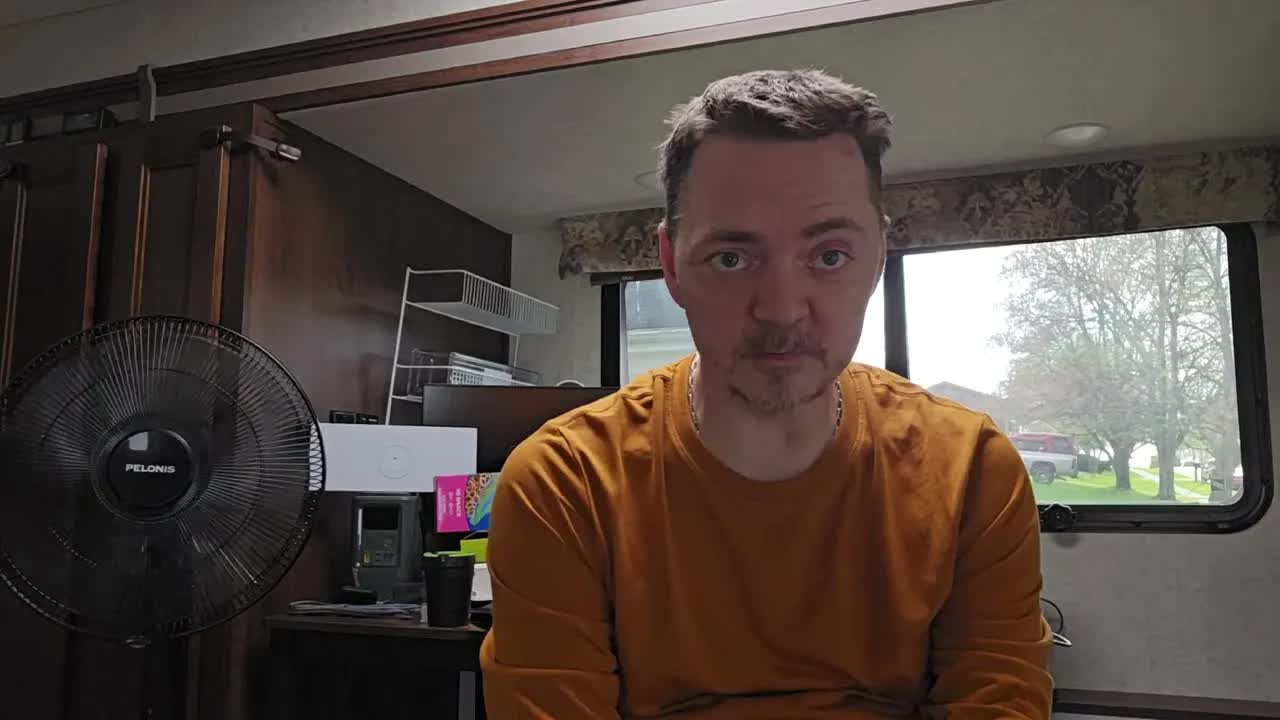
Then he sat and made the closing video with the daylight already four hours old, knowing he looked terrible and saying so. There were things the build footage had not covered: kitchen and living area insulated, bedroom still ahead, cold drafts coming off the cab and the door, and the floor — very cold, registered directly through hours of sitting on it while he worked. His answer to the floor was rugs and hope for the best. What he wanted, stated simply, was to be living in there with his cats. This room would be the living area, the office, the kitchen, the everything room. He told whoever was watching not to feel intimidated. This was just something that needed to be done.