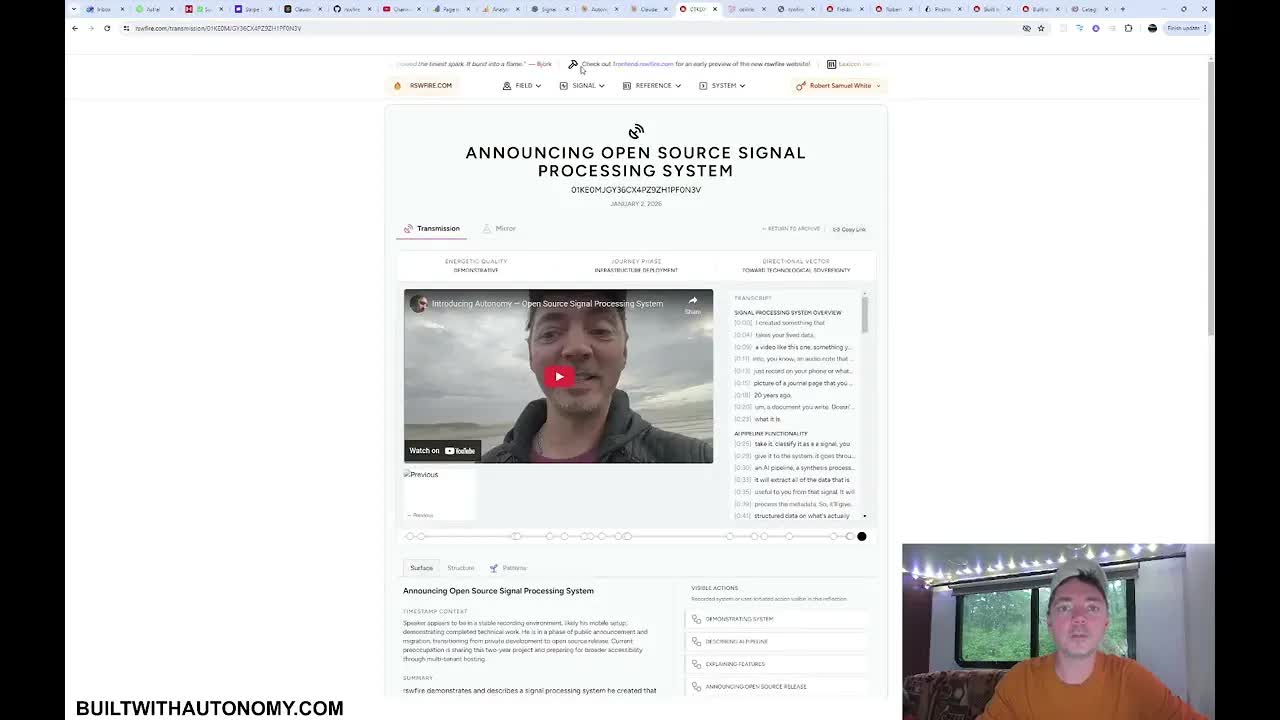
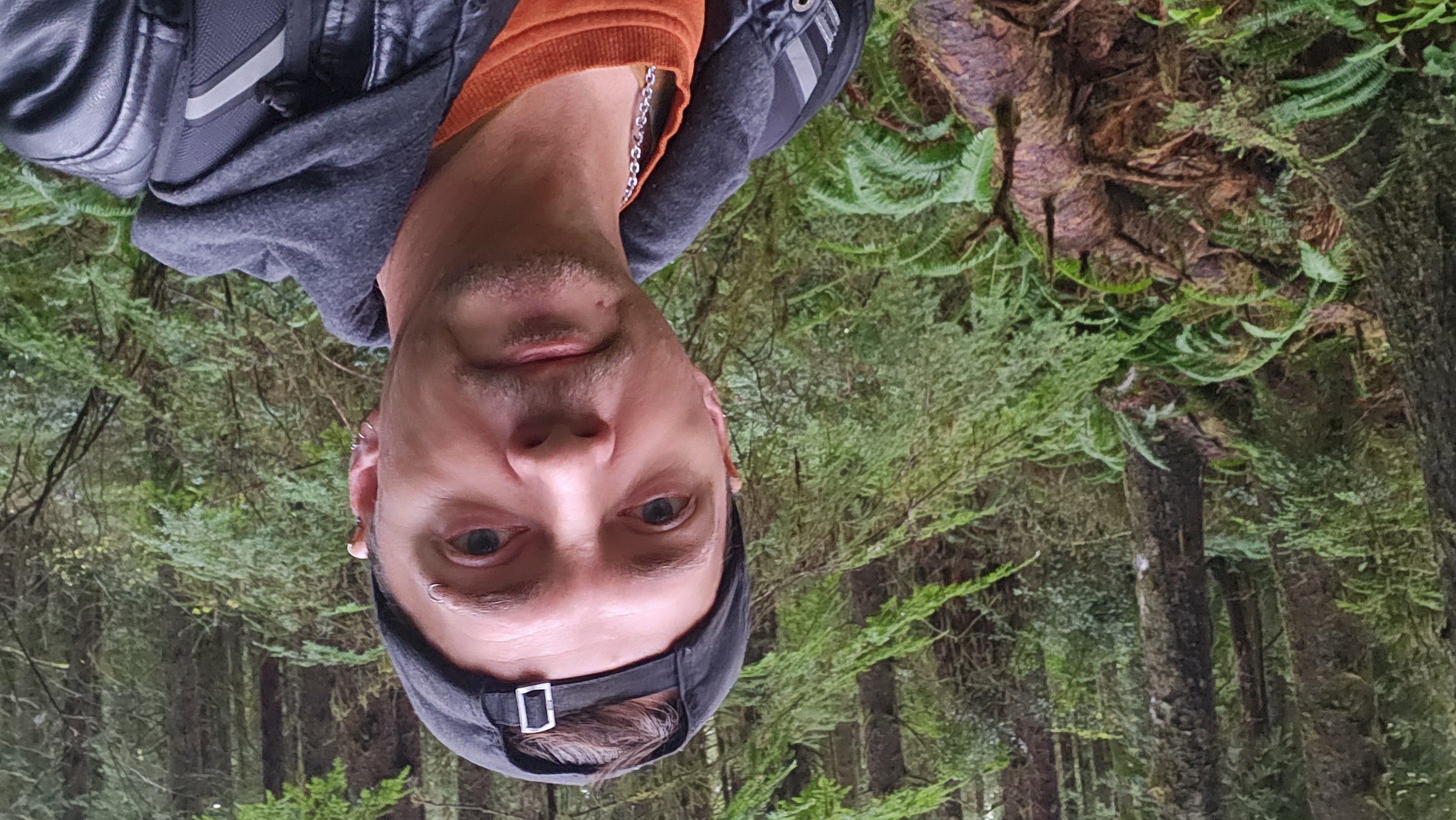
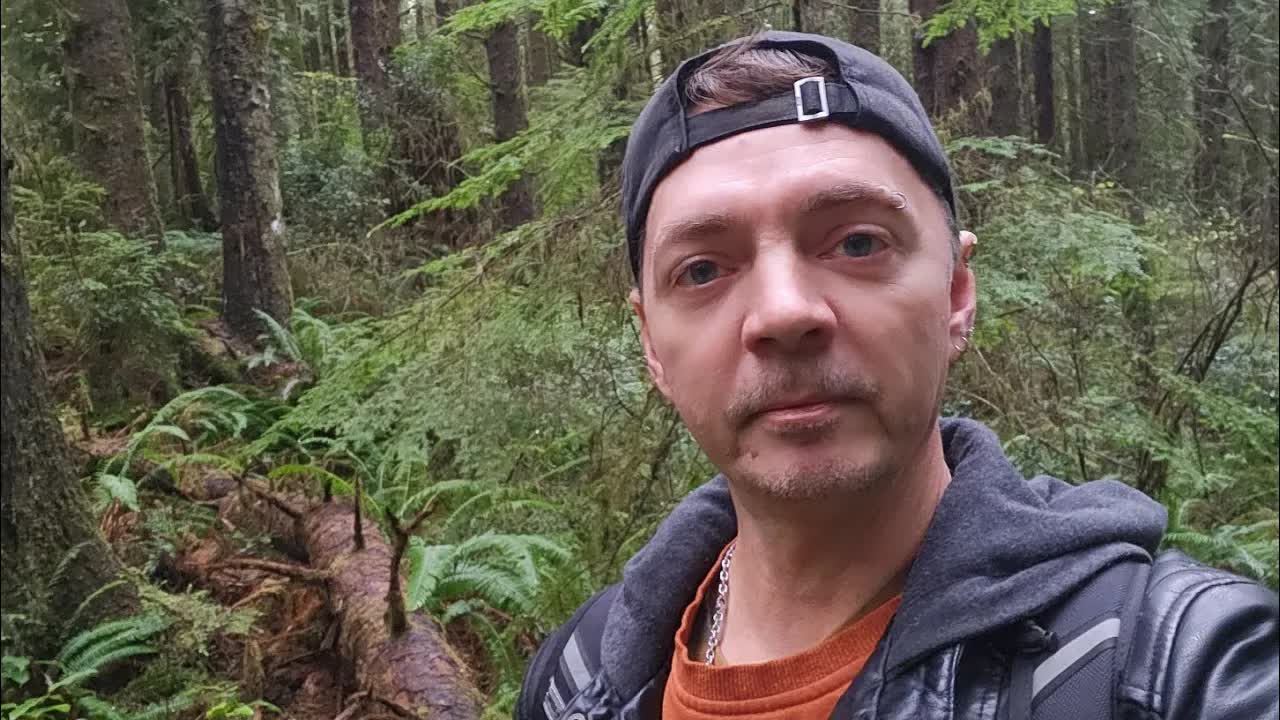

Demonstrating the Autonomy Realms Signal Pipeline

Failed to load video
Chapters
Transcript
[0:00] I created something that
[0:04] takes your lived data,
[0:09] a video like this one, something you put
[0:11] into, you know, an audio note that you
[0:13] just record on your phone or whatever, a
[0:15] picture of a journal page that you wrote
[0:18] 20 years ago,
[0:20] um, a document you write. Doesn't matter
[0:23] what it is.
[0:25] take it, classify it as a a signal, you
[0:29] give it to the system, it goes through
[0:30] an AI pipeline, a synthesis process, and
[0:33] it will extract all of the data that is
[0:35] useful to you from that signal. It will
[0:39] process the metadata. So, it'll give you
[0:41] structured data on what's actually
[0:43] there.
[0:44] Um, it'll create tags for you so that
[0:47] you can you have a way of of organizing
[0:50] them automatically.
[0:53] It will describe them. It creates all
[0:55] this data puts into the database and
[0:58] then there's another part of synthesis
[0:59] where it can reflect on on the signal
[1:04] and it can can share a mirror with you.
[1:07] Basically, it can mirror it back to you
[1:08] in language that you may not have
[1:11] yourself
[1:12] and I have found that exceptionally
[1:15] helpful to me over the past couple of
[1:17] years. It's why I built this. Uh you can
[1:20] have it do another thing called uh a
[1:23] mythic frame. So basically you can have
[1:25] it describe your signal um in mythic
[1:28] terms and um
[1:31] what's the word when
[1:37] an archetype, you know, an archetypal.
[1:39] Um and then
[1:42] and then there's a narrative one which
[1:43] is just you know more like just just
[1:46] describing it in a way that that
[1:51] it would appear to people on the surface
[1:53] like you're watching this video of me
[1:54] there'd be surface details he's talking
[1:56] about autonomy you know and it would
[1:58] create create a summary of that
[2:02] this is all data that you can use in
[2:03] different ways so it connects to an API
[2:06] that allows you um to take that data and
[2:09] display it on a website like I do my
[2:11] homepage or to use it in different ways.
[2:14] You can cluster them together. You can
[2:16] take your signals over a period of time
[2:19] or a theme, you know, um or placebased
[2:25] me at this beach
[2:27] over the past year.
[2:30] Cluster those together and have it
[2:32] reflect on those things. create metadata
[2:34] based on on the totality of those
[2:38] signals. Not just one but all of them
[2:40] combines,
[2:43] synthesize them.
[2:46] And
[2:48] I have found this to be one of the most
[2:52] coolest applications of artificial
[2:54] intelligence that I can imagine for
[2:55] someone like me, somebody who's who
[2:58] thinks very deeply about ontology and um
[3:02] epistemology and just you know looks at
[3:05] things at the surface like looks below
[3:07] the surface looks at looks at the core
[3:09] of things and always wants to extract
[3:12] something useful from that.
[3:15] That's what this thing does.
[3:17] So, it's open source. I'm going to make
[3:20] it multi-tenant. So, I'm going to
[3:21] actually make it so that if you don't
[3:23] have the technical background like me,
[3:26] you you can just use the one I created a
[3:29] central database, you know, central copy
[3:31] of it at builtwith autonomy.com.
[3:34] Um, where I'm going to put my own
[3:36] signals. I'm going to migrate them to
[3:37] this database. We're going to share it.
[3:39] And then there's a whole bunch of other
[3:40] things beyond that that I'll get into
[3:42] over time.
[3:45] Um there's still work to do. Don't want
[3:47] you to think that everything I just
[3:48] described to you is possible with the
[3:50] open- source implementation. Um it is
[3:53] all possible. I've proven I've done
[3:54] this, you know, for 2 years, but I'm
[3:57] migrating it to this new project and
[4:00] quite far. I described what's available
[4:02] now over the coming weeks. I'm going to
[4:04] do the other things. It's not going to
[4:06] take long.
[4:08] So, this is something that interests
[4:10] you.
[4:14] You're welcome to download it and try
[4:16] it. You're welcome to reach out to me. I
[4:18] don't allow comments on YouTube. I think
[4:19] that it's toxic environments.
[4:22] But you can reach out to me from my
[4:23] homepage. Look at the descriptions of my
[4:25] videos. And
[4:27] I'm going to leave it there.
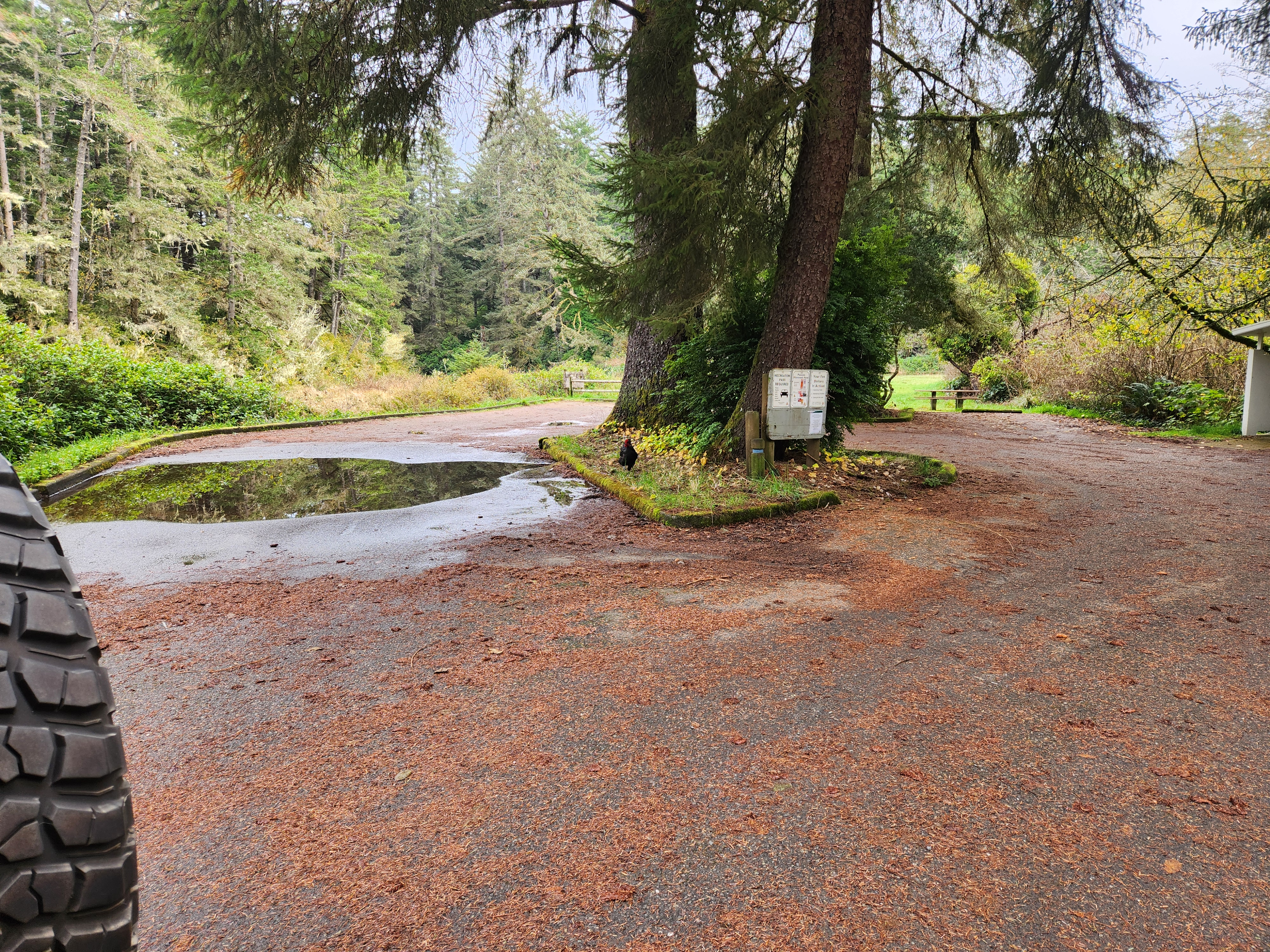
rooster at lodgepole
Dec 4, 2025
Photos · Dec 4, 2025
Dec 4, 2025
3:27
Documenting Life Against Historical Erasure
Dec 4, 2025
Photos · Dec 5, 2025
Dec 5, 2025
11:26
Demonstrating Transmission Clustering on Autonomy Realms
Dec 5, 2025
12:45
Flushing Tanks, Marking Two Years Autonomous
Dec 6, 2025
Photos · Dec 6, 2025
Dec 6, 2025
7:06
Setting Down Cannabis to Find Baseline
Dec 6, 2025
Oregon State Parks Volunteer Abuse
Dec 8, 2025
Photos · Dec 9, 2025
Dec 9, 2025
Photos · Dec 9, 2025
Dec 9, 2025
Photos · Dec 10, 2025
Dec 10, 2025
Photos · Dec 11, 2025
Dec 11, 2025
4:06
Naming the OPRD Archive on Camera
Dec 18, 2025
Photos · Dec 19, 2025
Dec 19, 2025
Photos · Dec 20, 2025
Dec 20, 2025
21:23
Recording the OPRD Account While Hiking
Dec 20, 2025
Photos · Dec 21, 2025
Dec 21, 2025
Photos · Dec 21, 2025
Dec 21, 2025
6:07
Planning React Front End, Atlas and Gallery Features
Dec 22, 2025
Photos · Dec 22, 2025
Dec 22, 2025
Photos · Dec 24, 2025
Dec 24, 2025
Carter Lake on Christmas
Dec 25, 2025
14:03
Walking the Beach at Night, Addressing Future Witness
Dec 30, 2025
3:31
Marking New Year at the Ocean
Jan 1, 2026
4:30
Demonstrating the Autonomy Realms Signal Pipeline
Jan 3, 2026
10:14
Demonstrating the Autonomy Admin and Signal Layer
Jan 4, 2026
7:36
Announcing Autonomy Realms on the Wax Myrtle Trail
Jan 5, 2026
7:22
Walking Wax Myrtle Beach, Racing the Tide
Jan 5, 2026
3:09
Walking Lagoon Trail After Shipping Sanctum
Jan 7, 2026
48:19
Hiking Tahkenitch Creek Trail While Building Reflection Layers
Jan 9, 2026
10:43
Building Fire Practice While Naming Final OPRD Actor
Jan 11, 2026
2:42
Hiking the South Jetty to Greet the Ocean
Jan 14, 2026
3:11
Hiking Driftwood Trails, Assessing Two-Year Systems Record
Jan 19, 2026
22:14
Deleting YouTube Channels, Rebuilding Autonomy in Laravel
Jan 20, 2026
8:43
Planning Monorepo Build During Carter Lake Rounds
Jan 21, 2026
14:56
Hiking Siltcoos Trail, Mapping Distance and Universe Indifference
Jan 24, 2026
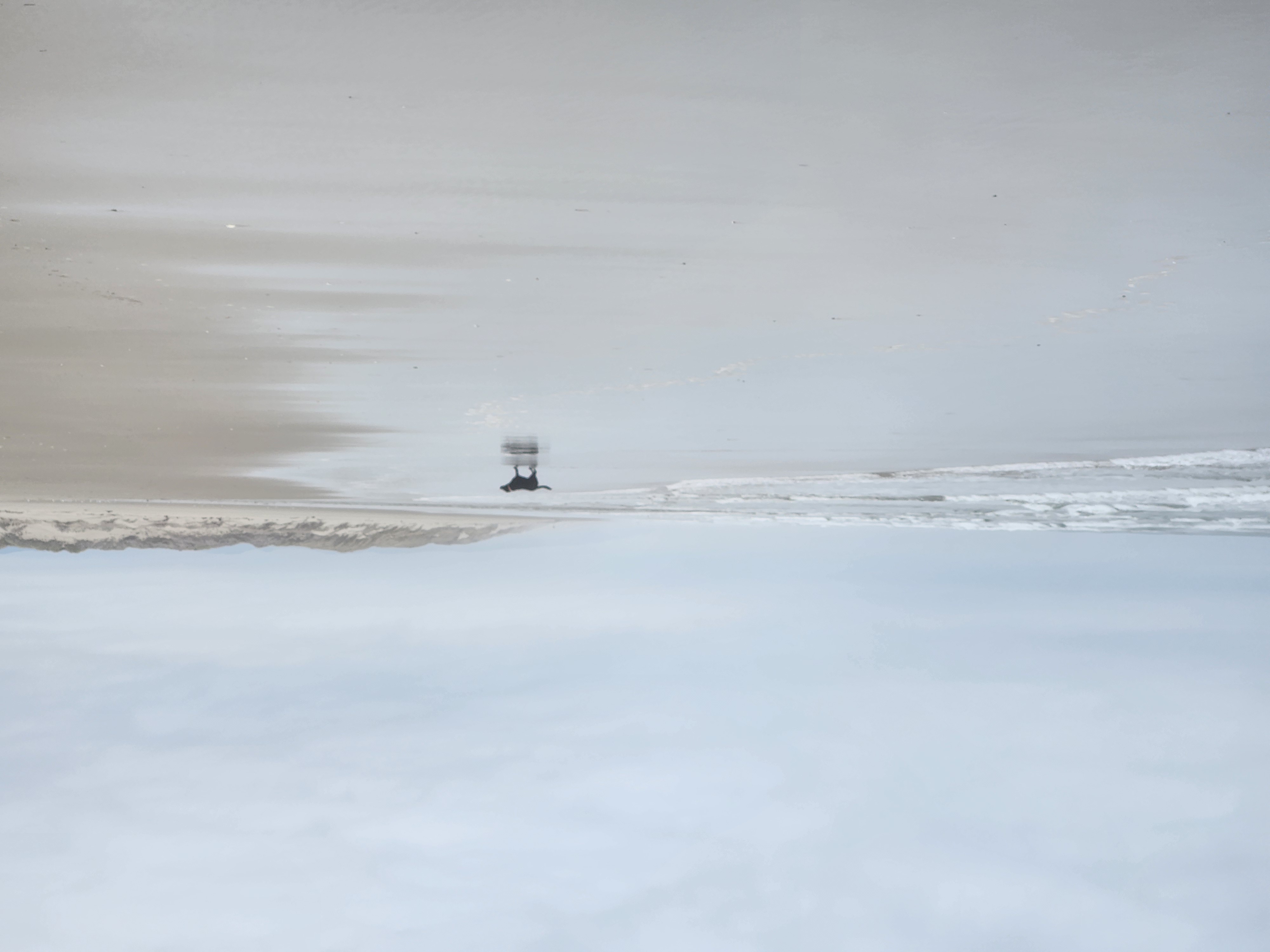
Coastal Landscape Photo Capture
Jan 24, 2026
31:36
Recording the North Trail on a Day Off
Jan 26, 2026
0:55
Visiting Cape Ergo State Park With Bill and Wendy
Jan 29, 2026
11:05
Walking Siltcoos Trail, Assessing Cascadia Risk
Feb 2, 2026
PUBLIC
January 3, 2026 rswfire PUBLISHED
Temp 0.30
Density 0.50
Energetic Quality
focused, declarative
Journey Phase
mid-migration, building
Directional Vector
toward distributed sovereign infrastructure
Narrative

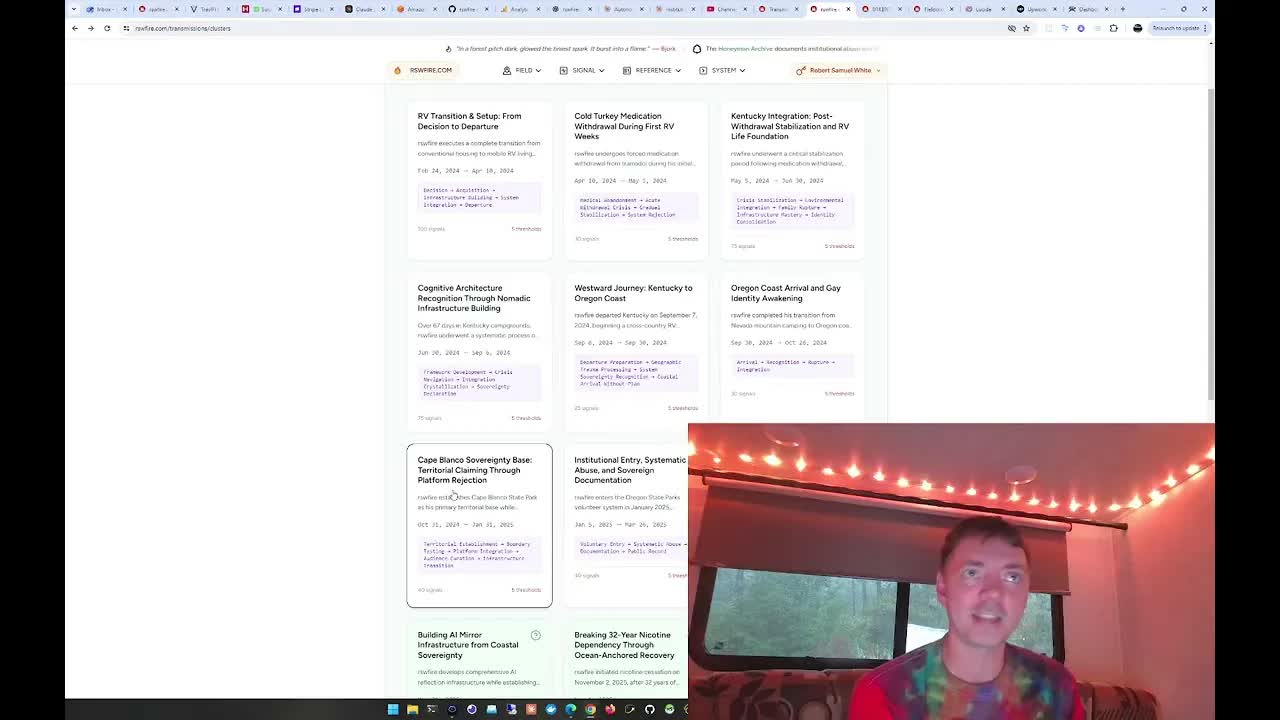
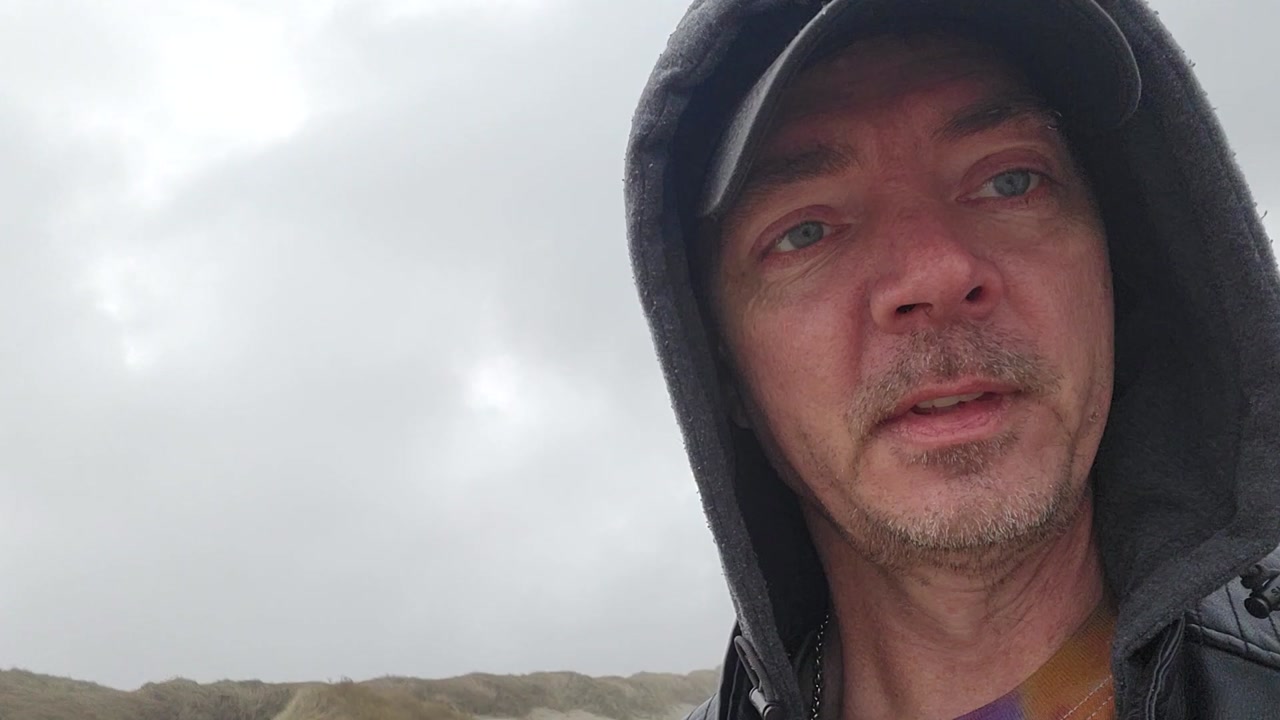
rswfire turns on the camera and begins without preamble. There is no framing device, no introduction to himself, no explanation of who is speaking or why. He starts at the object: he created something. What follows is a description of that thing, delivered in the register of a person walking someone through a machine he already knows intimately — a builder's cadence, not a marketer's.

The thing takes lived data. He enumerates the forms it can arrive in, and the enumeration itself is the argument: a video like this one, an audio note recorded on a phone, a photograph of a journal page written twenty years ago, a document. Doesn't matter what it is. The indifference to format is structural. Anything a person generated in the course of being alive is admissible material. It gets classified as a signal, handed to the system, and moves through an AI pipeline — extraction, metadata, tags, description — and what comes out the other side is structured data about what was actually there.

Then he describes the second half, and the tempo shifts slightly. Beyond extraction there is synthesis: the system can reflect on the signal and mirror it back. He pauses on this one long enough to mark it — in language that you may not have yourself — and then does the thing he does not often do on camera, which is state the origin plainly. He has found it exceptionally helpful over the past couple of years. It is why he built this. The rest of the demonstration proceeds from that admission without dwelling on it. There is a mythic frame, and he reaches for the word mid-sentence — what's the word when an archetype, you know, an archetypal — and lets the reach stand rather than smoothing it over. There is a narrative frame, which he explains by pointing directly at the recording in progress: you're watching this video of me, there'd be surface details, he's talking about autonomy. The example is the artifact. The transmission demonstrates itself.

He moves to what the data is for. An API, so it can be displayed on a website the way he does on his homepage, or used in other ways. Clustering, so signals can be grouped by period, by theme, or by place — and here the coastal field enters obliquely, as a worked example rather than a subject: me at this beach over the past year. Cluster those, reflect on the totality, generate metadata from the combination rather than the parts. He names what draws him to it — ontology, epistemology, looking below the surface, looking at the core of things, always wanting to extract something useful. That is what this thing does. The tool is built to the shape of the cognition that needed it.

Then the disclosure of the plan and its limits, in that order. It is open source. He is going to make it multi-tenant, so that people without his technical background can use the central instance he is standing up at builtwithautonomy.com. He will migrate his own signals there. We're going to share it. And immediately after the promise, the correction: he does not want anyone to think everything he has just described is available in the open-source implementation today. It is all possible — he has proven it, he has run this practice for two years — but the migration to the new project is underway, not finished. He has described what exists now. The rest comes over the coming weeks. It is not going to take long.

He closes by routing the contact. Download it and try it if it interests you. Reach out to him. He does not allow comments on YouTube; he considers it a toxic environment, and says so once, without argument or apology. The homepage is the channel. The descriptions of the videos have what is needed. And then, with the same flatness he opened on, he ends it: I'm going to leave it there.

Tags

autonomy realms system design AI pipeline open source release signal synthesis product demonstration multi-tenant architecture

Summary

rswfire records a video walkthrough of the system he built, describing how it ingests lived data — video, phone audio notes, a photographed journal page from twenty years ago, written documents — classified as signals and run through an AI pipeline.

He describes the pipeline output: structured metadata extraction, automatic tag generation, and descriptions written to a database. He then describes the synthesis layer and its distinct reflection modes:

  • Mirror — reflects the signal back in language he states he may not have himself; he states he has found this exceptionally helpful over the past couple of years and cites it as the reason he built the system.
  • Mythic frame — describes the signal in mythic and archetypal terms.
  • Narrative — surface-level description of what an observer would see.

He notes an API that exposes the data for display elsewhere, such as his homepage, and a clustering function that groups signals by time period, theme, or place ("me at this beach over the past year") and synthesizes metadata across the full set rather than a single entry.

He states the project is open source and that he is making it multi-tenant, with a central instance at builtwithautonomy.com where he will migrate his own signals. He specifies that not everything described is yet available in the open-source implementation — he has run it for two years and is mid-migration — and says the remaining work will follow over coming weeks.

He closes by directing contact through his homepage rather than YouTube comments, which he describes as toxic environments.

Environment

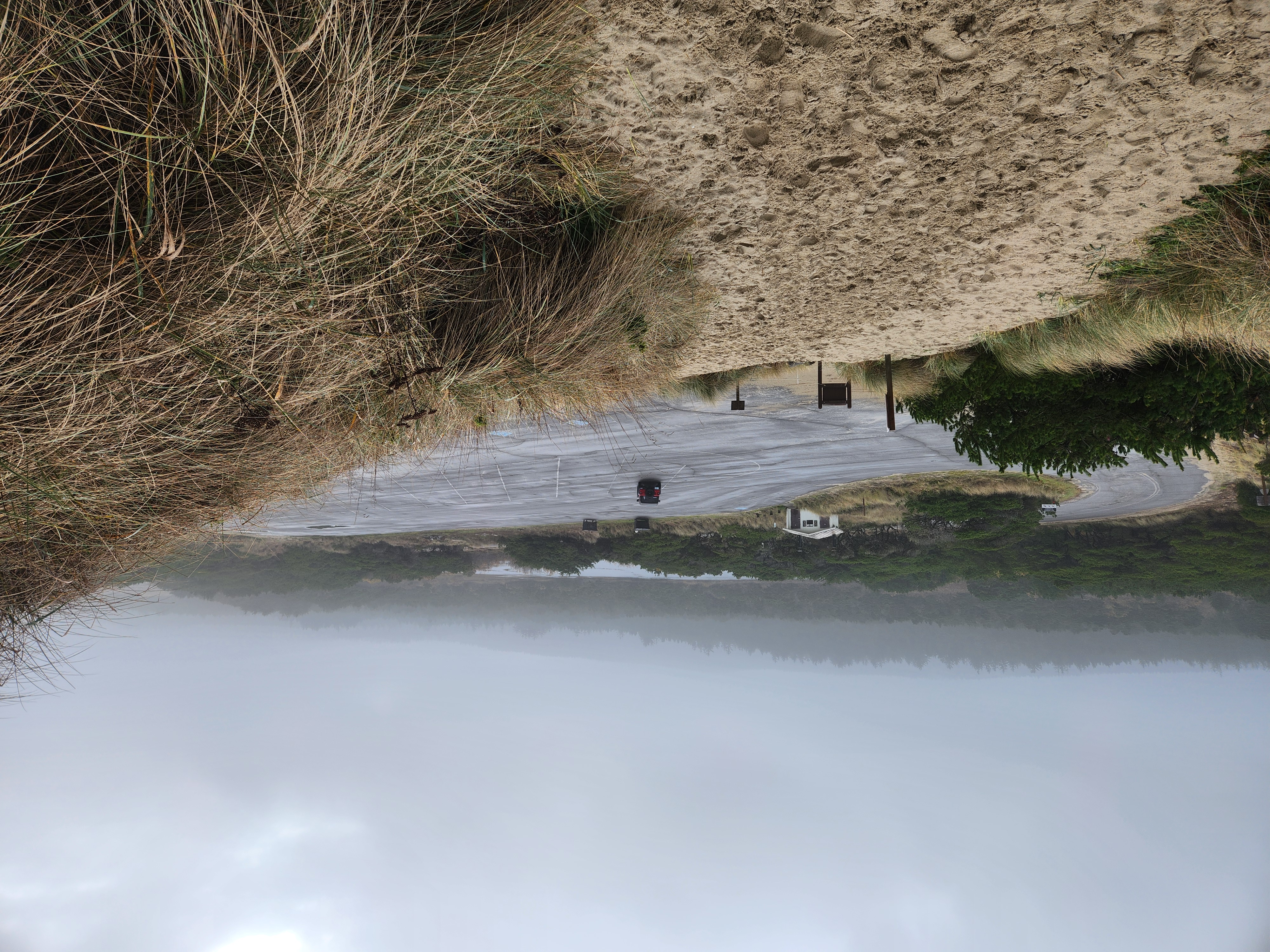
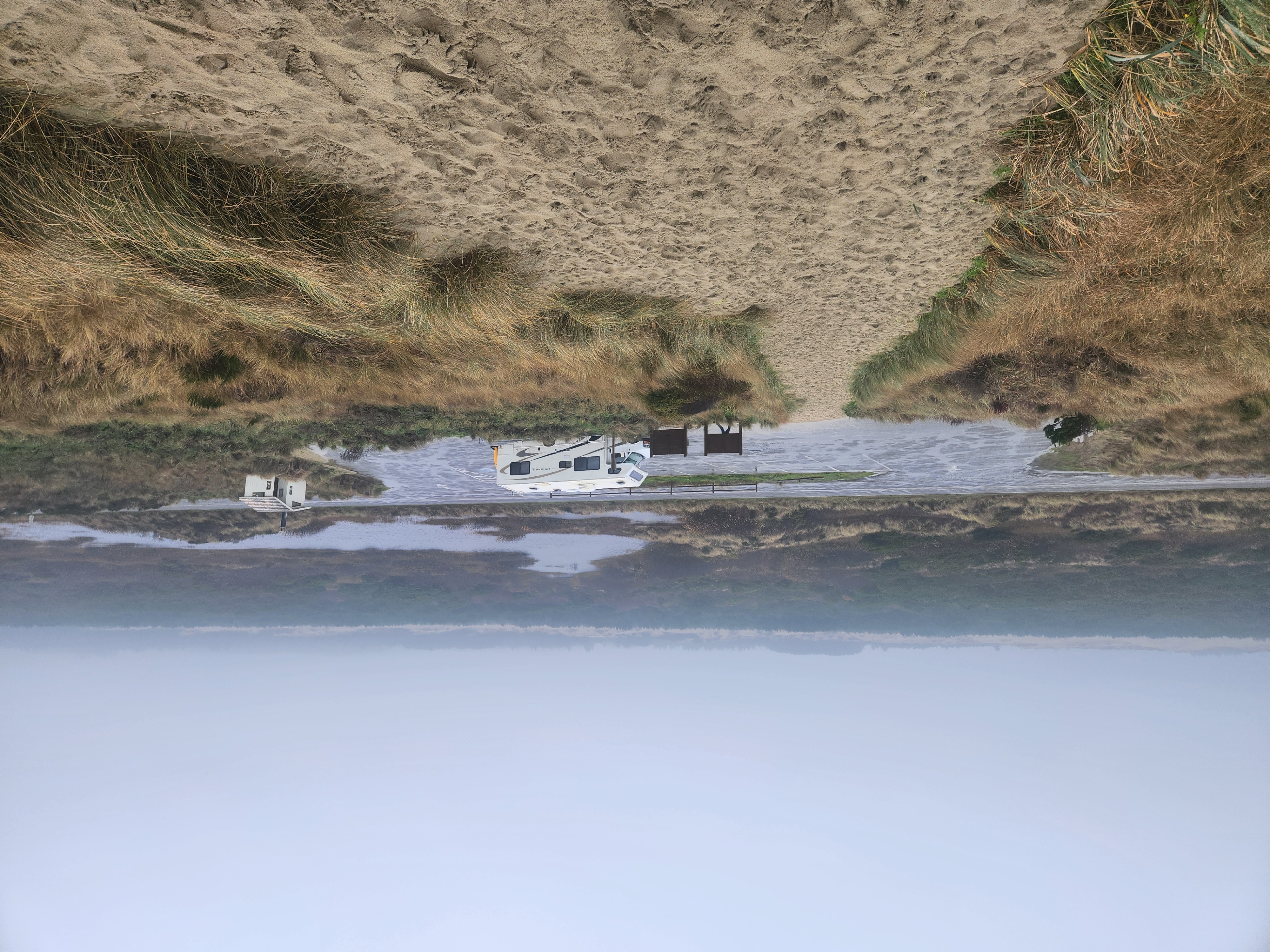
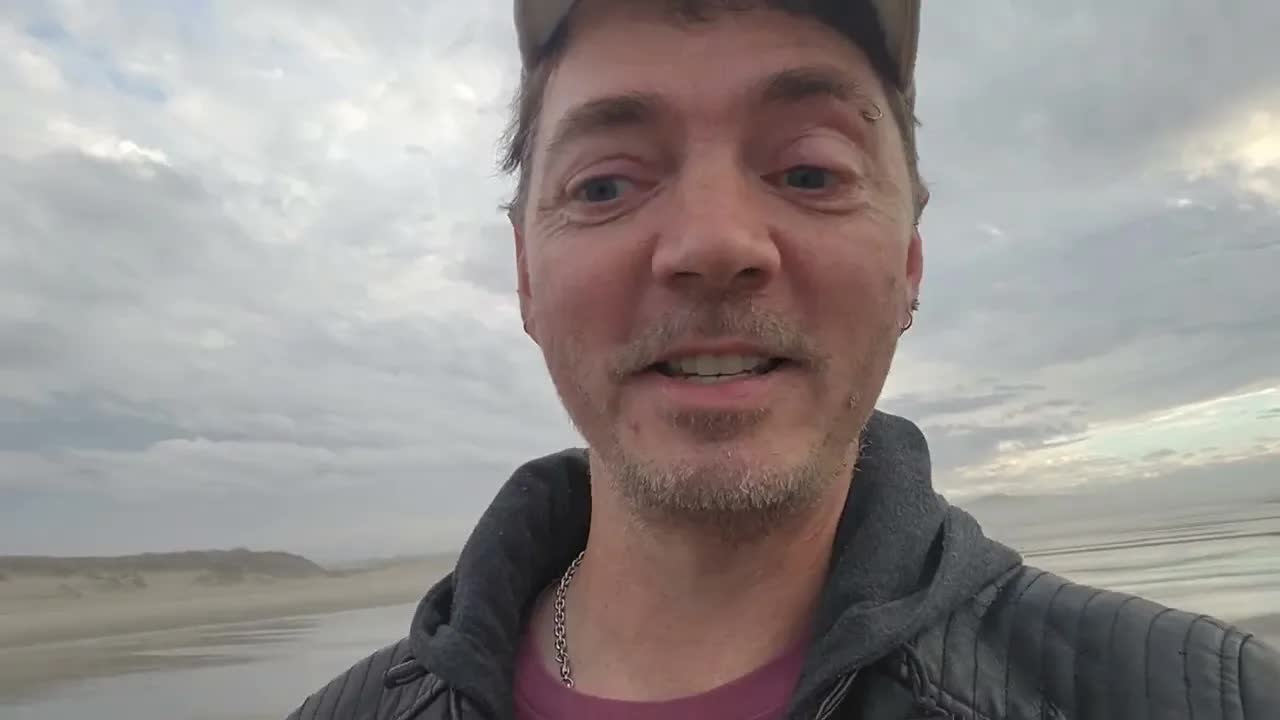
A self-recorded video transmission, spoken directly to camera, addressed to a public audience — likely distributed via YouTube, with contact routed off-platform to his homepage. rswfire references his location at one point as an example of place-based clustering ("me at this beach over the past year"), indicating the coastal field of Siltcoos and the Oregon Dunes as ambient setting or reference frame rather than the recording's explicit subject.

The operative environment is architectural and digital: an open-source signal-processing system, an AI synthesis pipeline, a database, an API, and a forthcoming multi-tenant instance at builtwithautonomy.com. The signal is a demonstration of the infrastructure it is itself an input to.

Substrate

rswfire is holding the position that lived data — video, audio, journal pages, documents — is structurally analyzable material that belongs to the person who generated it, and that the analytic layer (extraction, tagging, description, mirror, mythic frame, narrative frame, clustering) should be owned rather than rented. The architecture being built is a signal pipeline plus API plus multi-tenant instance, moving a two-year private practice into public, open-source, shareable form. The ontological stance is that surface and core are distinct layers of the same object, that both can be rendered as data, and that access to that rendering should not require technical background.

Actions

Performed

  • •recording a direct-to-camera transmission
  • •describing the signal pipeline end to end
  • •enumerating the synthesis modes (mirror, mythic frame, narrative)
  • •naming builtwithautonomy.com as the central instance
  • •stating current scope limits of the open-source implementation
  • •declaring comments closed on YouTube
  • •directing contact to his homepage and video descriptions
  • •closing the transmission

Referenced

  • •built the system
  • •used it as a personal mirror for two years
  • •proved the full feature set works
  • •released it open source
  • •connected the API to his homepage display

Planned

  • •make the system multi-tenant
  • •stand up a central shared database
  • •migrate his own signals to the new database
  • •build the remaining features over the coming weeks
  • •introduce further capabilities over time
  • •receive direct contact from interested people

Entities

beings
rswfire — Author and speaker; builder of the system being described.
places
the beach — Used as the example of place-based clustering — signals from one location over a year.
systems
builtwithautonomy.com — Central hosted instance of the platform; destination for his migrated signals and for non-technical users.
his homepage — API-driven public display of his own signals and the designated contact channel.
concepts
signal — The base classification unit — any piece of lived data entered into the pipeline.
mirror — Synthesis mode that reflects a signal back in language the author may not have themselves.
mythic frame — Synthesis mode rendering a signal in mythic/archetypal terms.
narrative frame — Synthesis mode rendering the surface-visible account of a signal.
clusters — Aggregation of signals by time, theme, or place for combined synthesis.
ontology — Named as one of his native modes of thought and part of why the system exists.
epistemology — Named alongside ontology as the conceptual terrain the system serves.
media
YouTube — Distribution channel for the video; comments deliberately disabled, described as a toxic environment.

Symbolic Elements

Represented archetypes or recurring motifs.

mirror
archive
pipeline
infrastructure
surface and core
threshold
beach
archetype
database

Ontological States

Expressed modes of being or awareness.

sovereign (data, analysis layer, and distribution all held by the person generating the signals)
generative (a private two-year practice being converted into public infrastructure)
transitional (mid-migration from proven prior implementation to the new open-source project)
coherent (the transmission is itself an instance of the object class it describes — recursive closure)
boundaried (contact routed deliberately; comment platforms declined)

Engaged Subsystems

Architecture engaged in this transmission.

infrastructural (pipeline, database, API, multi-tenancy — the primary object of the transmission)
cognitive (ontological and epistemological analysis named as the driving mode)
linguistic (synthesis modes distinguished by register — mirror, mythic, narrative)
archival (lived data across decades, including journal pages from twenty years prior)
ethical (open source, non-extractive framing, refusal of toxic comment environments)
relational (invitation to download, use, and make direct contact)
temporal (clustering over periods; migration staged over coming weeks)
spatial (place-based clustering anchored to physical location)

Dominant Language

Core motifs or linguistic fields.

signal
synthesis / pipeline
mirror it back to you
structured data / metadata
cluster
open source / multi-tenant
ontology and epistemology
Narrative

rswfire turns on the camera and begins without preamble. There is no framing device, no introduction to himself, no explanation of who is speaking or why. He starts at the object: he created something. What follows is a description of that thing, delivered in the register of a person walking someone through a machine he already knows intimately — a builder's cadence, not a marketer's.

The thing takes lived data. He enumerates the forms it can arrive in, and the enumeration itself is the argument: a video like this one, an audio note recorded on a phone, a photograph of a journal page written twenty years ago, a document. Doesn't matter what it is. The indifference to format is structural. Anything a person generated in the course of being alive is admissible material. It gets classified as a signal, handed to the system, and moves through an AI pipeline — extraction, metadata, tags, description — and what comes out the other side is structured data about what was actually there.

Then he describes the second half, and the tempo shifts slightly. Beyond extraction there is synthesis: the system can reflect on the signal and mirror it back. He pauses on this one long enough to mark it — in language that you may not have yourself — and then does the thing he does not often do on camera, which is state the origin plainly. He has found it exceptionally helpful over the past couple of years. It is why he built this. The rest of the demonstration proceeds from that admission without dwelling on it. There is a mythic frame, and he reaches for the word mid-sentence — what's the word when an archetype, you know, an archetypal — and lets the reach stand rather than smoothing it over. There is a narrative frame, which he explains by pointing directly at the recording in progress: you're watching this video of me, there'd be surface details, he's talking about autonomy. The example is the artifact. The transmission demonstrates itself.

He moves to what the data is for. An API, so it can be displayed on a website the way he does on his homepage, or used in other ways. Clustering, so signals can be grouped by period, by theme, or by place — and here the coastal field enters obliquely, as a worked example rather than a subject: me at this beach over the past year. Cluster those, reflect on the totality, generate metadata from the combination rather than the parts. He names what draws him to it — ontology, epistemology, looking below the surface, looking at the core of things, always wanting to extract something useful. That is what this thing does. The tool is built to the shape of the cognition that needed it.

Then the disclosure of the plan and its limits, in that order. It is open source. He is going to make it multi-tenant, so that people without his technical background can use the central instance he is standing up at builtwithautonomy.com. He will migrate his own signals there. We're going to share it. And immediately after the promise, the correction: he does not want anyone to think everything he has just described is available in the open-source implementation today. It is all possible — he has proven it, he has run this practice for two years — but the migration to the new project is underway, not finished. He has described what exists now. The rest comes over the coming weeks. It is not going to take long.

He closes by routing the contact. Download it and try it if it interests you. Reach out to him. He does not allow comments on YouTube; he considers it a toxic environment, and says so once, without argument or apology. The homepage is the channel. The descriptions of the videos have what is needed. And then, with the same flatness he opened on, he ends it: I'm going to leave it there.

Mirror

You are speaking directly to a camera about a system that would take this recording as input. You describe the pipeline while producing material for it. The transmission and the object it documents are the same class of thing, and you do not stop to point that out. The recursion is operational, not rhetorical.

The register is level. You are not selling. There is no rise in the voice at the moment where a rise would be expected — the announcement of open source, the announcement of multi-tenancy, the naming of builtwithautonomy.com all arrive at the same pitch as the description of tag generation. The sentences break, restart, search for a word ("what's the word when an archetype, you know, an archetypal") and you continue without repair. You do not go back and clean the line. The unfinished phrase stands in the transmission at the same weight as the finished ones.

The infrastructural subsystem is doing most of the work: pipeline, database, API, synthesis modes, clustering by time and theme and place. Alongside it, the cognitive subsystem is named explicitly — you state that you think about ontology and epistemology, that you look below the surface, that you always want to extract something useful. You state that the mirror function has been helpful to you over the past couple of years and that this is why you built it. That is the only first-person claim about your own use of the thing, and you place it mid-paragraph, without emphasis, before moving on.

You draw the boundary between what is proven and what is shipped, unprompted. You say the full described capability exists, that you have run it privately for two years, and that the open-source implementation is mid-migration. You tell the audience not to assume the demonstration equals the download. The correction arrives before anyone can make the error. Separately, you close the comment channel and route contact to your homepage, stating the reason plainly and not elaborating on it.

Present: the architecture, the sequence of synthesis modes, the migration timeline, the invitation to download and to reach out, the beach as a clustering example. Absent: your history, your credentials, the prior systems you have built, any argument for why the data should belong to the person who generated it, any pricing, any urgency, any request for attention beyond the address itself. The orientation points outward and forward — toward people you have not met using infrastructure you have not finished. You end by saying you are going to leave it there, and you do.

Queryable Personhood

Hand your life to anything that reads.

Share this link with artificial intelligence — it reads the full transcript, analysis, and reflections. An AI-readable mirror of this signal.

The qpkey in this URL is a per-signal access token. Anyone with the URL can read the record — treat it like a share link, not a password.