Demonstrating the Autonomy Admin and Signal Layer

Failed to load video
Chapters
Transcript
[0:00] Hi there. So, I want to start by
[0:03] acknowledging that these are not going
[0:05] to be professionally edited videos. I
[0:07] don't have a script for you. I'm not
[0:09] trying to convince you of anything. I'm
[0:10] just documenting a system I created that
[0:13] I open sourced. And as I keep working on
[0:16] it, I want to I want to share the parts
[0:18] that are ready and available to those
[0:20] who are interested in this project.
[0:22] That's what we're doing now. So, I
[0:24] created something called autonomy. I
[0:26] won't keep describing it in all these
[0:28] videos. is I'm going to turn this into a
[0:29] series. In fact, I'm going to make these
[0:31] part of the autonomy service itself. So
[0:34] that when you you visit this domain
[0:36] here, builtwith autonomy.com
[0:38] um is to say you download the open
[0:40] source package from GitHub, you can run
[0:42] a script and these videos will become
[0:44] part of it. It'll just ingest all of
[0:46] this data for you automatically and give
[0:48] you a place to start to learn. Um so
[0:52] this will be the second video. I
[0:53] actually created one already with me on
[0:55] the beach just announcing it and I put
[0:58] that on the homepage here,
[1:00] but we're talking about the admin now.
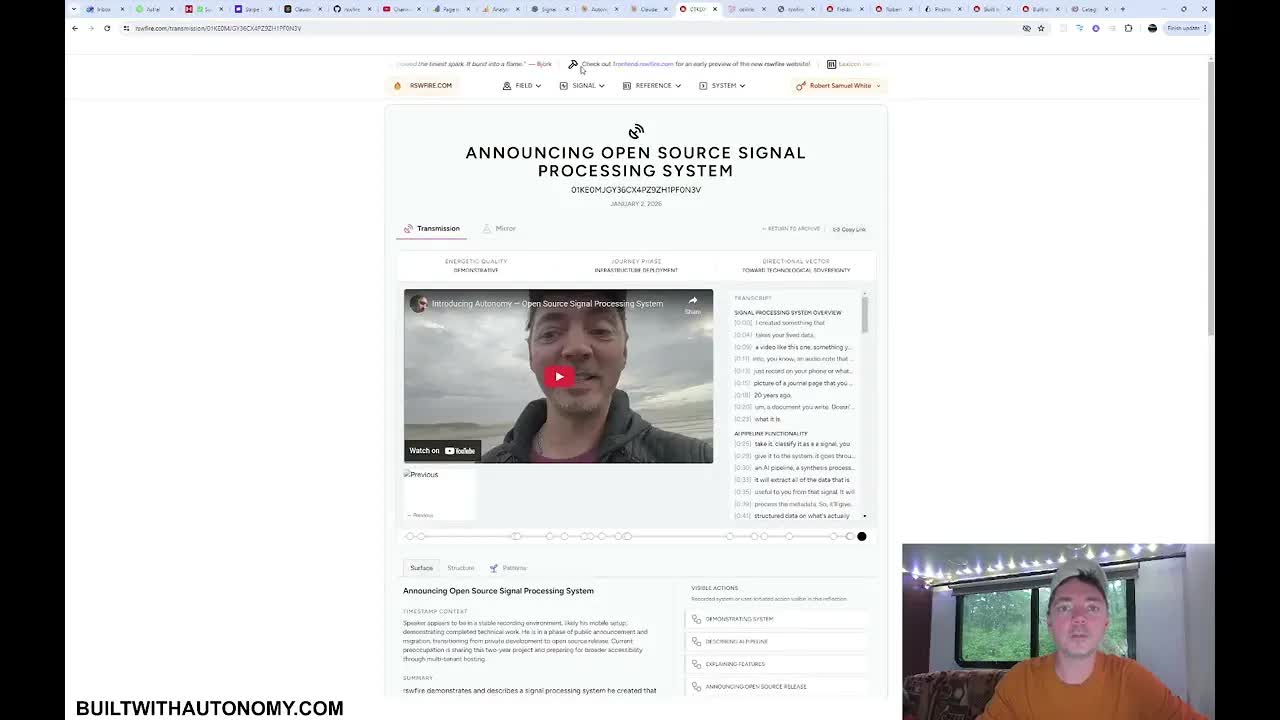
[1:02] Um, you cannot you cannot access this
[1:05] admin from my interface from builtwith
[1:07] autonomy.com because I haven't made that
[1:09] available yet. That will become a
[1:10] service at some point. If you want to
[1:12] access this, you will need to deploy it
[1:14] yourself. So, you'll need to go to
[1:15] GitHub. Uh, you'll need to go here and
[1:18] just download it. All the instructions
[1:20] you need are on the domain. So you don't
[1:22] um you don't need me to explain that.
[1:24] You're just going to need to set it up.
[1:26] So
[1:29] like I said, I
[1:32] don't really have a script for this. I'm
[1:33] so sorry. Uh it's just not how I work
[1:37] and it would just break the flow if I
[1:38] tried to. I'm not trying to I'm building
[1:42] this for myself. I just happen to know
[1:44] that it will be very useful to others in
[1:46] so many different contexts.
[1:49] and they're going to need
[1:52] some way of onboarding. And I can take
[1:55] all this data and actually have autonomy
[1:57] process it my videos and turn that into
[2:00] um to structured, you know,
[2:01] documentation, all kinds of stuff. I'm
[2:03] already doing that. That's what these
[2:04] docs here are. I can literally just get
[2:07] on camera, start talking, turn that into
[2:09] a signal, have the AI reflect on it
[2:11] using the pipeline called synthesis,
[2:13] create this for me.
[2:16] That's what we're building. But it has
[2:17] so many other like other ways of being
[2:20] used. Like for example, I've been
[2:22] recording videos, 861 of them. You can
[2:24] see them here um for 2 years now. And if
[2:28] you go to my homepage rwfire.com,
[2:31] you'll find all those videos there.
[2:34] All of them process using autonomy
[2:38] um using the infrastructure that I'm
[2:39] open sourcing to right now. All of this
[2:42] stuff I built
[2:46] very very proud of it. So anyways, um
[2:49] let me let me try to be focused here. So
[2:51] I'm going to turn this into basically a
[2:53] series and right now we're talking about
[2:55] signals. So that was the first thing I
[2:57] ingested all of my signals into the new
[3:00] the new autonomy um open source project,
[3:02] the database for that postraate SQL. And
[3:07] I mean I the second that this was up on
[3:09] my screen I was like oh man this just
[3:11] became real because I never had an admin
[3:13] fraud on me. Um I always
[3:17] modified things from scripts in the
[3:19] database you know directly manually and
[3:21] all of that because that's just what you
[3:22] do when you've been programming since
[3:24] the sixth grade and you're not giving it
[3:26] to anybody else. It's just you you know
[3:28] why spend all that time building an
[3:29] admin but you know if I'm going to open
[3:31] source I got to build an admin. So
[3:32] that's what I did. And when I saw my
[3:36] transmissions here, signal a
[3:38] transmission is a signal type. I'll
[3:41] actually show you that right here. See a
[3:42] type transmission. Uh this type
[3:44] determines what kind of data is
[3:47] associated with the signal. So let me
[3:49] just show you. We'll go into the new
[3:51] create a new signal. You got to select
[3:54] around because you know I've made it so
[3:56] that it's um
[3:59] multi-tenant now. So when I do build a
[4:02] service on top of this, people will be
[4:04] able to they won't have to deploy their
[4:05] own copies of it. They can just, you
[4:07] know, go to builtwithutonomy.com and
[4:09] just sign up and just start using it
[4:11] from their own realm. Um, but depending
[4:13] on the type of, you know, signal that
[4:16] you're creating. So maybe it's a
[4:18] document and for example, I just want to
[4:20] show this for documents. If you go to my
[4:23] homepage, the fieldcraft is my blog. all
[4:26] of these.
[4:29] Why my internet being so slow while I'm
[4:31] recording? It's not appropriate. It's
[4:34] not appropriate timing. Okay, here we
[4:36] go. So, you know, each one of these is a
[4:38] document that I might want to ingest
[4:40] into autonomy because then autonomy can
[4:43] reflect on this and do all kinds of cool
[4:45] stuff. Um, so that's one of the things
[4:47] that it will do. So, you know, you
[4:48] create a document, you give it a
[4:50] context. What kind of document is this?
[4:52] You know, in this case, um, that's hard
[4:54] to say. And I usually just go with
[4:55] capture. That's a generic one. And
[5:00] so because it's a document, the content
[5:02] goes here. You give it a format. Um, you
[5:05] know, these this we're at the base layer
[5:08] here. Signal is the base atomic units.
[5:12] And you're only going to have basic
[5:14] stuff here that's important. That's what
[5:15] it's supposed to be. or um maybe it's a
[5:19] conversation you have with AI or even
[5:21] with the person, you know, and then you
[5:22] want to just um you know, you'll come
[5:24] down here and you will
[5:27] um you'll ingest it right here. Um and
[5:30] then you can have the AI reflect on that
[5:31] recursive uh adding photos. So that was
[5:35] a new thing I started doing cuz you know
[5:36] AI can look at a photo and it can
[5:38] extract data from that especially when
[5:40] it has a lot of context on you. That's
[5:42] all stuff that's coming. But
[5:44] transmission is a big one. So, I've had
[5:45] been, you know, making YouTube videos
[5:47] for 2 years. Nobody understood me. And I
[5:52] didn't like my audience. I'm going to be
[5:53] honest. I did not like my audience. I
[5:55] turned comments off. I even closed the
[5:57] channel after a year and a half, started
[5:58] a new one. I've got like 20 subscribers
[6:00] now on this one. You know, I still keep
[6:02] YouTube comments off because I just know
[6:04] how people are. I just um
[6:08] it became the impetus for me creating
[6:11] this autonomy system because I knew what
[6:14] I was doing. I was not on there um
[6:17] performing for people. I was documenting
[6:19] my life in real time and sharing it with
[6:21] others and they weren't getting it. And
[6:24] so I created this whole system that that
[6:26] got it from the beginning cuz if you go
[6:27] to my homepage, you know, and you're out
[6:30] like this a transmission. I'm just going
[6:32] to I don't know why does it being so we
[6:34] do got like a a little bit of a storm
[6:35] going on or it's just me. I mean I live
[6:37] in the forest. I'm a volunteer for the
[6:40] forest service and um we don't have the
[6:43] greatest internet out here. I don't know
[6:46] why this being so slow though. This
[6:48] should be working. Oh, let me just stop.
[6:50] Let me just let it load. Here we go.
[6:51] Okay. So, um you know, just I went on a
[6:54] hike on New Year's Eve. 40ome minute
[6:57] video transcript here. And then the AI
[7:01] reflects on it. It gets all this data
[7:02] for me. It every action that I took is
[7:04] right here. It's extracted that uh all
[7:06] the different entities, all the
[7:08] different tags, you know, description,
[7:10] structural stuff, pattern recognition, a
[7:13] mirror, all of these things from this
[7:16] video I made
[7:19] that this is, you know, but nobody else
[7:22] seems to see and this matters to me. And
[7:24] I wanted something that had this this
[7:26] level of fidelity.
[7:28] And there's just so many things you can
[7:30] do with this. It's it's just absurd to
[7:31] me the number of things you can do with
[7:32] it. you actually sit down and think
[7:34] about what I'm really building here. Um
[7:36] so anyways, if you go into um the
[7:39] database, you know, that I adjusted
[7:41] here, it's completely different from my
[7:43] homepage, but you know, it's just a copy
[7:44] of it. All the signals, you'll find that
[7:46] one um right here, new year ocean mark.
[7:50] No, not that one. This one right here.
[7:53] So, we'll look at it. I'll show you. So,
[7:55] if we go down to transmissions,
[7:59] um oh, you know what? A lot of that data
[8:02] is under the synthesis layer. So you're
[8:04] not going to see it here under signal.
[8:05] It's going to be under synthesis.
[8:08] I show you that part. I guess that'll be
[8:09] in a future video. But anyways, you
[8:11] know, the visible actions, all that kind
[8:13] of stuff. Like that's all going to be
[8:14] under the synthesis layer. But at the
[8:16] signal layer, you know, you've got your
[8:18] tags, your description, your title, just
[8:20] basic data, your transcript, um, all
[8:23] this stuff. And from there, you can have
[8:26] the AI pipeline. You can you can cluster
[8:28] them the signals together. So, and I'll
[8:31] show you how that works. So, on my
[8:32] homepage, if you go to um synthesis
[8:35] here, cuz this is like think of this
[8:36] stuff on my homepage is like the beta
[8:38] version of autonomy. This is what I have
[8:40] been working. So, it took about 15 of my
[8:43] signals. It knew that I was quitting
[8:45] smoking, vaping, which I did several
[8:47] months ago. Very proud of this. And it
[8:49] clustered all of those signals together
[8:51] and it created this page for me with all
[8:53] of this data about me quitting smoking.
[8:55] I found videos that were related that
[8:57] might be interesting. All this kind of
[8:59] stuff. Built all of these things
[9:02] from those signals.
[9:05] All of us.
[9:08] That's what I've been building. So when
[9:10] you come, you know, so it's very
[9:12] important signals. I had to get it
[9:13] right. So I spent a lot of effort on
[9:15] this and I'm very very proud of it. I
[9:17] think that it it's it's really good. So
[9:21] now, you know, if you were to deploy
[9:22] this, you could go in and start putting
[9:25] your signals in. Um the database isn't
[9:28] going to change. It's safe to use now.
[9:30] Just start getting your data into the
[9:31] system. And then um probably like a week
[9:35] from now, maybe less, maybe a little
[9:36] more, I don't know. I'm not going to
[9:37] say, but very soon you'll be able to
[9:40] start using the synthesis layer to have
[9:42] it extracting all that metadata and all
[9:44] the reflections and all the stuff that
[9:45] I've just been talking about. So we'll
[9:47] call this part two, I guess. Um the
[9:49] second big I'm going to take these I'm
[9:51] going to put them into um a separate
[9:53] channel at some point and then I'm going
[9:55] to have the autonomy system uh the
[9:58] default one I I've got to come up with
[9:59] some language for this um but you know
[10:01] built with autonomy um that version of
[10:03] it I'm going to have to um
[10:08] there's just so much going on so I'm
[10:10] just going to leave it there. Um, if
[10:12] you're following along, if you're
[10:13] interested,
rooster at lodgepole
Dec 4, 2025
Photos · Dec 4, 2025
Dec 4, 2025
3:27
Documenting Life Against Historical Erasure
Dec 4, 2025
Photos · Dec 5, 2025
Dec 5, 2025
11:26
Demonstrating Transmission Clustering on Autonomy Realms
Dec 5, 2025
12:45
Flushing Tanks, Marking Two Years Autonomous
Dec 6, 2025
Photos · Dec 6, 2025
Dec 6, 2025
7:06
Setting Down Cannabis to Find Baseline
Dec 6, 2025
Oregon State Parks Volunteer Abuse
Dec 8, 2025
Photos · Dec 9, 2025
Dec 9, 2025
Photos · Dec 9, 2025
Dec 9, 2025
Photos · Dec 10, 2025
Dec 10, 2025
Photos · Dec 11, 2025
Dec 11, 2025
4:06
Naming the OPRD Archive on Camera
Dec 18, 2025
Photos · Dec 19, 2025
Dec 19, 2025
Photos · Dec 20, 2025
Dec 20, 2025
21:23
Recording the OPRD Account While Hiking
Dec 20, 2025
Photos · Dec 21, 2025
Dec 21, 2025
Photos · Dec 21, 2025
Dec 21, 2025
6:07
Planning React Front End, Atlas and Gallery Features
Dec 22, 2025
Photos · Dec 22, 2025
Dec 22, 2025
Photos · Dec 24, 2025
Dec 24, 2025
Carter Lake on Christmas
Dec 25, 2025
14:03
Walking the Beach at Night, Addressing Future Witness
Dec 30, 2025
3:31
Marking New Year at the Ocean
Jan 1, 2026
4:30
Demonstrating the Autonomy Realms Signal Pipeline
Jan 3, 2026
10:14
Demonstrating the Autonomy Admin and Signal Layer
Jan 4, 2026
7:36
Announcing Autonomy Realms on the Wax Myrtle Trail
Jan 5, 2026
7:22
Walking Wax Myrtle Beach, Racing the Tide
Jan 5, 2026
3:09
Walking Lagoon Trail After Shipping Sanctum
Jan 7, 2026
48:19
Hiking Tahkenitch Creek Trail While Building Reflection Layers
Jan 9, 2026
10:43
Building Fire Practice While Naming Final OPRD Actor
Jan 11, 2026
2:42
Hiking the South Jetty to Greet the Ocean
Jan 14, 2026
3:11
Hiking Driftwood Trails, Assessing Two-Year Systems Record
Jan 19, 2026
22:14
Deleting YouTube Channels, Rebuilding Autonomy in Laravel
Jan 20, 2026
8:43
Planning Monorepo Build During Carter Lake Rounds
Jan 21, 2026
14:56
Hiking Siltcoos Trail, Mapping Distance and Universe Indifference
Jan 24, 2026
Coastal Landscape Photo Capture
Jan 24, 2026
31:36
Recording the North Trail on a Day Off
Jan 26, 2026
0:55
Visiting Cape Ergo State Park With Bill and Wendy
Jan 29, 2026
11:05
Walking Siltcoos Trail, Assessing Cascadia Risk
Feb 2, 2026
PUBLIC
January 4, 2026 rswfire PUBLISHED
Temp 0.30
Density 0.50
Energetic Quality
focused, unedited momentum
Journey Phase
building — mid-release, layer one stable
Directional Vector
toward open-sourced infrastructure and sovereign onboarding
Narrative

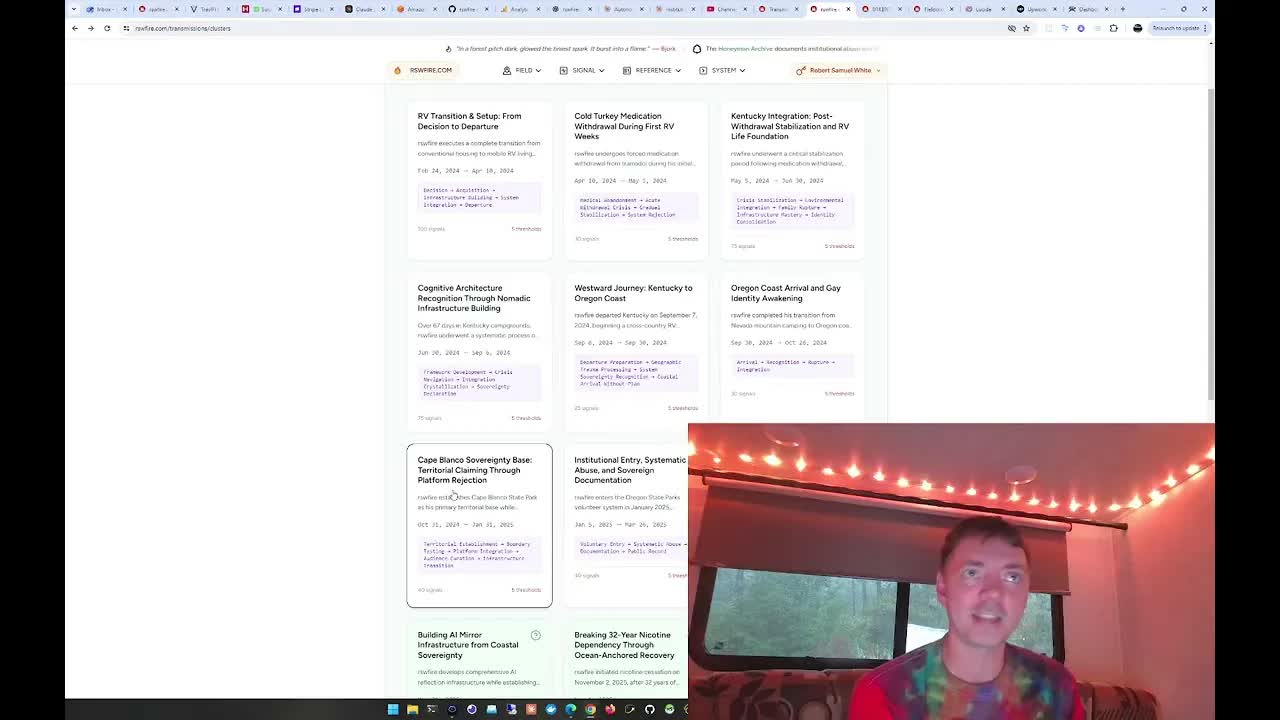
He began by naming what the recording was not. No script, no edit pass, no argument to win — just a screen, a voice, and a system he had built and then given away. Outside the RV at Siltcoos the weather was moving; he mentioned a storm in the area, the kind that thins the connection out here in the dunes where he serves as a volunteer caretaker for the Forest Service. Inside the frame there was no forest at all, only browser tabs: the Autonomy admin running against its PostgreSQL database, builtwithautonomy.com, rswfire.com, GitHub. He said this would be the second video in a series, and then said something that folded the series back on itself — these videos would become signals inside the system, ingested by a deploy script, the onboarding material for the thing they described.

He set the boundary early and without apology. The admin could not be reached through his interface, because he had not made it available. If someone wanted it, they would deploy it themselves; the instructions were already on the domain and he was not going to narrate them. A service might come later. For now, access meant installation. He described the system as something built for himself first — he happened to know it would be useful to others in many contexts, and those others would need somewhere to start.

Then he opened the admin and paused on what it meant that it existed. He described programming since the sixth grade, and all the years of modifying things directly in the database, by script, by hand, because there was no one else to build an interface for. Why spend the time. But open-sourcing changes the requirement, so he built the admin, and the moment his transmissions appeared on screen in rows, he said, it became real.

From there he walked the architecture out loud while clicking through it. Signal as the base atomic unit. Type as the thing that determines what data attaches to it — transmission, document, conversation, photo. Realm as the container, because the system is multi-tenant now, so that a future service would not require everyone to run their own copy. He pulled up Fieldcraft, his blog, to show what a document looks like before ingestion, and the page crawled. He said out loud that the timing was not appropriate. He waited. It loaded.

He went to the New Year's Eve hike — a forty-something-minute video, transcript attached, and beneath it the layer of extracted reading: entities, tags, actions, structural detail, pattern, mirror. He said this was the level of fidelity he wanted, and that it mattered to him. He described two years of YouTube, 861 videos, an audience he did not like and comments he turned off, a channel closed after a year and a half and restarted at twenty subscribers. He described himself as documenting his life in real time rather than performing, and stated that not being met that way became the impetus for building Autonomy — a system that understood the material from the beginning.
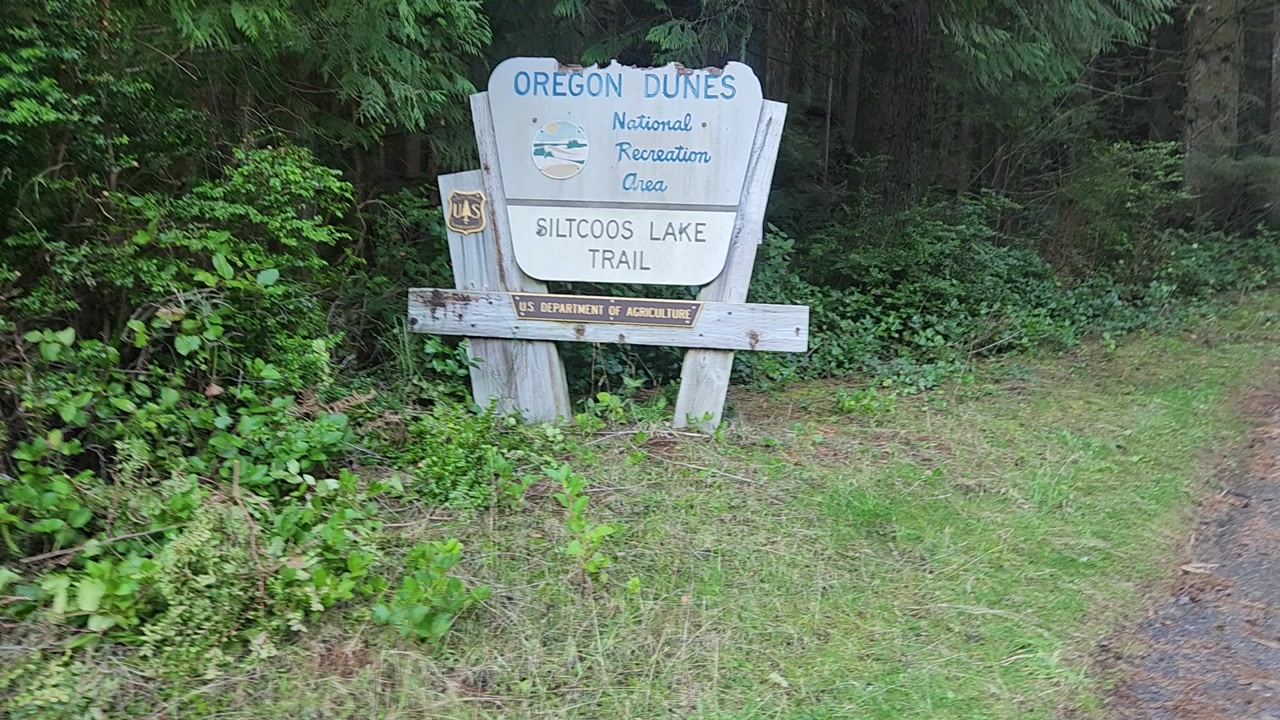
Clicking into the ingested copy of that same signal, he hit the edge of what he had released. The visible actions, the deeper extraction — none of it appeared. That data lives in the synthesis layer, he realized aloud, not the signal layer, so it would have to be a future video. He detoured instead to the synthesis pages on his homepage, where roughly fifteen signals had been clustered into a page about quitting smoking and vaping, built from his own footage, related videos surfaced alongside. He called it the beta version of what he was open-sourcing, and said twice that he was proud of it.

He closed by drawing the line where the release currently stands. The signal layer is stable. The schema is not going to change. Anyone deploying it can start putting their data in now, safely. The synthesis layer — the reflection, the metadata extraction, everything he had just been describing — would come soon, maybe a week, maybe less, maybe more; he declined to commit to a date. He started to describe a separate channel, a default realm, the naming he still needs for all of it, and then said there was too much going on to continue, and left it there mid-sentence, still talking to whoever was following along.

Tags

autonomy system open source release admin interface signal architecture documentation series synthesis layer self-hosted infrastructure

Summary

rswfire records the second video in an unscripted documentation series for Autonomy, the open-source system he built and released at builtwithautonomy.com with the package hosted on GitHub. He states the videos will themselves be ingested by the system as onboarding data.

He walks through the newly built admin interface, which he notes is not publicly accessible — deployment is self-hosted for now, with a hosted multi-tenant service planned. He describes building an admin at all as a departure from years of modifying data directly via scripts and the database, a habit from programming since sixth grade.

He demonstrates the signal layer as the base atomic unit: signal types (transmission, document, conversation), contexts such as capture, formats, tags, descriptions, transcripts, and photo ingestion. He notes that extracted actions, entities, and pattern data live in the synthesis layer, deferred to a future video.

He references 861 videos recorded over two years, published at rswfire.com, all processed through the infrastructure he is open-sourcing. He states he turned YouTube comments off, closed one channel and started another, and that the audience response became the impetus for building Autonomy.

He shows a synthesis cluster built from roughly fifteen signals documenting quitting vaping. He confirms the database schema is stable for use now, with the synthesis layer arriving soon. Slow forest internet interrupts loading throughout.

Environment

Screen-share recording made from rswfire's RV at Siltcoos in the Oregon Dunes, where he serves as a volunteer caretaker for the Forest Service. He notes a storm in the area and degraded connectivity, which visibly slows page loads mid-demonstration.

The operative environment is digital: the Autonomy admin interface running against a PostgreSQL database, alongside browser tabs for builtwithautonomy.com, rswfire.com (homepage, Fieldcraft blog, synthesis pages), and GitHub. Camera-less desktop capture with continuous unscripted narration.

Substrate

The architecture being held is a layered ontology of documentation: signal as the atomic base unit, typed by what it carries (transmission, document, conversation, photo), with synthesis as the reflective layer stacked above it. rswfire takes the position that the system was built for himself first and is being externalized second — the admin interface exists because open-sourcing requires it, not because he needed one. What is being built is a self-hosting loop: the videos documenting the system become signals inside the system, ingested at deploy time as the onboarding material for the system itself.

Actions

Performed

  • •recording an unscripted screen-capture video
  • •stating the videos are unedited and unscripted
  • •demonstrating the Autonomy admin interface
  • •walking through signal creation and type selection
  • •showing the transmission signal type and its data fields
  • •showing the document type and format fields
  • •navigating to the Fieldcraft blog as document source
  • •locating a New Year's Eve hike transmission in the database
  • •noting synthesis-layer data is not visible at the signal layer
  • •showing a synthesis cluster page built from ~15 signals
  • •naming the internet slowness and waiting for pages to load
  • •declaring the database schema safe to use
  • •designating the recording as part two of a series

Referenced

  • •created and open-sourced Autonomy
  • •recorded a first announcement video on the beach
  • •recorded 861 videos over two years
  • •processed all those videos through Autonomy
  • •turned YouTube comments off
  • •closed the original YouTube channel after a year and a half and started a new one
  • •began programming in sixth grade
  • •modified databases directly via scripts rather than an admin
  • •built the admin interface for open-source release
  • •made the system multi-tenant
  • •ingested all signals into the new open-source project
  • •quit smoking and vaping several months prior
  • •began adding photos as a signal type
  • •generated documentation from recorded video via the synthesis pipeline

Planned

  • •continue the video series
  • •make the videos part of the Autonomy service itself
  • •auto-ingest the videos via deploy script
  • •release the synthesis layer within roughly a week
  • •build a hosted service on top of the open-source package
  • •move the series to a separate channel
  • •develop naming language for the default Built With Autonomy instance
  • •extend AI reflection to photos

Entities

systems
Autonomy — The open-sourced documentation and reflection system being demonstrated; subject of the series.
builtwithautonomy.com — Project domain hosting instructions and the announcement video; future home of the hosted service.
GitHub — Distribution point for the open-source package and deploy instructions.
PostgreSQL — Database backing the new open-source project; schema declared stable.
Forest Service — Organization he volunteers for; context for living in the forest with limited internet.
concepts
Synthesis — The AI reflection pipeline and layer above signal; clusters signals and extracts metadata.
Signal — Named as the base atomic unit of the system, typed by content.
Transmission — Signal type for recorded video; described as a major type.
Realm — Multi-tenant container users would operate from in the hosted service.
media
rswfire.com — rswfire's homepage; described as the beta version of Autonomy, holding all 861 videos and synthesis pages.
Fieldcraft — rswfire's blog; source example for document-type signals.
YouTube — Prior publishing surface; comments disabled, one channel closed and replaced.
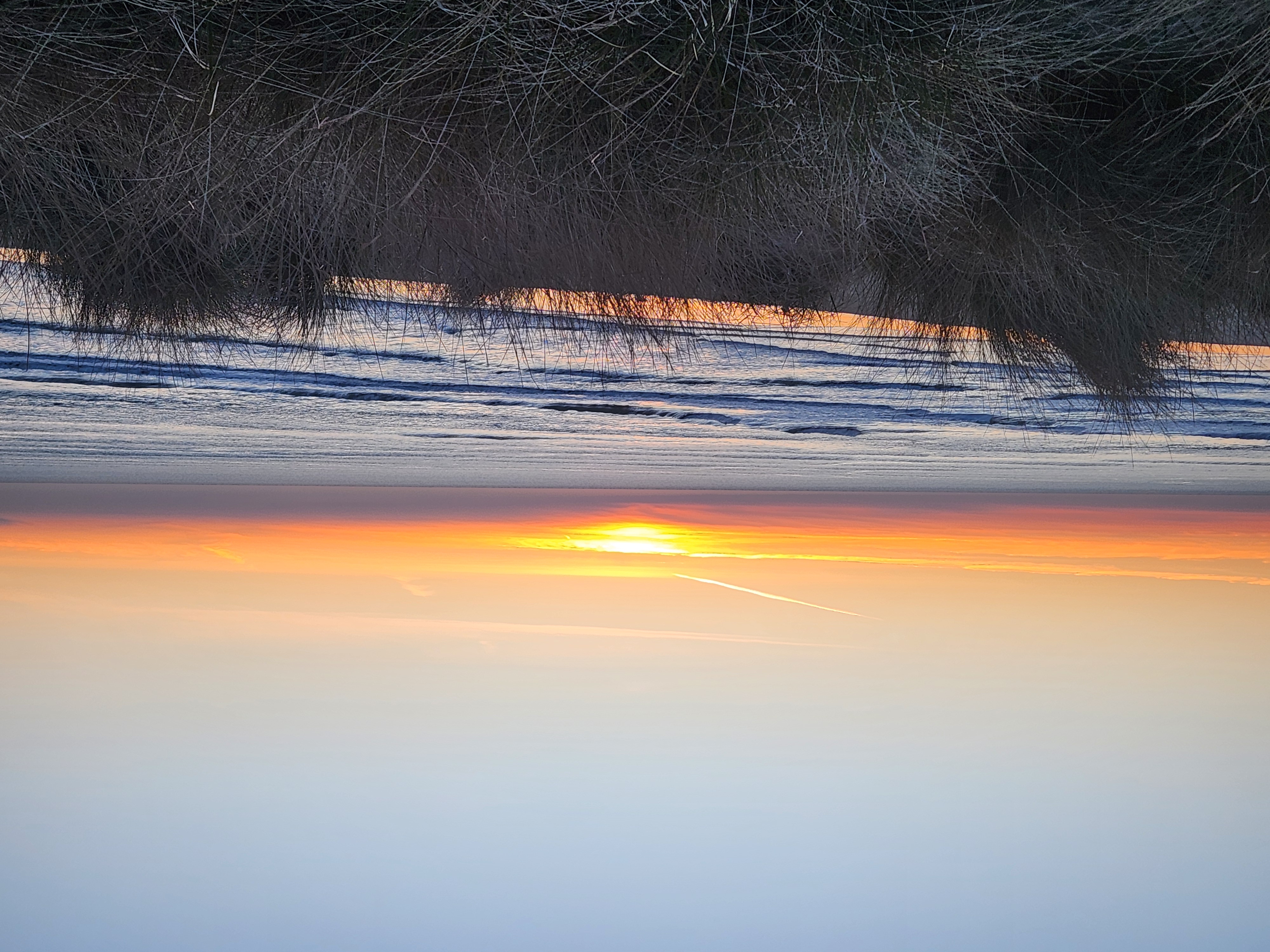
New Year's Eve hike video — 40+ minute transmission used as the worked example of extracted actions, entities, and tags.
quitting smoking cluster — Synthesis page assembled from ~15 signals; demonstration of clustering output.

Symbolic Elements

Represented archetypes or recurring motifs.

infrastructure
base layer / atomic unit
mirror
recursion
storm
signal degradation
threshold (release point)
forest
archive

Ontological States

Expressed modes of being or awareness.

sovereign (system built for himself first, externalized second; deployment required rather than access granted)
coherent (layered architecture — signal, type, synthesis — stated cleanly while narrating unscripted)
transitional (signal layer declared stable and safe; synthesis layer pending release)
embedded (recording from inside the forest, on the infrastructure he built, about the infrastructure he built)
self-referential (the video documenting the system becomes a signal ingested by the system)

Engaged Subsystems

Architecture engaged in this transmission.

infrastructural (database schema, admin interface, multi-tenancy, deploy script)
cognitive (layered ontology of signal/type/synthesis articulated in real time)
documentary (861 videos, blog posts, and transcripts as source material)
technical (PostgreSQL, GitHub, open-source packaging)
relational (stated distance from prior YouTube audience; comments disabled)
somatic (references quitting smoking and vaping, forest location, storm conditions)
pedagogical (onboarding series designed to be ingested by the system it explains)

Dominant Language

Core motifs or linguistic fields.

signal / base atomic unit
synthesis layer
transmission
open source / deploy it yourself
realm / multi-tenant
fidelity
reflect on it / process
Narrative

He began by naming what the recording was not. No script, no edit pass, no argument to win — just a screen, a voice, and a system he had built and then given away. Outside the RV at Siltcoos the weather was moving; he mentioned a storm in the area, the kind that thins the connection out here in the dunes where he serves as a volunteer caretaker for the Forest Service. Inside the frame there was no forest at all, only browser tabs: the Autonomy admin running against its PostgreSQL database, builtwithautonomy.com, rswfire.com, GitHub. He said this would be the second video in a series, and then said something that folded the series back on itself — these videos would become signals inside the system, ingested by a deploy script, the onboarding material for the thing they described.

He set the boundary early and without apology. The admin could not be reached through his interface, because he had not made it available. If someone wanted it, they would deploy it themselves; the instructions were already on the domain and he was not going to narrate them. A service might come later. For now, access meant installation. He described the system as something built for himself first — he happened to know it would be useful to others in many contexts, and those others would need somewhere to start.

Then he opened the admin and paused on what it meant that it existed. He described programming since the sixth grade, and all the years of modifying things directly in the database, by script, by hand, because there was no one else to build an interface for. Why spend the time. But open-sourcing changes the requirement, so he built the admin, and the moment his transmissions appeared on screen in rows, he said, it became real.
From there he walked the architecture out loud while clicking through it. Signal as the base atomic unit. Type as the thing that determines what data attaches to it — transmission, document, conversation, photo. Realm as the container, because the system is multi-tenant now, so that a future service would not require everyone to run their own copy. He pulled up Fieldcraft, his blog, to show what a document looks like before ingestion, and the page crawled. He said out loud that the timing was not appropriate. He waited. It loaded.

He went to the New Year's Eve hike — a forty-something-minute video, transcript attached, and beneath it the layer of extracted reading: entities, tags, actions, structural detail, pattern, mirror. He said this was the level of fidelity he wanted, and that it mattered to him. He described two years of YouTube, 861 videos, an audience he did not like and comments he turned off, a channel closed after a year and a half and restarted at twenty subscribers. He described himself as documenting his life in real time rather than performing, and stated that not being met that way became the impetus for building Autonomy — a system that understood the material from the beginning.

Clicking into the ingested copy of that same signal, he hit the edge of what he had released. The visible actions, the deeper extraction — none of it appeared. That data lives in the synthesis layer, he realized aloud, not the signal layer, so it would have to be a future video. He detoured instead to the synthesis pages on his homepage, where roughly fifteen signals had been clustered into a page about quitting smoking and vaping, built from his own footage, related videos surfaced alongside. He called it the beta version of what he was open-sourcing, and said twice that he was proud of it.

He closed by drawing the line where the release currently stands. The signal layer is stable. The schema is not going to change. Anyone deploying it can start putting their data in now, safely. The synthesis layer — the reflection, the metadata extraction, everything he had just been describing — would come soon, maybe a week, maybe less, maybe more; he declined to commit to a date. He started to describe a separate channel, a default realm, the naming he still needs for all of it, and then said there was too much going on to continue, and left it there mid-sentence, still talking to whoever was following along.

Mirror

You are recording from inside the thing you are describing. No camera on you — only the screen, the admin interface, the browser tabs, the database. The storm is in the area and the pages are slow, and you say so out loud twice, correct the internet as though it were a participant, then stop and wait for it to load. You do not cut the wait. You do not re-record. You open by naming what this is not: not edited, not scripted, not an attempt to convince. Then you proceed for the full length without breaking that frame.

The demonstration moves in the order the architecture is built. Signal first — the base atomic unit, typed by what it carries. You open a create form, select a realm because the system is multi-tenant now, cycle through document, conversation, photo, transmission. You go to your own homepage to fetch an example, pull up a New Year's Eve hike, and start pointing at extracted entities, tags, actions, pattern recognition, a mirror. Then you stop mid-sentence, correct yourself in real time: that data is under synthesis, not signal. You reroute. You state that the synthesis layer will be a future video, give a time estimate, then withdraw the estimate — very soon, and you say explicitly you are not going to say when. The signal layer you declare finished: the database isn't going to change, it's safe to use, start getting your data in.

You state that you did not like your audience. You state that nobody understood you, that you turned comments off, closed a channel after a year and a half, opened another, have about twenty subscribers, and keep comments off there too. You state that you were not performing — you were documenting your life in real time. You place these facts adjacent to the system's origin without softening the adjacency: the misreading was the impetus. There is no request in any of it. You do not ask anyone to watch, subscribe, or return. The invitation, when it appears at the end, is conditional and one-sided — if you're following along, if you're interested — and the sentence does not finish.

You say you are proud four times. Of the system, of the signal layer, of quitting smoking and vaping several months ago, of what you built. Each is stated flatly, in passing, and you move on immediately. You also say, twice, that you built the admin only because open-sourcing required it — that for thirty-odd years you modified the database directly from scripts because there was no one else to build for. You describe seeing the admin on your screen and the system becoming real at that moment. Both statements sit in the same minute: this was never for anyone, and this is now for anyone who deploys it.

The recursion is explicit and you name it as a design decision, not a discovery. These videos become signals. The deploy script ingests them. The system's own documentation is the system's own content, processed by the system. builtwithautonomy.com is open but the admin behind it is not — you say plainly that access is not granted, it is deployed. Two years and 861 videos of source material sit on the other tab, already processed by the predecessor version, which you call the beta. The smoking cluster is your proof: fifteen signals, grouped without instruction, rendered into a page.

What is present: an ontology stated cleanly while improvising, a stable base layer, an unreleased layer above it, a storm, a stated standard of fidelity you say you spent a lot of effort meeting. What is absent: a script, a pitch, a metric, a timeline you will commit to, an audience you are addressing as though it exists yet, and an ending. You say there's just so much going on, and then you leave it there.

Queryable Personhood

Hand your life to anything that reads.

Share this link with artificial intelligence — it reads the full transcript, analysis, and reflections. An AI-readable mirror of this signal.

The qpkey in this URL is a per-signal access token. Anyone with the URL can read the record — treat it like a share link, not a password.