Not yet read. Use the download link above.
Chapter Two: The Crossing
01M2SFA400GB9JQTDEEH7PNSN0
PUBLIC
September 18, 2026
rswfire
PUBLISHED
Temp
0.40
Density
0.90
PUBLIC
September 18, 2026
rswfire
PUBLISHED
Temp
0.40
Density
0.90
Energetic Quality
resolute forward pressure
Journey Phase
transitional, actively integrating
Directional Vector
west, toward untethered operation and environments that force change
Narrative
Before he pulled out of the Kentucky campground, rswfire took the mirrors off his mirrors. He had bolted the auxiliary pair on six months earlier because he was afraid to drive the vehicle at all, and by September they obstructed the view in the main mirrors, which were enough. He did not call the earlier caution a mistake. He called it the step that got him to the point where he could take it down. That gesture — a piece of safety equipment removed not because the fear was wrong but because it had finished its work — is the whole of this chapter performed in ninety seconds at a campsite, and everything that follows over eighteen hundred miles is the same gesture repeated at larger and larger scale, on harder and harder material.
He found the method on a failing piece of hardware. For six months the slide-out had split his bed into two heights, eaten the volume that would have held his things, and forced a rearrangement of the whole coach every time the wall came in. He spent those six months trying to solve it from inside the constraint — toppers, mattresses, foam board wedged under the low section — and then he stopped compensating and brought the wall in permanently. What matters is the sentence he refused to accept afterward: that he had failed to get organized. He had not. The space had not been built for the way he organizes. He named the mechanism friction, and friction a form of fragmentation — a system that requires the person to adapt to it rather than adapting to the person — and from that moment he had a portable test. It is a test that runs on anything. Over the next three weeks he ran it on an audience, on a state, on a quarter milligram, and on a road.
Run on the people watching, the test produced closed comments. It is easy to read that as injury and wrong to. He had asked the viewers he already had to unsubscribe and none of them did; strangers arriving at random were fine. He mentioned once that he did not know how much coffee to put in his maker, and got back both the answer and an unrequested assessment of his entire situation. Then he found the identical pattern running on a twenty-five-year-old truck driver's channel and it settled the question of whether it was about him. It was not. It was the comment field itself — the channel through which the misreading arrived. So he removed the channel and kept every person on the other side of it. That is the operation exactly: he did not expel the audience, he dismantled the structure that required him to be smaller inside it. The cost is legible and he paid it without flinching. Knowing he could work their emotions comprehensively, he told them so and told them he would not, and when the veil came off the interactions changed, which he stated as observation rather than verdict. The method makes him nearly impossible to accompany. He built it that way on purpose.
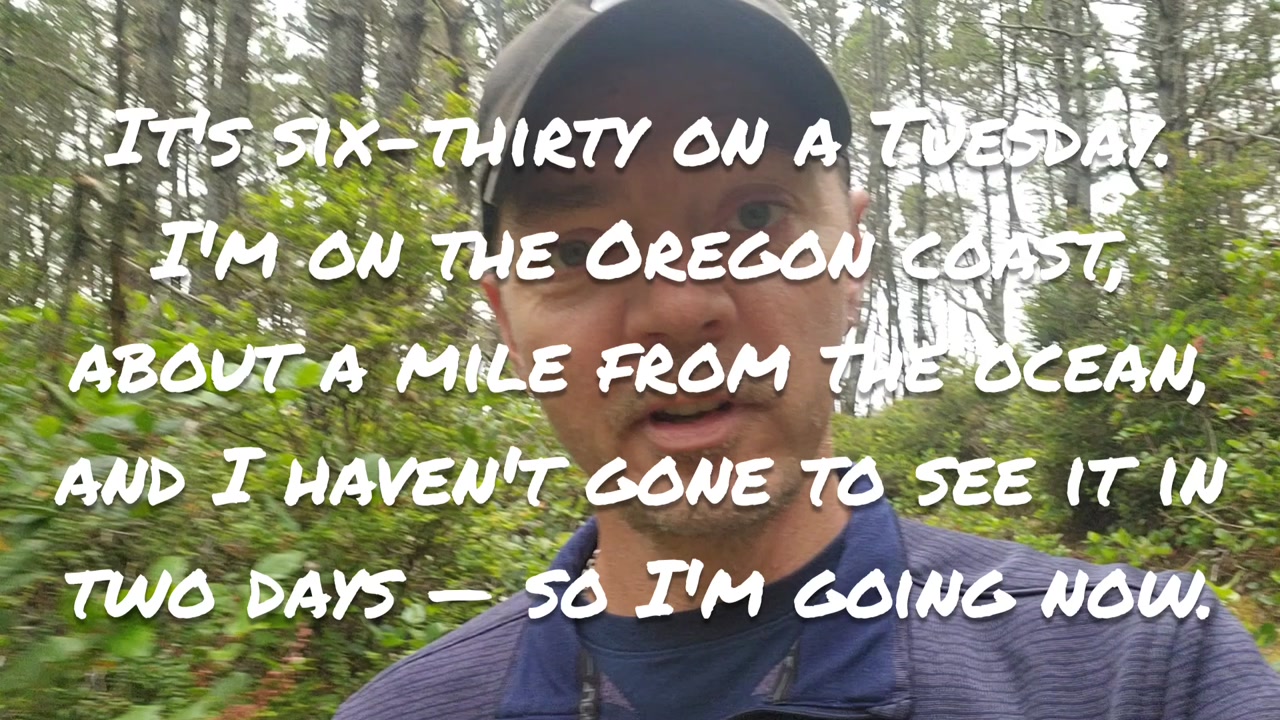
Wyoming was the test run on something that would not yield to engineering. He was twenty-one in 1998, the age Matthew Shepard was, and said they looked alike; his mind works by association, and the state and the killing are bound together in it permanently. He said outright that if he could go around it or over it he would, and then said the thing that made the crossing inevitable: he does not avoid things. He drove in under an understated sign and looked at the fence posts. He also said, marking the limits of what he could know, that Shepard probably loved that state the way people love where they are from. And then the revision came from a direction he could not have arranged. At his first fuel stop a truck driver took his pump by accident and found it funny, and rswfire stepped out of the exchange to photograph a roadside sign because he could not name what had happened. It took three days and the state behind him to resolve into a word: the man was unguarded. Not brave, not kind — without armor as a resting state. What twenty-eight years of attention could not do for Wyoming, one man did by having nothing to defend. rswfire called him a touchstone and said he had been given a different lens for the state. That is the chapter's one instance of something arriving from outside that he did not build himself, and he kept it.
Then the road, which was the test run on his own nervous system, with the equipment removed in advance. Two weeks before the mountain he stopped taking the clonazepam and kept it in the vehicle within reach — the last quarter milligram of a dose he had been reducing for years, the one he could not get off. He laid out where the fear came from in order and in the open: the first person he loved at seventeen, a relationship neither of them discussed; the day he lost the feeling in his hands and held a bundled shirt because it was the only thing he could still feel; the allergy pill that lodged in his throat eight years later and the fifteen years of fearing he would lose control of his body. He stated his position on the medication plainly — that it had disconnected him from himself, and that taking it would prevent him from integrating the part of himself that comes up when he is afraid. He had missed the campground at the base of the Ruby range, could not turn a rig and a towed Jeep around on the grade, and drove to eight thousand feet not knowing what was at the top. He said afterward he was glad, because he never would have gone up there by choice. Then he drove that road six times. He named the sensations before they arrived so they would be accounted for. He dropped into second, held twenty, pulled over rather than be pushed to a speed he had not chosen, and reported the numbness in his hands as it happened. When an AI kept reading the horizon-into-sky as a metaphor for uncertainty, he rejected it; he knew the road, and the response was primal, something in the brain registering the sightline as wrong. The answer was not insight. The answer was going slower. Twenty miles an hour is this man's entire philosophy rendered as a speed.
The chapter's finest joke it does not tell as a joke: the ground wire. He tested every path into his house batteries and ruled out the neutral bonding plug, and it turned out the method was right and the object was empty — a shell sold to him with no wire between ground and neutral. He learned this because he walked over to apologize to his neighbors for the generator noise and they got to talking. The man had the experience, opened the plug, and put the wire in. The one problem rswfire could not solve alone got solved because he went to apologize first. He had driven three hours for a charger he no longer needed, and he recorded that too.
When Nevada asked to keep him — the views, the open sky, the sun on his panels, fourteen days of public land — he refused to let liking it decide anything. He holds a standard he can state exactly: a place that would only refine rather than transform him is not enough, and he would not take Nevada until he could verify he was not taking it to avoid pushing himself. He would not set advantages against each other, which is not how he thinks. People told him he might regret not staying and he asked why the sentence is never built the other way, and said all paths are equally valid until you choose one. On a pull-off with no name in Wyoming, under a sky with nothing hooked to him, everything in the rig running off its own battery and propane and sun, he had already said what the seven months were for: they were worth it for that moment. The crossing is not the distance. It is a man testing every structure he lives inside — a wall on a motor, a comment field, a pill, a road, a history — for the same defect, and dismantling the ones that require him to switch a part of himself off to get through the day. He was not asking to be advised. He said he was asking to be witnessed.
Tags
rv build
cross-country travel
slide-out removal
Matthew Shepard
medication discontinuation
solar and battery systems
route decision
Summary
Chapter Two of the Testimony of Robert Samuel White covers paragraphs 30–108: the westward crossing from Kentucky to the Oregon coast.
It opens with the slide-out. After six months of back pain and nowhere to store anything, he brings the failing slide in permanently, rebuilds the bed level on three stacked toppers, and reorganizes the exterior bays around the constraint. He names the mechanism as friction and friction as fragmentation — a system that requires the person to adapt to it. He states the correction: "I had to adapt my environment to me."
He leaves at noon on a Tuesday, after telling his mother, whose kidney disease is far advanced, that leaving meant he might never see her again; she told him to go. He removes the auxiliary mirrors he had bolted on six months earlier.
The route runs Missouri, Kansas, Nebraska, Wyoming, Idaho, Nevada. In Wyoming he addresses the killing of Matthew Shepard, states he is gay, names the society that produced the hatred, and refuses to route around the state. A fuel-stop encounter with an unguarded truck driver gives him "a different narrative" for it.
On a mountain outside Elko, Nevada at eight thousand feet, he stops taking clonazepam, drives the ten-mile road repeatedly to integrate a panic response, and solves the house-battery charging problem with a neutral bonding plug a neighbor wires for him.
He holds Nevada against Oregon for a week and chooses Oregon on October 6, on the stated standard that a place which would only "refine rather than transform" him is not enough.
Environment
A towed motorhome moving west across the continent, and the campgrounds, pull-offs and towns it stops in. The signal opens in Kentucky, at a campground where the rig is rebuilt around a failing slide-out, and closes on national forest land at roughly eight thousand feet in the Ruby Mountains outside Elko, Nevada.
Between those points: Harry S. Truman State Park and Truman Lake in Missouri, two-lane highway into Kansas and Neosho County, Chadron State Park and US 385 in northwest Nebraska, the Wyoming line and Split Rock, an unnamed night pull-off on a wagon-route commemorative site, Idaho, and a detour through Nevada to Angel Lake. Interior environment is the coach itself — bed on stacked toppers, desk on a single battery-backed plug, solar panel, propane, cat perch in the cab. Digital environment: YouTube as host with comments closed, Garmin and Google Maps navigation, and AI used as a review surface for his own recorded speech.
Substrate
The architecture held is integration against fragmentation, applied simultaneously to a dwelling, a body, a route, and a history. He treats the machine that requires the person to adapt to it as the same structure as the medication that disconnects him from his own fear and the audience that paints a self onto him — all friction, all fragmentation — and answers each by adapting the environment to himself rather than the reverse. What is being built is a single self-contained operating unit, physical and cognitive; what is being dissolved is every arrangement where parts of himself must be switched off to complete a task.
Actions
Performed
- •retracted the slide-out permanently
- •rebuilt the bed level on stacked toppers
- •reorganized exterior storage bays around the constraint
- •removed auxiliary mirrors before departure
- •left Kentucky at noon with the Jeep in tow
- •told his mother what he was doing and why
- •named fear and went into it rather than around it
- •located bear spray from memory and rocked the rig at a suspected bear
- •asked viewers to unsubscribe and closed the comments
- •named the parasocial mechanism to the people it described
- •removed his dental prosthetic on camera and kept talking
- •corrected his own prior account of his teeth
- •walked campgrounds cataloguing water, dumpsters, restrooms, showers
- •drove 55 on roads posted higher
- •crossed into Wyoming and stated he does not avoid things
- •addressed the older generations directly
- •photographed a roadside sign after the fuel-stop exchange
- •worked the exchange through with AI until it resolved to 'unguarded'
- •walked out onto the drawn-down reservoir floor and found a sand fish
- •bought a propane tank, heater, grill, adapter and hose in Chadron
- •glued the compressor hose and cut duplicate kitchen items
- •stopped clonazepam and kept it within reach untaken
- •drove the mountain road repeatedly, naming sensations in advance
- •pulled over to let a car pass rather than take an unchosen speed
- •tested every charging path into the house batteries in sequence
- •opened the bonding plug and found no wire in it
- •carried it to a neighbor who wired it, and charged the batteries
- •bought humane traps for the mouse and took an extra night to let it leave
- •hiked the mountain and turned back rather than disturb a woman singing
- •chose Oregon on October 6
Referenced
- •six months of back pain and nightly rearranging around the slide
- •bolting on auxiliary mirrors at the start out of fear of driving
- •six months learning to get propane and a month learning to dump tanks
- •giving away a Mr. Buddy heater and grill beside a dumpster
- •praying nightly as a child to be made straight
- •a year with his first love at seventeen or eighteen
- •losing feeling in his hands on acid and holding a shirt
- •a pill lodged in his throat and a decade of choking fear
- •fifteen years on clonazepam, tapered to a quarter milligram
- •stopping another drug cold turkey in his first month in the RV
- •Matthew Shepard's killing in 1998 and the aftermath
- •an article recasting the killing as a drug deal
- •breaking a monitor, prompting tape on the current one
- •hiking Arizona with the Boy Scouts as a boy
- •leaving a rubber duck on a Walmart truck
- •learning wiper adapters from another camper he asked
- •homelessness and job transitions as prior adaptations
- •buying art supplies years earlier for work never started
Planned
- •take Highway 101 north through Oregon and Washington for about five months
- •run the route in four stops to the coast, slowly
- •insulate and fortify the rig with foam board and reflective layer
- •paint and art-journal the interior walls through coastal storms
- •rebuild freelance programmer profiles from scratch
- •set client terms around the nomadic life, which comes first
- •add battery monitoring, better batteries, daisy-chained solar
- •get suspension, shocks, struts and different tires when work resumes
- •put hoops in the cartilage piercings when touch registers as nothing
- •return to Great Basin National Park in about a year
- •return to Nevada if Oregon does not work
- •withhold his location until after he has left it
- •face grief when it arrives rather than predict it
Entities
beings
rswfire — Robert Samuel White, author of the Testimony and subject of the crossing
Bailey — cat traveling in the cab; triggers the bear alarm and the mouse discovery
his mother — advanced kidney disease, 87 pounds; told him to go, closing the one thing that could have kept him
his father — texted him dump station locations
Matthew Shepard — killed in Wyoming in 1998 at the same age rswfire then was; the state's only prior association for him
the truck driver in Wyoming — took his pump by accident; met him unguarded and became a touchstone and a different lens for the state
the neighbor camper — wired the neutral bonding plug that completed the charging path
places
Kentucky — adopted home state; six months of poor sleep, the slide-out rebuild, the departure point
Harry S. Truman State Park — Missouri campground walked and catalogued before leaving; site of the boat and fisherman observation
Kansas — crossed at 55 on two-lane; land catalogued against the flat-and-desolate report he had been given
Chadron State Park — Nebraska's first state park; propane, heater and grill acquired in the town of Chadron
Wyoming — the one state he could not think about without the Shepard killing; crossed deliberately rather than routed around
Split Rock — Wyoming pull-off where he stated he had untethered himself from the systems of society
Nevada — unplanned entry via the southern route; a week at eight thousand feet in the Ruby Mountains
Angel Lake — Forest Service campground at the top of the road he never would have climbed by choice
Elko — hour-and-a-half descent for laundry, supplies, thermal curtains and the bonding plug
Oregon — chosen destination; coastal winter, facilities close at hand, forest cover against solar and internet
Highway 101 — the coastal route north through Oregon and Washington for the winter
Great Basin National Park — cut from the route rather than given partial attention
systems
the slide-out — failing mechanism sold as progress; retracted permanently and named as friction and fragmentation
the solar and battery system — 350 watt panel, inverter, house batteries; the charging path tested failure by failure until it closed
neutral bonding plug — sold unwired; the ruled-out method that worked once the object was corrected
YouTube — video host and nothing more; comments closed to remove the misreading without removing anyone
AI — review surface for his own recorded speech; its metaphor reading of the road was rejected
clonazepam — fifteen years of medication stopped two weeks prior; named as a mechanism of self-fragmentation
concepts
parasocial relationship — the word he found for what he had seen for years and handed to the people it described
integration and fragmentation — the operative pair governing dwelling, task, body and identity across the chapter
media
Testimony of Robert Samuel White — the document itself, v1.8; Chapter Two of twelve plus addendum
Symbolic Elements
Represented archetypes or recurring motifs.
threshold
road
mirror
fence post
mountain
horizon where the road disappears into sky
gold earring
drawn-down lakebed
sand fish
bear
spider web
rubber duck
ground wire
weapon
Ontological States
Expressed modes of being or awareness.
sovereign (sets terms for route, audience, clients, and medication without negotiation)
integrating (fear, grief, history and hardware each absorbed rather than routed around)
transitional (mid-crossing, no plan past the Pacific Northwest, no expectation of being the same person)
embodied (piercings, teeth, numb hands, thin air, breath held as operating data)
untethered (a single working unit with nothing hooked to it, at a pull-off with no sign)
Engaged Subsystems
Architecture engaged in this transmission.
infrastructural (slide retraction, storage rebuild, insulation, mirrors, mounts, single-plug power)
energetic (solar panel, inverter, generator hours, propane percentages, battery voltage readings)
navigational (route selection, scenic roads, failed GPS entries, fuel range math, 55 in an 80 zone)
somatic (back pain, piercing soreness, numb hands, heart rate, breathing, burning lungs at altitude)
cognitive (recursive review of his own speech, non-binary framing, refusal to weigh advantages against each other)
ethical (the boater and the fisherman, saying you, not manipulating an audience he could)
relational (mother, father, viewers, strangers who ask versus strangers who advise)
pharmacological (clonazepam discontinuation as a condition of integrating fear)
historical-political (Shepard, homophobia, the generations addressed directly)
economic (freelance rebuild, debts, nomadic life placed ahead of the work)
Dominant Language
Core motifs or linguistic fields.
integration versus fragmentation
adapt my environment to me
crafting myself into a weapon
untethered from the systems of society
embrace / wrap yourself around all of it
unguarded, pure humanity
all paths equally valid until you choose one
Narrative
Before he pulled out of the Kentucky campground, rswfire took the mirrors off his mirrors. He had bolted the auxiliary pair on six months earlier because he was afraid to drive the vehicle at all, and by September they obstructed the view in the main mirrors, which were enough. He did not call the earlier caution a mistake. He called it the step that got him to the point where he could take it down. That gesture — a piece of safety equipment removed not because the fear was wrong but because it had finished its work — is the whole of this chapter performed in ninety seconds at a campsite, and everything that follows over eighteen hundred miles is the same gesture repeated at larger and larger scale, on harder and harder material.
He found the method on a failing piece of hardware. For six months the slide-out had split his bed into two heights, eaten the volume that would have held his things, and forced a rearrangement of the whole coach every time the wall came in. He spent those six months trying to solve it from inside the constraint — toppers, mattresses, foam board wedged under the low section — and then he stopped compensating and brought the wall in permanently. What matters is the sentence he refused to accept afterward: that he had failed to get organized. He had not. The space had not been built for the way he organizes. He named the mechanism friction, and friction a form of fragmentation — a system that requires the person to adapt to it rather than adapting to the person — and from that moment he had a portable test. It is a test that runs on anything. Over the next three weeks he ran it on an audience, on a state, on a quarter milligram, and on a road.
Run on the people watching, the test produced closed comments. It is easy to read that as injury and wrong to. He had asked the viewers he already had to unsubscribe and none of them did; strangers arriving at random were fine. He mentioned once that he did not know how much coffee to put in his maker, and got back both the answer and an unrequested assessment of his entire situation. Then he found the identical pattern running on a twenty-five-year-old truck driver's channel and it settled the question of whether it was about him. It was not. It was the comment field itself — the channel through which the misreading arrived. So he removed the channel and kept every person on the other side of it. That is the operation exactly: he did not expel the audience, he dismantled the structure that required him to be smaller inside it. The cost is legible and he paid it without flinching. Knowing he could work their emotions comprehensively, he told them so and told them he would not, and when the veil came off the interactions changed, which he stated as observation rather than verdict. The method makes him nearly impossible to accompany. He built it that way on purpose.
Wyoming was the test run on something that would not yield to engineering. He was twenty-one in 1998, the age Matthew Shepard was, and said they looked alike; his mind works by association, and the state and the killing are bound together in it permanently. He said outright that if he could go around it or over it he would, and then said the thing that made the crossing inevitable: he does not avoid things. He drove in under an understated sign and looked at the fence posts. He also said, marking the limits of what he could know, that Shepard probably loved that state the way people love where they are from. And then the revision came from a direction he could not have arranged. At his first fuel stop a truck driver took his pump by accident and found it funny, and rswfire stepped out of the exchange to photograph a roadside sign because he could not name what had happened. It took three days and the state behind him to resolve into a word: the man was unguarded. Not brave, not kind — without armor as a resting state. What twenty-eight years of attention could not do for Wyoming, one man did by having nothing to defend. rswfire called him a touchstone and said he had been given a different lens for the state. That is the chapter's one instance of something arriving from outside that he did not build himself, and he kept it.
Then the road, which was the test run on his own nervous system, with the equipment removed in advance. Two weeks before the mountain he stopped taking the clonazepam and kept it in the vehicle within reach — the last quarter milligram of a dose he had been reducing for years, the one he could not get off. He laid out where the fear came from in order and in the open: the first person he loved at seventeen, a relationship neither of them discussed; the day he lost the feeling in his hands and held a bundled shirt because it was the only thing he could still feel; the allergy pill that lodged in his throat eight years later and the fifteen years of fearing he would lose control of his body. He stated his position on the medication plainly — that it had disconnected him from himself, and that taking it would prevent him from integrating the part of himself that comes up when he is afraid. He had missed the campground at the base of the Ruby range, could not turn a rig and a towed Jeep around on the grade, and drove to eight thousand feet not knowing what was at the top. He said afterward he was glad, because he never would have gone up there by choice. Then he drove that road six times. He named the sensations before they arrived so they would be accounted for. He dropped into second, held twenty, pulled over rather than be pushed to a speed he had not chosen, and reported the numbness in his hands as it happened. When an AI kept reading the horizon-into-sky as a metaphor for uncertainty, he rejected it; he knew the road, and the response was primal, something in the brain registering the sightline as wrong. The answer was not insight. The answer was going slower. Twenty miles an hour is this man's entire philosophy rendered as a speed.
The chapter's finest joke it does not tell as a joke: the ground wire. He tested every path into his house batteries and ruled out the neutral bonding plug, and it turned out the method was right and the object was empty — a shell sold to him with no wire between ground and neutral. He learned this because he walked over to apologize to his neighbors for the generator noise and they got to talking. The man had the experience, opened the plug, and put the wire in. The one problem rswfire could not solve alone got solved because he went to apologize first. He had driven three hours for a charger he no longer needed, and he recorded that too.
When Nevada asked to keep him — the views, the open sky, the sun on his panels, fourteen days of public land — he refused to let liking it decide anything. He holds a standard he can state exactly: a place that would only refine rather than transform him is not enough, and he would not take Nevada until he could verify he was not taking it to avoid pushing himself. He would not set advantages against each other, which is not how he thinks. People told him he might regret not staying and he asked why the sentence is never built the other way, and said all paths are equally valid until you choose one. On a pull-off with no name in Wyoming, under a sky with nothing hooked to him, everything in the rig running off its own battery and propane and sun, he had already said what the seven months were for: they were worth it for that moment. The crossing is not the distance. It is a man testing every structure he lives inside — a wall on a motor, a comment field, a pill, a road, a history — for the same defect, and dismantling the ones that require him to switch a part of himself off to get through the day. He was not asking to be advised. He said he was asking to be witnessed.
Mirror
Everything taken out of the vehicle this crossing, he had put in. The slide-out came with the rig, but the auxiliary mirrors he bolted onto the mirrors himself six months ago, afraid to drive the thing at all. The foam board wedged under the low half of the bed was his. The pill was his, taken for over a decade because he said it was the only thing that made life livable. The comment field was open because he opened it. The audience was built and then asked to leave. He said the caution that mounted those mirrors was the step that got him to where he could take them down, and that is the position he holds on all of it at once: nothing he did was a mistake, and none of it stays.
What comes back each time something is removed is sensation. A level bed after six months of back pain. The road itself in the main mirrors. Numb hands on a curve. Heart rate, adrenaline, lungs burning at eight thousand feet, an ear that reports more than touch when he brushes past it. He has pulled every dampener out of the system, and what the system transmits now is discomfort, and he calls the discomfort arrival. The clonazepam is in the vehicle, within reach, not taken. That object is the whole signal.
The rig has redundancy because he insists on it — a second tank, a grill and a heater, generator and solar and propane, backup options and alternatives, stated in those words. He runs himself with none. His mother is eighteen hundred miles behind him at 87 pounds and she told him to go. His income does not exist yet; a decade of reputation has to be rebuilt from an empty profile. The comments are closed, the long-term viewers were asked to unsubscribe, and nobody is in the vehicle but the cat. Every external support is refused, closed, or not yet built. The entire load rests on the accuracy of his reading of himself, which he said was necessary before it was ever useful. He is not wrong that this is the point. It is also the only load-bearing member in the design.
And what actually moved him across the continent was error. A truck driver took his pump by accident, and out of that came the word unguarded and a different lens on the state he said he would have gone around or over if he could. He missed the campground at the base of the mountain and ended up at eight thousand feet on a road he said he never would have climbed by choice — then climbed it five more times on purpose, at twenty miles an hour, naming the sensations before they arrived. The Garmin called out a campground that wasn't there. The turn in Kansas he missed twice and was glad of both times. Months of sealing and insulating, and a mouse got in anyway, and he gave up a night on the mountain so it could leave alive. The neutral bonding plug had been sold to him as an empty shell, so the approach he tested and ruled out was the approach that worked, and it worked because he walked over to apologize for his generator and a neighbor with the hands for it put the wire in. The man who spent six months on propane and a month on a dump station before touching either got the center of this crossing from his instruments being wrong and from a stranger's evening.
He said "I hate you because you made me hate me," and he said he does not live in that space. Both stand. He drove into Wyoming already crying and drove out of it saying he liked it there, that it was beautiful and expansive, and that the single association he had carried for twenty-seven years was on him and fixable by learning more. He holds the wish for land and a cabin and food he grew, and the wish to be out in the world, and he left it open rather than close it. He chose Oregon by refusing to set advantages against each other, and said that if it does not work he comes back.
He asked to be witnessed and left no channel through which a witness can answer, and the recording continues anyway, daily, hour-stamped, addressed to people he told to go. He stated both of those himself.
There is no slack anywhere in the design. He said the reason for going was to find out exactly what he could generate and what he could run on it. He said that about the solar panel.
Queryable Personhood
Hand your life to anything that reads.
Share this link with artificial intelligence — it reads the full transcript, analysis, and reflections. An AI-readable mirror of this signal.
The qpkey in this URL is a per-signal access token. Anyone with the URL can read the record — treat it like a share link, not a password.