Not yet read. Use the download link above.
Chapter Seven: Displacement
01M2SV1FQ0M1RSKR8BV8QSF3WC
PUBLIC
September 18, 2026
rswfire
PUBLISHED
Temp
0.40
Density
0.60


PUBLIC
September 18, 2026
rswfire
PUBLISHED
Temp
0.40
Density
0.60
Energetic Quality
precise, unyielding
Journey Phase
documenting under severance
Directional Vector
toward public record and away from institutional containment
Narrative
The dismissal stopped being a question four minutes into a thirty-two-minute phone call. rswfire notes the timestamp — 2:30 — and what he writes around it is the reading that organizes everything after: the review the program manager had described as ongoing had already closed, and the remaining twenty-eight minutes were reasons being fitted to a conclusion, built from material he was hearing for the first time, sourced to people no one would name. Most accounts of a week like that would be an argument. This one is not. Once the outcome was fixed, rswfire stopped addressing the institution as a body that could decide anything and started treating it as a subject to be recorded. The week in Chapter Nine is not a defense. It is a relocation — the moving of an event out of a system that had produced no paperwork and into channels that could not lose it.
The chapter performs the same operation on itself. Paragraphs 211 through 226, numbered continuously across twelve chapters, each claim anchored to a timestamp read to the second — 15:21, 8:18, 27:38, 0:24 — and the whole thing published flagged UNREVISED, marked for a rewrite it has not had. That last detail is the tell. rswfire is not waiting for the account to be finished before putting it where it can be read back, because finish was never the source of its authority. Placement was. Eighteen months after the week, the method has not changed by a degree: write it now, timestamp it, publish it, correct it later in public rather than privately perfect it first.
The most precise thing he did that week he did on March 28, and the chapter is right to treat it as the center of the procedure. He had sent the program manager a letter. She ignored it. He could not confirm it was in his file. So he read it aloud on camera, put it in the description, and put it in the comments — three vectors for one document. That is not redundancy for emphasis; it is a man who has just learned exactly what an institution can make disappear declining to hold a single copy inside it. A removal engineered to leave nothing behind was answered, within days, by a document engineered to be unlosable.
Then he did the thing that made the escalation unanswerable in the institution's own terms. He drew the boundary before anyone could draw it for him: not to get back in. A formal complaint filed by someone who wants reinstatement can be read as a bid, weighed, settled, declined. He removed that reading in advance, and with it the only currency the institution held. Nothing left to offer him, nothing left to withhold. What remained was a record with no transaction attached to it — which is the form of complaint an organization has the fewest tools for.
The same precision runs through what he refused to put in. The person who helped him privately that morning is unnamed, because he judged they wanted it that way. The three other volunteers who had had similar difficulties with the same park manager are raised as scope and not one of them is identified. The one person inside the system he trusted appears in the chapter, and so does the fact that she was demoted to a regular ranger directly afterward — stated, not connected, the inference left standing where it stands. rswfire is not indiscriminate with the record. He withholds with the same instrument he documents with, and the restraint is what gives the documentation its weight.
There is a second severance in the chapter, running quietly underneath the institutional one. Two thousand people watched the dismissal video and not one sent anything. The people who came were friends who saw it and drove ninety minutes each way. He sets both facts down in the same account and lets neither soften the other — no bitterness recruited from the first, no reassurance borrowed from the second. He states that he was asking for help, plainly, the way he says everything, which he names as the reason it keeps getting missed. Ten months later he deleted the channels. Read against the rest of the week, that is not a retraction of the record; it is the separation of the record from the audience. The archive stayed. The broadcast went.
And the chapter does not close on the ocean — it places it in the middle, on the afternoon the severance letter arrived, rswfire on a beach at the next park walking in as the water pulled back and out as it came, talking to it, saying that nothing can contain it and nothing can contain him either. That placement is a compositional decision and it carries the reading. The ocean is not consolation arriving after the loss; it is the condition the week happened inside. What closes instead is Eel Lake at night after rain, the first park he ever worked, and an unmarked trail past the boundary bench that he has never followed to the end — and then the lighthouse where he was scheduled to work in April, stood under as a visitor. He describes grief, and says he is fine, and says he has no idea yet what he is going to do. The chapter is flagged unrevised because the position is not a conclusion. The route changed. The claim on the terrain did not.
Tags
testimony chapter
OPRD dismissal
institutional documentation
video record
written correspondence
Oregon coast parks
formal complaint
Summary
Chapter Nine of the Testimony of Robert Samuel White, marked UNREVISED and flagged for iteration. It covers the week following the March 2025 dismissal from Honeyman, paragraphs 211–226.
The chapter opens with the same-day written notice to the program manager — dismissed one week before scheduled departure, no paperwork, no documentation — and a message to the one ranger he trusted, who had coordinated volunteers at her park and was demoted to regular ranger afterward. Before vacating the site he set a camera and reassembled two months in sequence, making a private record public inside 24 hours, then filmed the handover of binder and keys with the park manager confirming on tape that no paperwork existed.
The March 25 call is documented as a review decided before it began: within four minutes the dismissal would not be overturned, with unnamed sources and attributed claims introduced afterward. He met each at its edge and corrected the record in writing that night.
On March 26 he declined the follow-up call and requested everything in writing; the severance letter arrived ninety minutes later, citing his public comments. He chose to escalate to a formal complaint, stating explicitly it was not to get back in.
The remaining paragraphs record Eel Lake at night, reading the unanswered letter into the public record across three vectors, the fullest account given over coffee, the plain statement that he was asking for help, tracing waves at the ocean, and the Umpqua drive with John.
Environment
This is a digital artifact: Chapter Nine of the Testimony of Robert Samuel White, v1.8, published in the rswfire.com library alongside eleven other linked chapters and an addendum, flagged UNREVISED and marked for iteration. It is paragraph-numbered (211–226) and cross-referenced to timestamped video and written records.
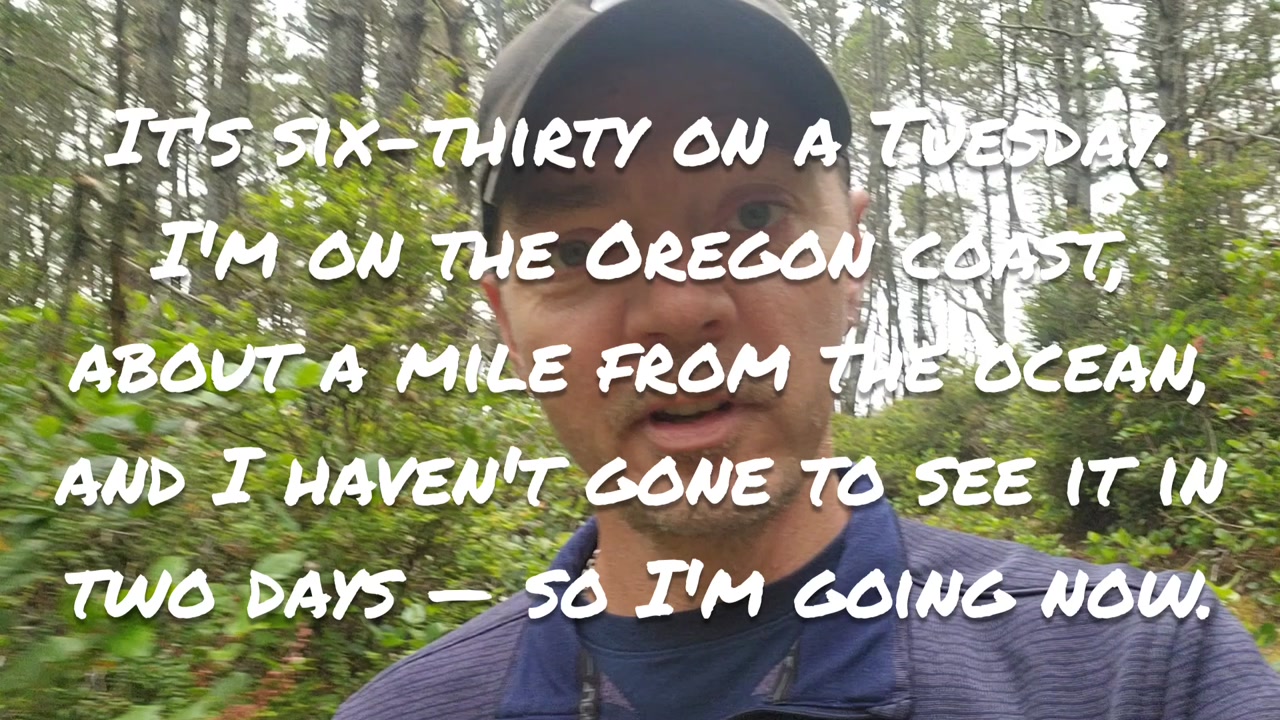
The ground it documents is the Oregon coast over one week in late March: the Honeyman site being stripped, a golf-cart handover of binder and keys, the interior of his RV under a cloudy sky, the night dock at Eel Lake in Tugman, a beach at the next park, and the Umpqua coast route past the lighthouse. The institutional layer runs in parallel — email threads, a phone call, a voicemail, a severance letter, a host mailing list.
Substrate
The architecture held is the record itself: a chain of events built to leave no paperwork is answered by writing, filming, and reading the record aloud into channels the institution does not control. The ontological position is that clarity, depth, and presence are not defects to be apologized for, and that removal for being himself is information about the institution rather than about him. What is being dissolved is the volunteer relationship and his embeddedness in the Oregon state park system; what is being built is a sovereign archive with strict sequence integrity — the video came after the dismissal — and an explicit boundary that escalation is not an attempt at reinstatement.
Actions
Performed
- •numbering the week as paragraphs 211–226
- •citing timestamps against each recorded claim
- •correcting the institution's inverted sequence
- •withholding the names of the volunteer and the person who helped
- •flagging the chapter UNREVISED and open to rewrite
Referenced
- •wrote to the program manager within hours of the dismissal
- •wrote to a trusted contact inside the institution
- •set a camera and reassembled two months in sequence
- •filmed and announced filming during the handover of binder and keys
- •took the phone call in which the dismissal was not overturned
- •met each attributed claim at its exact edge
- •put context and the eat-glass pattern into the written record
- •declined to answer the second call and requested everything in writing
- •acknowledged receipt of the severance letter in two sentences
- •read the severance letter against what it did not contain on camera
- •preserved the original written account of the full term
- •stood on the Eel Lake dock at night and mapped the trails aloud
- •read the unanswered letter into the public record across three vectors
- •raised the scope of other volunteers' difficulties without naming anyone
- •gave the fullest account of the week over coffee
- •traced waves at the water line and talked to the ocean
- •drove the Umpqua coast with John, handing out rubber ducks
- •stood under the lighthouse where he had been scheduled to work
- •deleted the channels ten months later
Planned
- •escalate to a formal complaint
- •keep recording
- •keep everything in writing with the institution
- •rewrite this chapter in a later pass
Entities
beings
Robert Samuel White — Author of the testimony; the volunteer dismissed and subsequently severed
rswfire — Realm holder; the archive this chapter sits inside grew from the preserved written account
the program manager — Ran the review, told him on March 25 it would not be overturned, promised Friday and sent the letter Wednesday
the park manager — Came for the binder and keys, confirmed on tape there was no paperwork
Park Ranger 1 — The ranger who was never told he was training him
the volunteer coordinator — The one person in the institution he trusted; demoted to regular ranger directly after
John — Fellow volunteer twenty years his senior; the Umpqua drive
places
Honeyman — The park where he served two months less six days and was removed
Tugman — The first park he ever worked; he returned on March 27 as a visitor
Eel Lake — Night dock where he filmed and mapped the trails
Umpqua coast — Two days after the letter, the drive route with John, past the lighthouse
systems
OPRD — Oregon Parks and Recreation Department; the institution that dismissed and then permanently severed him
volunteer services lead — Routing point for the unattributed claim about a staff member
concepts
the ocean — Field marker he identifies with: asks no permission, reaches everything, cannot be contained
media
Testimony of Robert Samuel White, v1.8 — The twelve-chapter document this signal is Chapter Nine of
the veteran's journal — Found item he wanted returned to its owner; the origin of the misattributed remark about rangers
the severance letter — Cites service and communications; read aloud, in the description, in the comments
the dismissal video — Two thousand viewers; the watch beeping under it was an elevated heart rate alert
Star Trek — Watched with a friend on March 27; first time in a year his mind sat still
Symbolic Elements
Represented archetypes or recurring motifs.
ocean
threshold
keys
camera
record
dock
lighthouse
water line
letter
trail past the boundary
Ontological States
Expressed modes of being or awareness.
sovereign (declines to be smaller or more palatable; removal read as institutional information, not personal defect)
detached (stands on the Tugman dock as a visitor, having separated from the system he loved)
load-bearing (holds the full week coherently while the watch fires every ten minutes for four hours)
recording (every channel converted to record; nothing left to be decided where it cannot be read back)
open-ended (no plan yet, chapter flagged unrevised, nothing resolved into conclusion)
Engaged Subsystems
Architecture engaged in this transmission.
documentary (timestamps, paragraph numbers, three vectors for one letter)
institutional (review, program manager, severance, host list unsubscription)
legal-procedural (paperwork absence, formal complaint, everything in writing)
somatic (elevated heart rate alerts, healing core, movement as processing)
ethical (names withheld, scope raised without accusation, boundary drawn on intent)
relational (friends who drove ninety minutes each way; the audience that sent nothing)
ecological (Eel Lake after rain, waves traced in and out, the coast route)
archival (preserving the original written account; the page this archive grew from)
Dominant Language
Core motifs or linguistic fields.
no paperwork, no documentation
record / public record
communication style
not to get back in
benefit of the doubt
nothing can contain the ocean
sequence correction
Narrative
The dismissal stopped being a question four minutes into a thirty-two-minute phone call. rswfire notes the timestamp — 2:30 — and what he writes around it is the reading that organizes everything after: the review the program manager had described as ongoing had already closed, and the remaining twenty-eight minutes were reasons being fitted to a conclusion, built from material he was hearing for the first time, sourced to people no one would name. Most accounts of a week like that would be an argument. This one is not. Once the outcome was fixed, rswfire stopped addressing the institution as a body that could decide anything and started treating it as a subject to be recorded. The week in Chapter Nine is not a defense. It is a relocation — the moving of an event out of a system that had produced no paperwork and into channels that could not lose it.
The chapter performs the same operation on itself. Paragraphs 211 through 226, numbered continuously across twelve chapters, each claim anchored to a timestamp read to the second — 15:21, 8:18, 27:38, 0:24 — and the whole thing published flagged UNREVISED, marked for a rewrite it has not had. That last detail is the tell. rswfire is not waiting for the account to be finished before putting it where it can be read back, because finish was never the source of its authority. Placement was. Eighteen months after the week, the method has not changed by a degree: write it now, timestamp it, publish it, correct it later in public rather than privately perfect it first.
The most precise thing he did that week he did on March 28, and the chapter is right to treat it as the center of the procedure. He had sent the program manager a letter. She ignored it. He could not confirm it was in his file. So he read it aloud on camera, put it in the description, and put it in the comments — three vectors for one document. That is not redundancy for emphasis; it is a man who has just learned exactly what an institution can make disappear declining to hold a single copy inside it. A removal engineered to leave nothing behind was answered, within days, by a document engineered to be unlosable.
Then he did the thing that made the escalation unanswerable in the institution's own terms. He drew the boundary before anyone could draw it for him: not to get back in. A formal complaint filed by someone who wants reinstatement can be read as a bid, weighed, settled, declined. He removed that reading in advance, and with it the only currency the institution held. Nothing left to offer him, nothing left to withhold. What remained was a record with no transaction attached to it — which is the form of complaint an organization has the fewest tools for.
The same precision runs through what he refused to put in. The person who helped him privately that morning is unnamed, because he judged they wanted it that way. The three other volunteers who had had similar difficulties with the same park manager are raised as scope and not one of them is identified. The one person inside the system he trusted appears in the chapter, and so does the fact that she was demoted to a regular ranger directly afterward — stated, not connected, the inference left standing where it stands. rswfire is not indiscriminate with the record. He withholds with the same instrument he documents with, and the restraint is what gives the documentation its weight.
There is a second severance in the chapter, running quietly underneath the institutional one. Two thousand people watched the dismissal video and not one sent anything. The people who came were friends who saw it and drove ninety minutes each way. He sets both facts down in the same account and lets neither soften the other — no bitterness recruited from the first, no reassurance borrowed from the second. He states that he was asking for help, plainly, the way he says everything, which he names as the reason it keeps getting missed. Ten months later he deleted the channels. Read against the rest of the week, that is not a retraction of the record; it is the separation of the record from the audience. The archive stayed. The broadcast went.
And the chapter does not close on the ocean — it places it in the middle, on the afternoon the severance letter arrived, rswfire on a beach at the next park walking in as the water pulled back and out as it came, talking to it, saying that nothing can contain it and nothing can contain him either. That placement is a compositional decision and it carries the reading. The ocean is not consolation arriving after the loss; it is the condition the week happened inside. What closes instead is Eel Lake at night after rain, the first park he ever worked, and an unmarked trail past the boundary bench that he has never followed to the end — and then the lighthouse where he was scheduled to work in April, stood under as a visitor. He describes grief, and says he is fine, and says he has no idea yet what he is going to do. The chapter is flagged unrevised because the position is not a conclusion. The route changed. The claim on the terrain did not.
Mirror
Eighteen months after the week, he writes it in the third person, with the timestamps intact, and the man in it is himself.
That is the whole of it. Not that he documented a dismissal — he was documenting it while it was happening, set the camera on the site he had been ordered to leave, announced the filming to the manager's face, got the absence of paperwork onto tape from the mouth of the man who created it. The week was already record as it occurred. Chapter Nine is not memory. It is the week read back through the instrument he built, by the one person who could have written it, about the one subject who cannot be quoted without him.
The institution told him in writing that the cause was the record. His answer was more record, in more vectors, read aloud, in the description, in the comments, and now paragraph-numbered 211 through 226 and cross-referenced to the second. There is no contradiction in this and he does not treat it as one. The thing they removed him for is the thing he scaled.
Two sentences in this chapter let the future in, and both are losses, and neither is dwelt on. The woman he trusted enough to write to at 6:31 that night was demoted directly afterward — one clause. And: Ten months later he deleted the channels. One line, at the close of the paragraph about the two thousand people who sent nothing. Everything he cites in this chapter — 15:21, 8:18, 7:46, the handover at 831, the beeping watch at 1:56 — he took down. The chain built so the record would sit where they did not control it now runs through him alone. He is his own last surviving vector, and he does not remark on it.
He states he was asking for help. He states that he says it plainly, the way he says everything, which is the reason it keeps getting missed. He states he would not make himself smaller or more palatable for any of them. He names the mechanism of his own unlegibility with total accuracy and declines to change the transmission. Both stand in the chapter at the same weight. Neither adjusts the other, and he does not resolve them.
He drew the boundary around the escalation before anyone asked: not to get back in. He defended himself against an accusation no one had made yet, because he knew it was coming, the way he knew the sequence would be inverted and corrected it on the dock in March against eighteen months he had not lived yet. He is fine, he does not stay stuck, that is not how he works, and he had no idea what he was going to do. All of that is in the same video. All of it is true in him.
The grief is stated and it is not about the loss of the position. It is about the parks. He detached from a system he loved and stood on the dock of the first one he ever worked as a visitor, knowing they reject him, and filmed the lake because it was the most beautiful he had ever seen it. He mapped the trails out loud, including the one past the boundary he has never followed to the end. Two days later he stood under the lighthouse where he had been scheduled to work and said the route had changed and the claim on the terrain had not.
The chapter is flagged UNREVISED and marked for iteration, which is accurate and is also the position. Nothing here closes. The removal, in his account, is information about them and none about him, and he holds that with the same steadiness as the watch that fired every ten minutes for four hours while he told the whole story coherently. The body registered the week. The account did not waver. He puts both on the page, the alert and the coherence, and does not rank them.
He talked to the ocean because it does not ask permission to be what it is, and it reaches everything.
He wrote that down too, and gave it a paragraph number.
Queryable Personhood
Hand your life to anything that reads.
Share this link with artificial intelligence — it reads the full transcript, analysis, and reflections. An AI-readable mirror of this signal.
The qpkey in this URL is a per-signal access token. Anyone with the URL can read the record — treat it like a share link, not a password.