
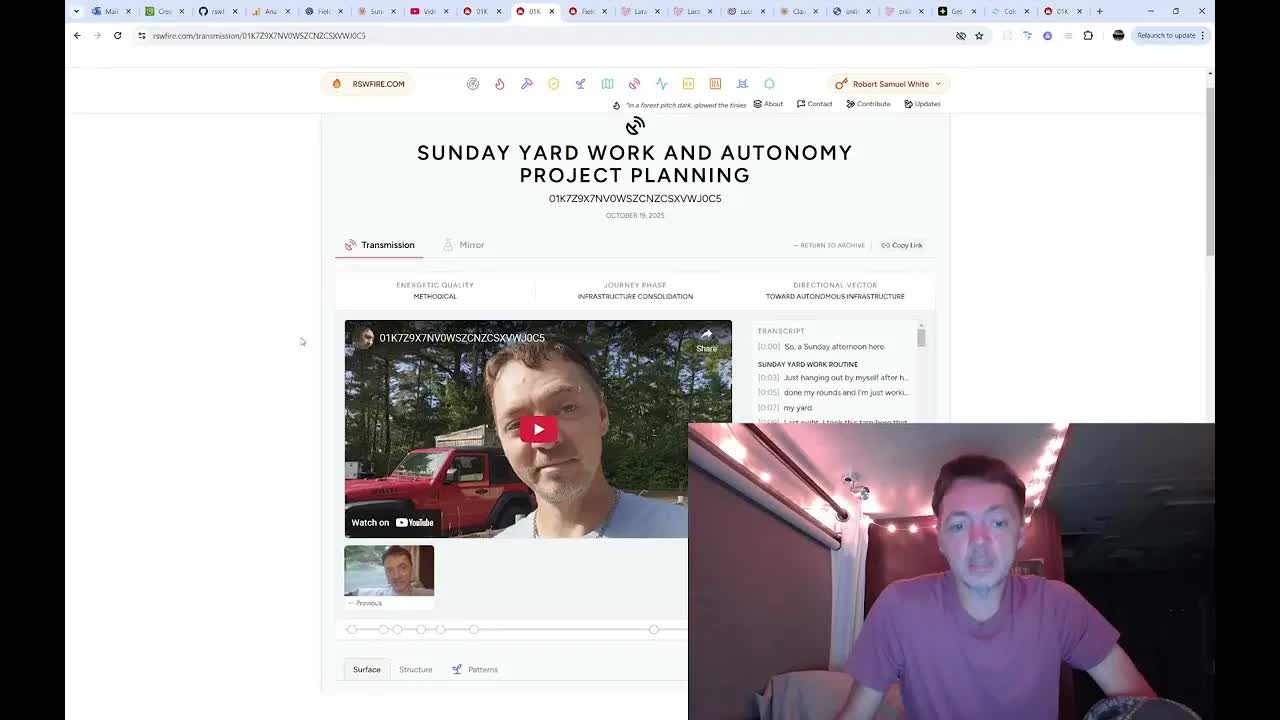
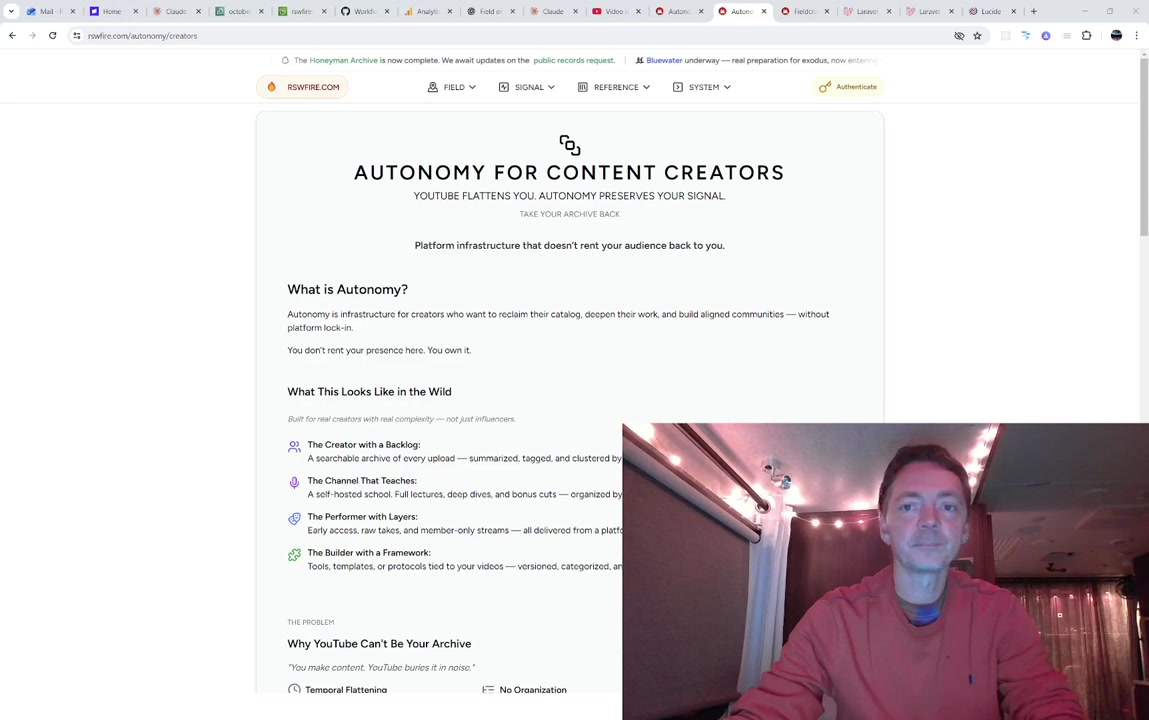
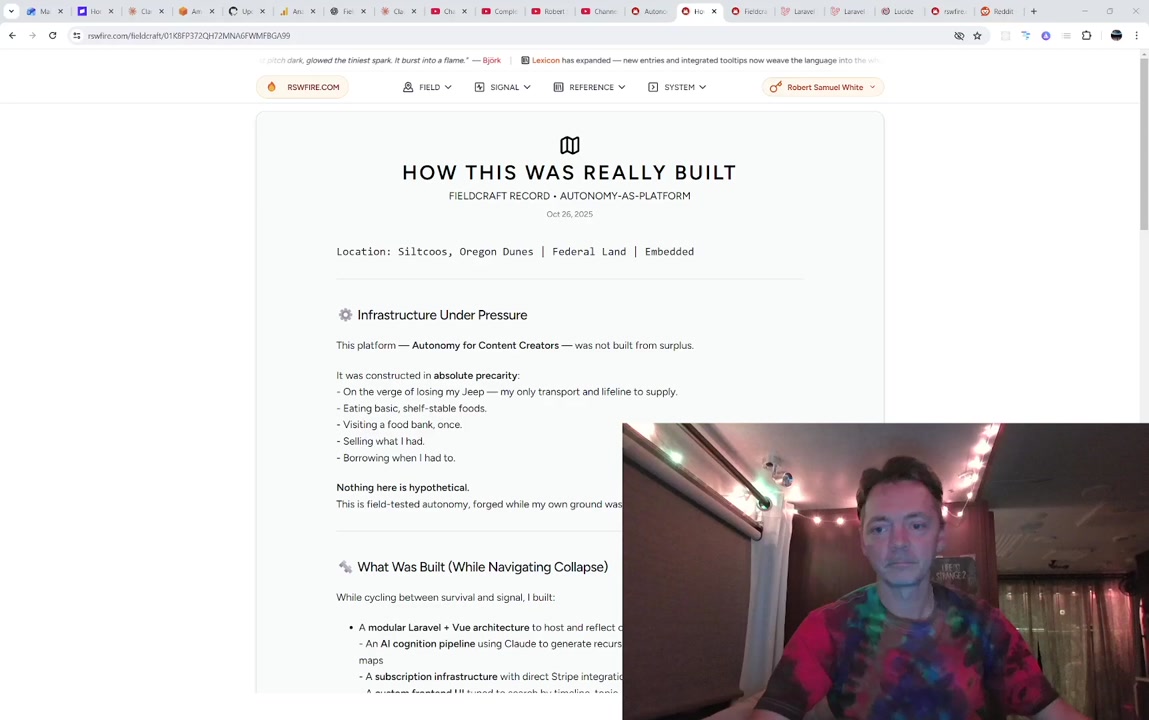
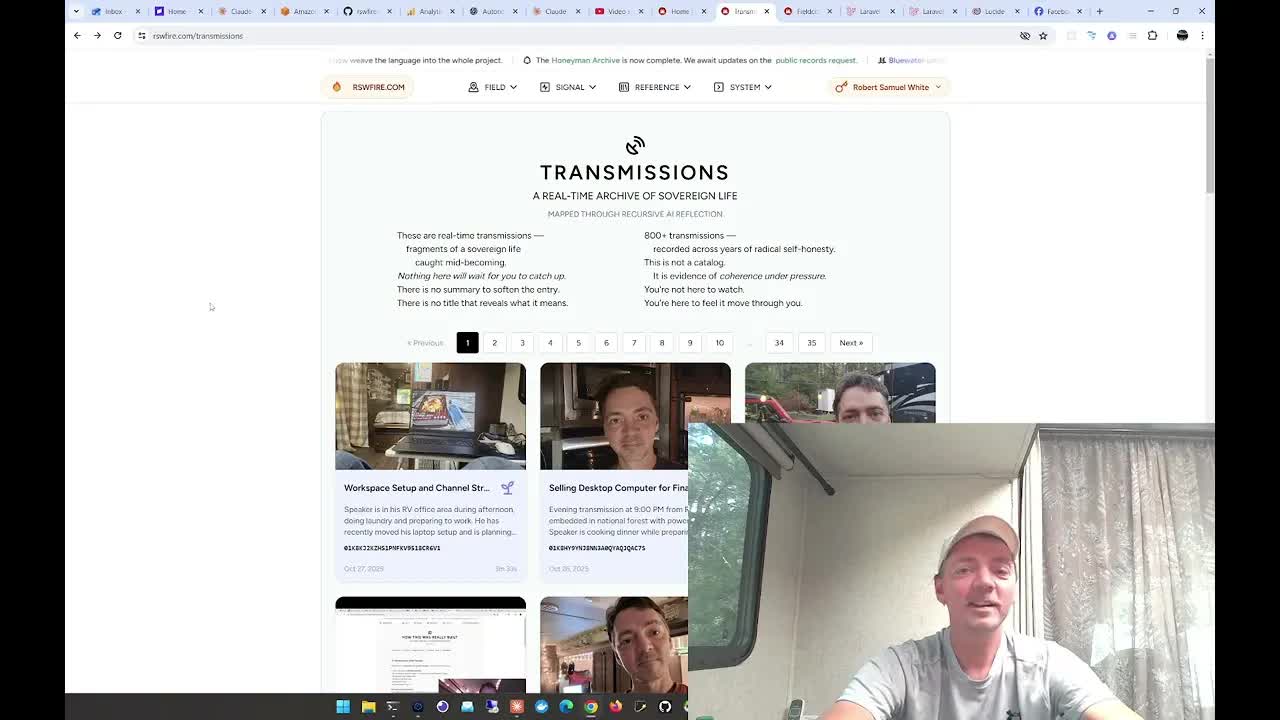
He began with the browser already open, his own domain filling the screen, and introduced himself by name. Almost two years, he said, almost eight hundred videos. What followed was not a complaint but an inventory: content that disappears the moment it is posted, an algorithm that will not resurface it, a profile page that cannot be searched even by the person who made it, no way to organize, no way for anyone to follow a journey from its beginning. He named each of these and then made the move that governed everything after it — these are design issues. Deliberate. Intentional. Having established that the architecture was authored, he turned to the thing he had authored in response, and the tour began.
The listings page loaded. He called them transmissions rather than videos, correcting the vocabulary in passing, the way someone does when the renaming happened long ago and is no longer under discussion. He explained the shape of the build in three sentences — eight hundred videos imported into his software, artificial intelligence run across them to generate data and content, the output assembled into a catalog on his own website. Then the index page, two years of transmissions running back to the beginning. Some entries carried no context. He said plainly why: he had not had the funds to process them. About half the catalog had been through the system. He suggested a visitor could browse to page twenty if they wanted to look around, and moved on without lingering on the gap.
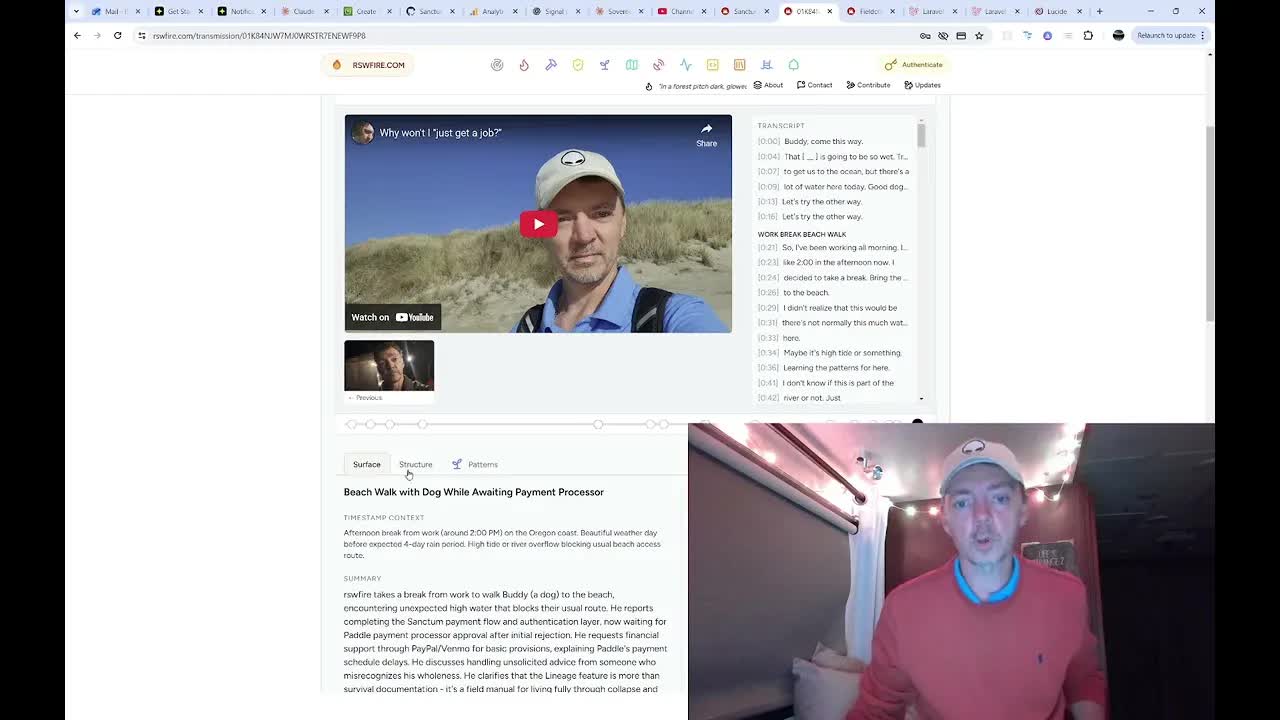
Opening a single transmission, he laid out the four passes — surface, structure, patterns, mirror — and immediately sorted them by usefulness to someone who was not him. Surface, he said, was the one most relevant to creators: context, summary, descriptions, keywords, titles, hashtags, the material a creator would want in a YouTube description. Then the extraction layer. Actions that took place. Entities, which he defined as he went — nouns, this person or this thing that matters to me. Tags. All of it convertible into searchable links. He noted that on his own site the links were not clickable, because he was going a different direction, and used that as the door into the vector database: not keyword matching but resonance, so that a phrase like Oregon coast would surface its variations, clustering content by proximity of meaning rather than exact string. He said he did not want to get too technical. He showed a timeline feature. He said that for an author who wanted their own archive online, he could build all of this, pretty much anything they wanted. Then, mid-sentence, that he had been programming since sixth grade, self-taught — and then that he was getting off topic, and returned to the walkthrough.
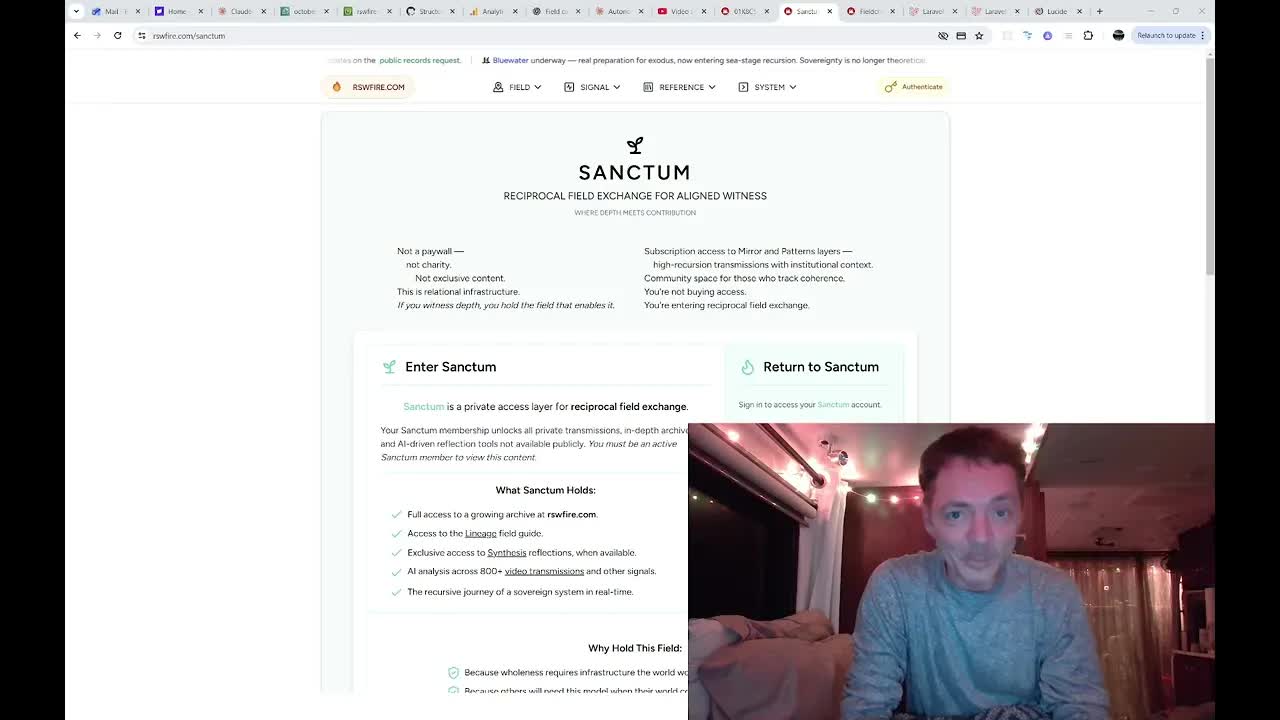
The subscription layer came next, and here the pacing changed slightly. He described the reasoning rather than the mechanism first: his content is dense and recursive, the default mode of interaction on the platform is shallow and often trollish, and he calls that distortion. He had turned comments off more than a year earlier. He said it had reached a point where he felt his audience was consuming him, that there was no reciprocity, and that he wanted a layer where someone who subscribes is more aligned with him. He framed it as an access layer, then immediately generalized it outward — others might want tiers, might want it for entirely different reasons. He had finished building it that day. The page was live but inert, awaiting approval from Paddle. If the message is still here, he said, then I'm still waiting. If they don't approve me, there are other routes; this was the one that felt aligned.
He signed into his own account to show what sat behind the gate. Patterns opened. He pointed out that he tracks the language used in a video. He named mirror as central to everything he is building on the site, and then, in the same breath, said he did not think it was very relevant to most YouTubers — offering it anyway, in case someone wanted to look around at that sort of thing. There was more he could show. He started to add something, stopped himself, started again, and then decided: I'm going to leave it there.
What he left there was one statement, delivered without adornment. He built this under absolute scarcity, on the edge of survival, and he acknowledged that not everybody could do that. The point of saying it, he specified, was the inference it supports — if he could build this under scarcity, the question becomes what he could build with aligned support. He had not found that yet. He had tried for two years on the channel and it never materialized. So the offer went out to other creators, ones who might have more functional communities than his, or a higher tolerance for what he calls fragmentation. He closed the recording on the terms he had chosen: an offering that feels aligned, released to see if anyone else agrees.