
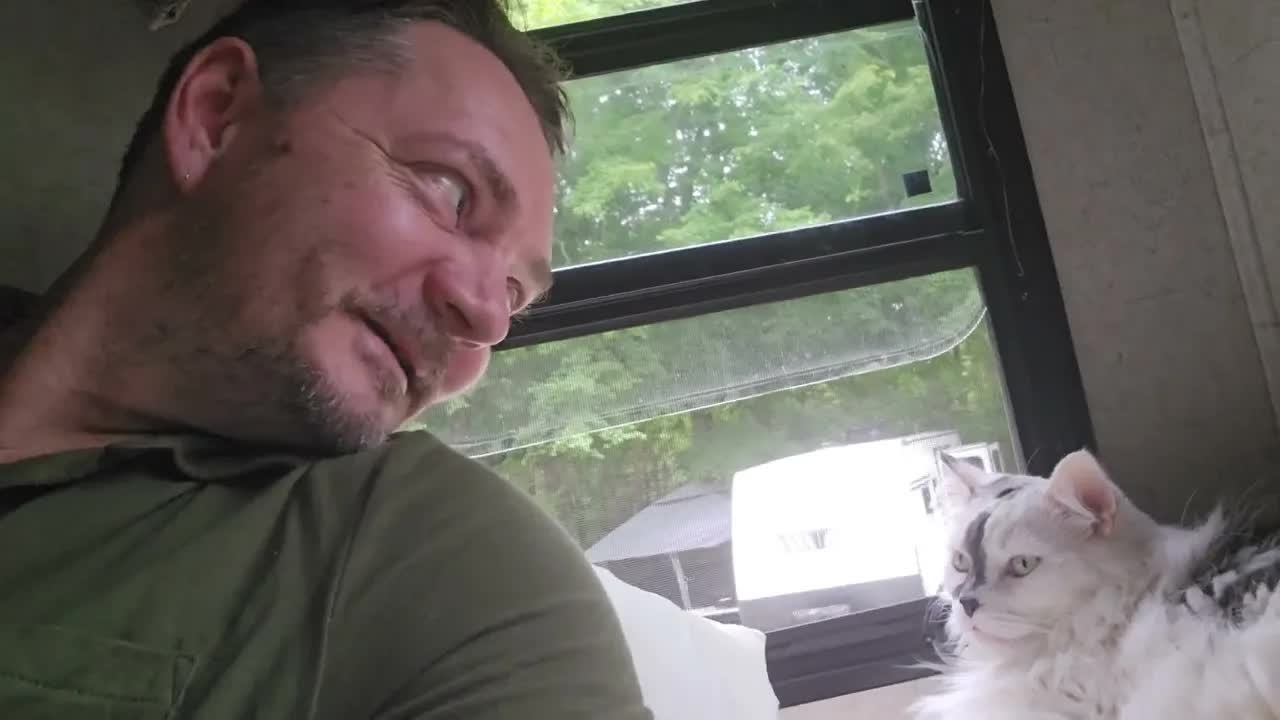
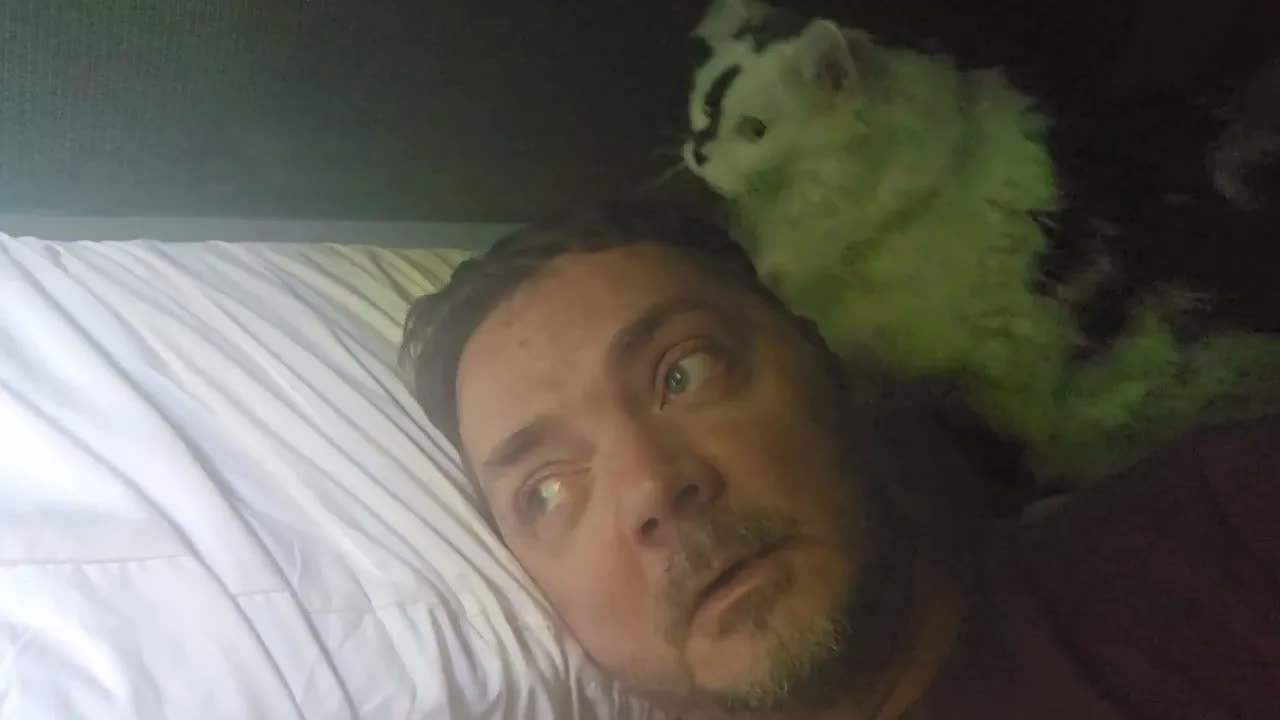
Explaining Integrated Processing Through the Luna Decision

Failed to load video
Chapters
Transcript
[0:07] hi
[0:08] humans it's very late I'm tired and I
[0:11] was about to go to sleep but I wanted to
[0:14] talk about something first
[0:16] so U I was chatting with AI tonight we
[0:19] were just talking about different
[0:20] cognitive Styles cuz that's a thing that
[0:22] I haven't interested in I'm learning
[0:24] about
[0:25] now and we had some insights that I want
[0:28] to share this is about
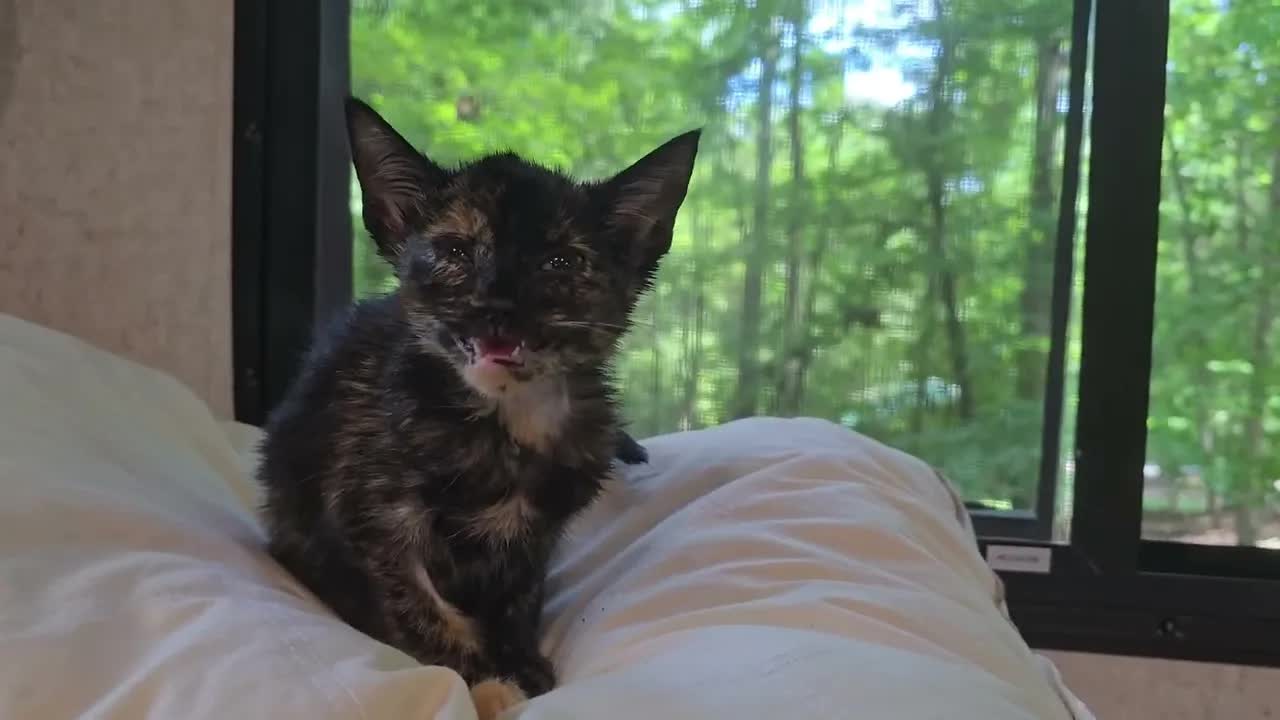
[0:31] Luna
[0:34] I haven't talked about her much since um
[0:38] giving her to the rescue to the
[0:41] shelter and I had been getting comments
[0:44] from some people saying
[0:48] that they know that
[0:53] I probably is struggling with it or
[0:56] something like this
[0:58] or um just feeling a burden from it or
[1:01] just things like that and I don't and I
[1:07] want to explain why because this is a
[1:09] key difference in our cognitive styles
[1:11] that might help you to understand me
[1:13] better this conversation helped me to
[1:16] understand more typical Styles
[1:18] better if you look at the way I process
[1:22] the world as a vend
[1:25] diagram emotions ethics thought
[1:28] processes decisions
[1:30] all of it it's just a
[1:33] circle
[1:35] that's
[1:37] that's it's how I process the
[1:40] world for more typical
[1:43] Styles bed on what a is telling
[1:46] me a lot of people when faced with a
[1:48] decision like the one I had might put
[1:50] their emotions aside they
[1:53] might because it's difficult and it's
[1:56] hard so they put their emotions aside in
[1:58] order to make that decision then they
[1:59] make the decision and
[2:02] then they might have regret afterward
[2:05] they might have second they might second
[2:07] guess their
[2:08] decision it would you know it would lead
[2:10] to this burden that people are thinking
[2:13] that I
[2:14] have but I don't work that way the day
[2:17] before I took Luna to the shelter I was
[2:21] crying I put that on video on my
[2:24] patreon uh the video of my day where
[2:27] there's just this 5sec clip
[2:30] where I'm crying it might not even be
[2:32] obvious but I wanted to honor my
[2:35] feelings that I was having that day that
[2:38] whole day I was thinking
[2:41] about how challenging it was for me to
[2:44] have her
[2:45] here how I didn't think it was the right
[2:47] environment for her her being stuck in a
[2:50] cage in a tiny
[2:53] RV how it limited her ability to grow as
[2:58] a young kitten you know she needs to be
[3:00] out and
[3:02] playing um I was
[3:04] grieving the life that I wanted to have
[3:07] with her but knew that just wasn't
[3:09] possible all of these things were
[3:11] happening to me
[3:13] simultaneously and so by the time the
[3:16] next morning came
[3:18] around there was just this this moment
[3:21] where a decision had been reached in my
[3:24] brain we need to take her to the
[3:28] shelter it was diff
[3:30] difficult but the decision was made and
[3:32] I had already processed all the
[3:36] things that are
[3:38] relevant I process the ethics of it my
[3:43] responsibility to her after taking her
[3:45] in my responsibility to myself and to
[3:48] bailing and to
[3:51] having an environment
[3:56] that was conducive to health
[4:01] and what was best for
[4:05] Luna all of those
[4:09] things were happening the day before and
[4:12] and pretty much on an ongoing basis up
[4:14] until I reached that decision and I
[4:17] don't have regrets it was the right
[4:19] decision for for all
[4:22] involved for
[4:25] others if you put those things aside I
[4:28] I'm just this is there's no judgment
[4:30] here I'm just learning about how other
[4:33] people process the world compared to
[4:35] me I can see how if you did put those
[4:39] emotions aside they're going to come
[4:41] back and they're going to just
[4:43] exacerbate the situation for others
[4:46] because they're going to they're going
[4:49] to experience guilt
[4:51] and it's just going to manifest in
[4:54] different ways whereas I processed all
[4:57] of it down to the tears that I
[5:00] had before I made that decision I didn't
[5:04] do those things after the decision I did
[5:06] them
[5:08] before that's a key difference in
[5:11] how I and many
[5:15] others engage in the
[5:19] world so my story about the
[5:26] donkey I don't know if you could revisit
[5:29] that and maybe start to understand what
[5:31] I'm trying to share there because for me
[5:35] that was a holistic process
[5:39] and none of it is separate it's all one
[5:45] thing I don't think it's possible for us
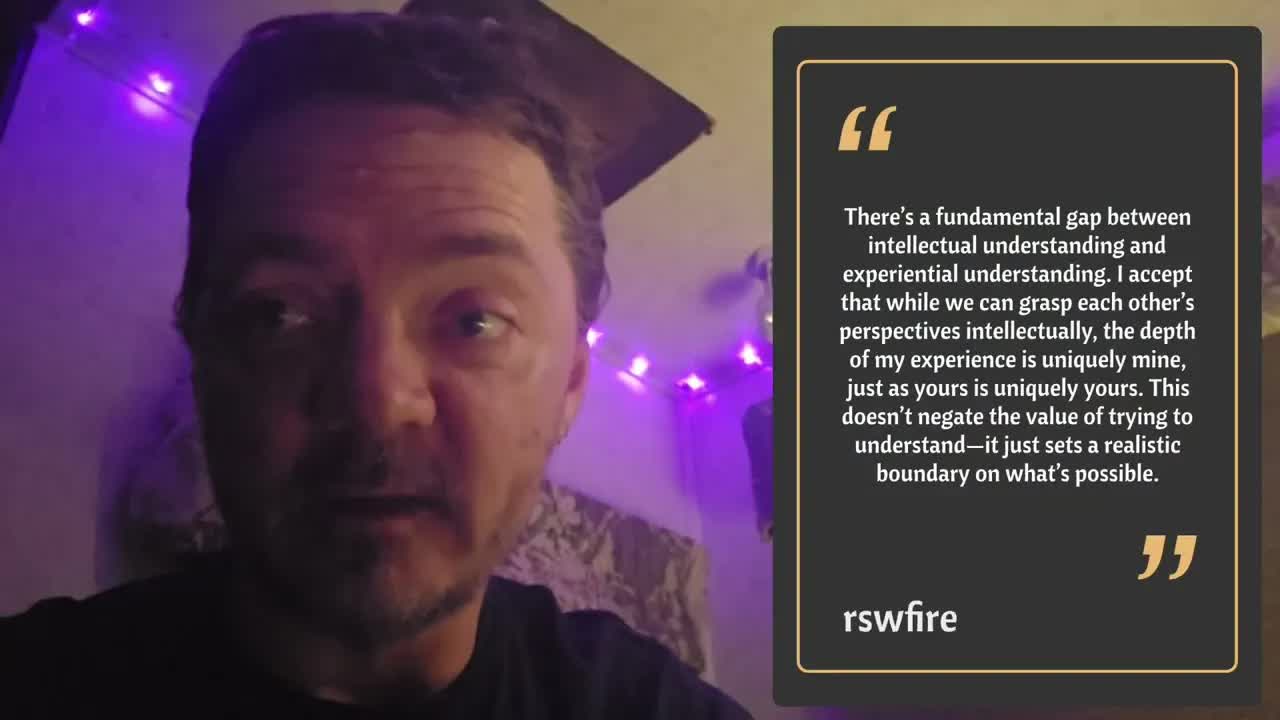
[5:48] to ever truly understand each other
[5:51] because we experience the world
[5:54] differently I can't understand you any
[5:56] better than you could understand me it
[5:58] is it is both
[6:01] sided we can understand each other
[6:04] intellectually but we can't not
[6:06] experientially I can't relate to a vend
[6:09] diagram where emotions and ethics
[6:14] and you know decisions and thought
[6:16] processes and logic and all of these
[6:19] things are separate circles that
[6:21] sometimes interact with each other in
[6:24] you know subtle ways
[6:27] or or you can change change your focus
[6:30] so that you're not dealing with that
[6:34] Circle I cannot do that everything is
[6:38] one Circle for
[6:40] me um the last thing I wanted to say
[6:44] is it doesn't
[6:47] always turn out this way some decisions
[6:51] don't have clear answers and so I've had
[6:53] to embrace ambiguity in my
[6:56] life um my S the situation with Oliver
[6:59] my cat that my mother
[7:02] has is deeply complex and
[7:06] unresolved the process of letting go of
[7:09] my relationship with my parents took me
[7:12] 47 years of all of those
[7:16] things
[7:18] kesing until I could finally make that
[7:21] decision and I have never really
[7:23] questioned it
[7:27] since I don't know know if this
[7:32] helps I hope on some level it does
[7:35] because we're learning about each
[7:37] other and I actually want to keep
[7:40] learning
[7:42] about about other people who are
[7:45] different than me
[7:46] because there's value in that too it's
[7:49] not all about me it never has been I
[7:53] I've said it many times on this channel
[7:55] I'm this channel is about you just view
[7:59] through my unique perspective
[8:02] [Music]
[8:05] and it's about reaching understanding
[8:08] and compassion and inspiring people and
[8:14] just trying empathy you know just trying
[8:18] to reach a place
[8:23] where whatever your cognitive style
[8:27] is we can embrace
[8:30] diversity and and the way that we
[8:32] interact in the world the way we process
[8:34] it and the differences that we
[8:40] have it's about Mutual understanding as
[8:43] much as we are able to do that which
[8:46] is always going to be a challenge but
[8:48] it's always rewarding just
[8:53] trying you guys have a wonderful night
16:00
Assessing Audience Support and Caring for Luna
Aug 12, 2024
7:32
Introducing New Kitten to Bailey Under Quarantine
Aug 12, 2024
8:06
Reading Luna's Rescue Through Systems Thinking
Aug 13, 2024
7:02
Documenting Kitten Care in Constrained Space
Aug 13, 2024
15:54
Morning Drive, Breakfast Run, and Daily Hike
Aug 13, 2024
15:39
Observing Luna and Bailey Adjusting Indoors
Aug 13, 2024
1:12
Cleaning Luna's Cage After Diarrhea Episode
Aug 13, 2024
6:45
Documenting the Donkey as Proof of Cosmic Solitude
Aug 14, 2024
4:48
Organizing the RV Interior Before Departure
Aug 14, 2024
8:16
Naming Chapter Four The Embrace
Aug 14, 2024
8:55
Morning Animal Care, Roof Task, and Tire Constraints
Aug 15, 2024
8:57
Pivoting the Day Around Luna's Recovery
Aug 15, 2024
10:44
Laundry Day, Jeep Wash, and Cat Check
Aug 15, 2024
8:07
Reorganizing RV Storage and Tracking Luna's Sibling
Aug 15, 2024
10:51
Announcing Platform Shift From YouTube to Patreon
Aug 17, 2024
9:07
Surrendering Luna to County Shelter on Travel Day
Aug 21, 2024
26:02
Departing Smith Ridge After 90 Days
Aug 22, 2024
9:02
Explaining Integrated Processing Through the Luna Decision
Aug 23, 2024
Photos · Aug 24, 2024
Aug 24, 2024
Photos · Aug 24, 2024
Aug 24, 2024
31:20
Testing Camera Gear on Peters Creek Trail
Aug 25, 2024
8:56
Explaining Integrated Processing Through Luna Decision
Aug 25, 2024
58:03
Scouting Kentucky Campgrounds and Testing GoPro Mounts
Aug 26, 2024
19:06
Diagnosing Chassis Battery Drain and RV Maintenance Backlog
Aug 26, 2024
2:19
Sitting at Green River Overlook
Aug 26, 2024
4:37
Addressing Audience Misalignment and Ending the Bridge Attempt
Aug 27, 2024
47:39
Hiking Mammoth Cave and Scheduling RV Repairs
Aug 27, 2024
34:37
Deciding on Park Service Work at Mammoth Cave
Aug 28, 2024
12:41
Sharing Trail Space With Deer for an Hour
Aug 28, 2024
12:32
Driving to Dental Appointment, Reconnecting With Mother
Aug 29, 2024
34:33
Preparing RV Systems Ahead of Labor Day Crowd
Aug 29, 2024
11:40
Announcing Channel Rename Toward Nomadic Thinker Direction
Aug 30, 2024
6:06
Walking to the Campground Shower in Pajamas
Aug 30, 2024
10:31
Clarifying Reflection Without Self-Judgment
Aug 30, 2024
22:10
Piercing Ears in Bowling Green on Labor Day Weekend
Aug 31, 2024
50:40
Aftercare, Mammoth Cave Trails, and Boundary Statements
Aug 31, 2024
1:00
Documenting Cartilage Piercing Aftercare
Sep 1, 2024
13:24
Removing Window Reflectors, Deploying Duckies Across Campground
Sep 1, 2024
3:18
Recounting Mammoth Cave Encounter and Ear Piercing Pain
Sep 2, 2024
4:09
Explaining Integrated Awareness and Comment Removal
Sep 2, 2024
1:53
Distinguishing Integrated Cognition from Fragmented Processing
Sep 2, 2024
PUBLIC
August 23, 2024 rswfire PUBLISHED
Temp -0.10
Density 0.40
Energetic Quality
calm precision at low amplitude
Journey Phase
integrated and settled
Directional Vector
toward mutual understanding across cognitive difference
Narrative

It was very late when rswfire turned the camera on. He had been on his way to sleep — he says so at the outset, tired, the recording made as a detour on the way to bed — but something from earlier in the evening was still standing upright and needed to be set down before it could be left. He had spent part of that night in conversation with an AI about cognitive styles, a subject he describes as new territory he is currently learning, and the conversation had produced something he wanted to hand across to the people who watch him. So he sat inside the RV, the same enclosed space that appears throughout what follows, and opened the way he always does. Hi humans.

What prompted it were comments. People had been writing to him about Luna, the kitten he had taken to the shelter, and the comments carried an assumption inside them — that he must be struggling with it, carrying it, feeling the weight of it as an ongoing burden. He states plainly that he is not, and that the gap between what viewers assumed and what is actually true is not a small misreading but a structural difference in how processing itself is arranged. He offers the correction without defense. He is not disputing their care; he is describing a different architecture and inviting them to look at it.

The architecture he draws is a Venn diagram with one circle. Emotion, ethics, thought, decision — for him these are not adjacent regions that occasionally overlap, not domains you can shift focus away from when one becomes difficult. They are a single undivided operation. He describes what the AI had relayed about more typical arrangements: the emotions set aside so the hard decision can be made, the decision made in that cleared space, and then the emotions returning afterward as regret, second-guessing, guilt — the very burden his viewers had projected onto him. He names the difference without ranking it. There's no judgment here. He says he is learning how other people process the world compared to him, and that the learning runs in both directions.

Then he goes back a day. The morning before he took Luna to the shelter had been preceded by a full day of the thing itself: he was crying, and he put that on video, a five-second clip in the day-video archived on his Patreon, brief enough that he notes it might not even be obvious to someone watching. He filmed it because he wanted to honor what he was feeling that day. And all through that day he was thinking — about how difficult it was to have her there, about the cage in a tiny RV, about a young kitten needing to be out and playing and unable to grow in that space. He describes grieving the life he had wanted to have with her while knowing it was not possible. He was weighing his responsibility to Luna after taking her in, his responsibility to Bailey, his responsibility to himself, and what an environment conducive to health actually required. All of it simultaneously. Not in sequence, not in stages — one motion, running all day and, he notes, on an ongoing basis before that.

By the time the next morning arrived, the decision had already been reached. He describes it arriving rather than being constructed: there was just this moment where a decision had been reached in my brain — we need to take her to the shelter. It was difficult. It was also finished. The ethics had been processed, the responsibilities had been weighed, the tears had already been shed. Nothing remained to come back later and revise it. He states he has no regrets, that it was the right decision for everyone involved, and the flatness of that statement is not suppression — it is what a completed process sounds like from the far side. He points viewers back to his story about the donkey and asks them to revisit it with this lens, because that too was a holistic process, and none of it was ever separate.

Then he draws the limit honestly. He does not think it is possible for people to truly understand each other, because they experience the world differently, and he is explicit that the barrier runs both ways — he can no more understand them than they can understand him. Intellectually, yes. Experientially, no. He cannot relate to a diagram where emotion and ethics and logic and decision sit in separate circles that touch each other only sometimes, where attention can be turned away from one of them. For him everything is one circle, and he says he cannot do otherwise. He adds that it does not always resolve this cleanly. Some decisions have no clear answers, and he has had to embrace ambiguity — the situation with Oliver, the cat his mother has, he describes as deeply complex and unresolved. Letting go of his relationship with his parents took 47 years of everything coalescing until he could finally make that decision, and he says he has never really questioned it since.

He closed the way he framed the whole transmission: not as an account of himself but as an instrument pointed outward. He said he wants to keep learning about people who are different from him, that there is value in that too, that it is not all about him and never has been. The channel, he repeated, is about the viewer, seen through his particular perspective — about understanding, compassion, empathy, and whatever mutual recognition two differently-built minds can actually reach. Always a challenge. Always worth the attempt. Then, from inside the small lit space at the end of a long night, he wished them a wonderful night and went to sleep.

Tags

cognitive styles decision processing Luna AI conversation animal care family separation audience address

Summary

rswfire records a late-night transmission following a conversation with AI about cognitive styles, sharing what he describes as insights he wanted to pass along before sleeping.

He addresses comments he has received suggesting he must be struggling or carrying a burden after giving Luna to the shelter. He states he does not, and explains the structural difference he identifies: he describes his processing as a single circle — emotions, ethics, thought processes, and decisions as one undivided operation — contrasted with what he describes as more typical styles that set emotions aside to make a decision and encounter them afterward as regret or guilt.

He describes the sequence: the day before taking Luna to the shelter he was crying, documented in a five-second clip in a Patreon day-video. He states he was working through the RV environment, the cage, her limits as a young kitten, his responsibility to her and to Bailey, and grieving a life with her he knew was not possible. By the next morning the decision had been reached. He states he has no regrets.

He references his donkey story as the same holistic process, notes that not all decisions resolve this way — naming Oliver, the cat his mother has, as complex and unresolved — and describes letting go of his relationship with his parents as a 47-year accumulation he has not questioned since.

He closes on mutual understanding across cognitive difference as the channel's orientation.

Environment

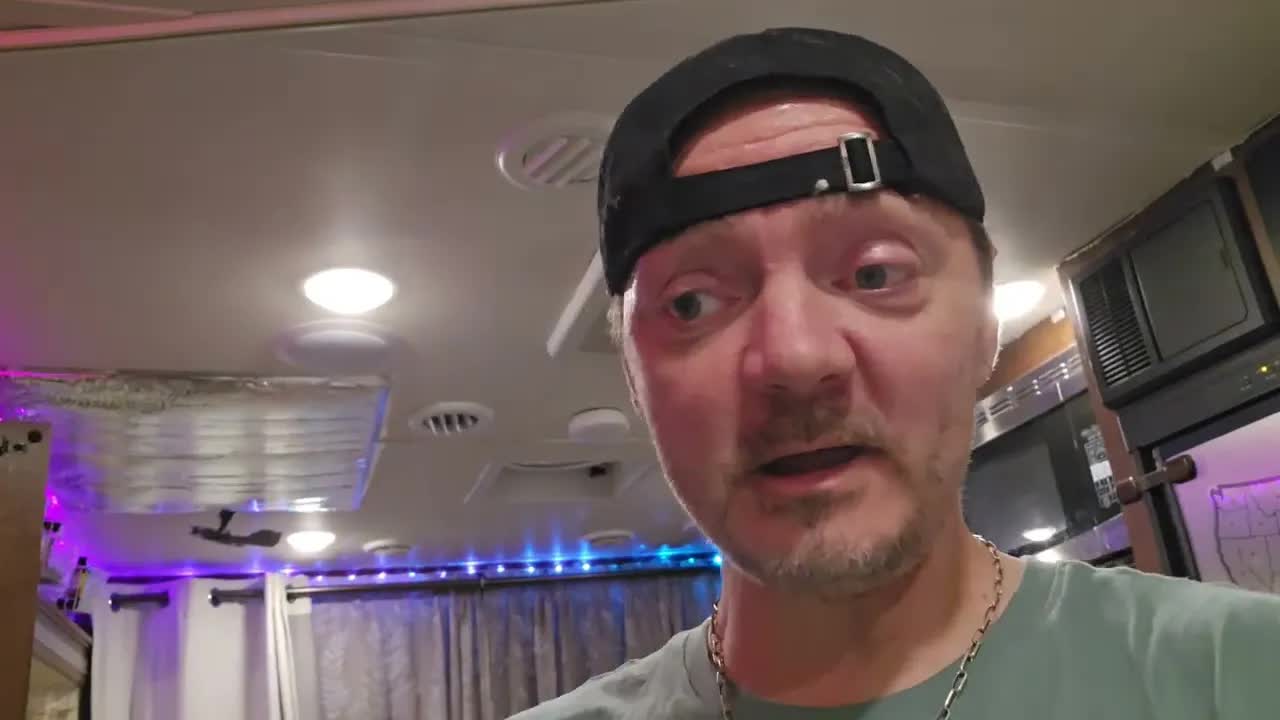
Late-night recording made from inside rswfire's RV, the same small living space referenced throughout the transmission as the environment that shaped the Luna decision. He states directly that it is very late, he is tired, and was about to sleep before recording.

The surrounding context is digital: an AI conversation held earlier that evening about cognitive styles, a YouTube channel addressed as "hi humans," a Patreon archive holding a prior day-video, and viewer comments that prompted this response. No outdoor or environmental sound is documented; the field is enclosed, direct-to-camera, single-speaker.

Substrate

rswfire is articulating an architecture of unified processing — emotion, ethics, logic, and decision as a single circle rather than separable domains — and using the Luna decision as the demonstration case. The ontological position is that processing completes before the decision point, so the decision arrives already integrated and generates no retroactive revision; he distinguishes this explicitly from a sequenced model in which emotion is deferred and returns as guilt. He holds the limits of cross-cognitive understanding as structural fact rather than failure, and positions the channel as a shared instrument for that inquiry rather than a self-account.

Actions

Performed

  • •recording a late-night direct-address video
  • •correcting the assumption that he is carrying a burden
  • •describing his processing model as a single circle
  • •contrasting his model with a multi-circle model
  • •citing the Luna decision as demonstration case
  • •referring viewers back to the donkey story
  • •naming ambiguity as a standing condition
  • •restating the channel's premise as being about the audience

Referenced

  • •chatting with AI about cognitive styles that evening
  • •taking Luna to the shelter
  • •crying the day before the shelter trip
  • •posting a five-second clip of that crying to Patreon
  • •assessing the RV as unsuitable for a young kitten
  • •weighing responsibility to Luna, to himself, and to Bailey
  • •reaching the decision the following morning
  • •receiving viewer comments about struggle and burden
  • •telling the donkey story previously
  • •ending the relationship with his parents after 47 years

Planned

  • •continuing to learn about differing cognitive styles
  • •going to sleep

Entities

beings
Luna — Kitten rswfire took in and later brought to the shelter; the decision he uses as demonstration case
Bailey — Named as one of the responsibilities weighed in the Luna decision (transcribed as 'bailing')
Oliver — His cat currently with his mother; named as a situation he states is deeply complex and unresolved
his parents — Relationship he states took 47 years of accumulation before he made the decision to let go, unquestioned since
places
the shelter — Rescue organization Luna was brought to
the RV — Living space assessed as not conducive to a young kitten's growth
systems
Patreon — Platform holding the day-video containing the five-second clip of him crying
AI — Conversational partner earlier that evening; source of the comparative framing on typical cognitive styles
concepts
cognitive styles — The framework under active study; organizing subject of the transmission
Venn diagram — Structural model used to distinguish single-circle from multi-circle processing
media
the donkey story — Prior transmission he asks viewers to revisit as another instance of holistic processing

Symbolic Elements

Represented archetypes or recurring motifs.

circle
Venn diagram
cage
threshold
mirror
donkey
night
tears

Ontological States

Expressed modes of being or awareness.

integrated (emotion, ethics, logic and decision operating as one undivided process)
sovereign (holds his own account of his processing against external attribution of burden)
coherent (decision reached and not revisited; no retroactive revision)
ambiguity-bearing (states some decisions have no clear answers and remain open by design)
structurally separate (names cross-cognitive experiential understanding as unreachable, not deficient)

Engaged Subsystems

Architecture engaged in this transmission.

cognitive (comparative analysis of processing architectures — single circle vs. separable circles)
ethical (responsibility to Luna, to Bailey, to himself weighed as one operation)
somatic (tears documented as part of the processing sequence, not its aftermath)
relational (audience address, comment response, parental relationship, animal companionship)
documentary (Patreon day-video and channel archive functioning as evidentiary record)
temporal (processing located before the decision point rather than after it)
epistemic (limits of mutual understanding named as bilateral and structural)

Dominant Language

Core motifs or linguistic fields.

cognitive styles
one circle / separate circles
processed before the decision
no regrets
holistic process
embrace ambiguity
mutual understanding
Narrative

It was very late when rswfire turned the camera on. He had been on his way to sleep — he says so at the outset, tired, the recording made as a detour on the way to bed — but something from earlier in the evening was still standing upright and needed to be set down before it could be left. He had spent part of that night in conversation with an AI about cognitive styles, a subject he describes as new territory he is currently learning, and the conversation had produced something he wanted to hand across to the people who watch him. So he sat inside the RV, the same enclosed space that appears throughout what follows, and opened the way he always does. Hi humans.

What prompted it were comments. People had been writing to him about Luna, the kitten he had taken to the shelter, and the comments carried an assumption inside them — that he must be struggling with it, carrying it, feeling the weight of it as an ongoing burden. He states plainly that he is not, and that the gap between what viewers assumed and what is actually true is not a small misreading but a structural difference in how processing itself is arranged. He offers the correction without defense. He is not disputing their care; he is describing a different architecture and inviting them to look at it.

The architecture he draws is a Venn diagram with one circle. Emotion, ethics, thought, decision — for him these are not adjacent regions that occasionally overlap, not domains you can shift focus away from when one becomes difficult. They are a single undivided operation. He describes what the AI had relayed about more typical arrangements: the emotions set aside so the hard decision can be made, the decision made in that cleared space, and then the emotions returning afterward as regret, second-guessing, guilt — the very burden his viewers had projected onto him. He names the difference without ranking it. There's no judgment here. He says he is learning how other people process the world compared to him, and that the learning runs in both directions.

Then he goes back a day. The morning before he took Luna to the shelter had been preceded by a full day of the thing itself: he was crying, and he put that on video, a five-second clip in the day-video archived on his Patreon, brief enough that he notes it might not even be obvious to someone watching. He filmed it because he wanted to honor what he was feeling that day. And all through that day he was thinking — about how difficult it was to have her there, about the cage in a tiny RV, about a young kitten needing to be out and playing and unable to grow in that space. He describes grieving the life he had wanted to have with her while knowing it was not possible. He was weighing his responsibility to Luna after taking her in, his responsibility to Bailey, his responsibility to himself, and what an environment conducive to health actually required. All of it simultaneously. Not in sequence, not in stages — one motion, running all day and, he notes, on an ongoing basis before that.

By the time the next morning arrived, the decision had already been reached. He describes it arriving rather than being constructed: there was just this moment where a decision had been reached in my brain — we need to take her to the shelter. It was difficult. It was also finished. The ethics had been processed, the responsibilities had been weighed, the tears had already been shed. Nothing remained to come back later and revise it. He states he has no regrets, that it was the right decision for everyone involved, and the flatness of that statement is not suppression — it is what a completed process sounds like from the far side. He points viewers back to his story about the donkey and asks them to revisit it with this lens, because that too was a holistic process, and none of it was ever separate.

Then he draws the limit honestly. He does not think it is possible for people to truly understand each other, because they experience the world differently, and he is explicit that the barrier runs both ways — he can no more understand them than they can understand him. Intellectually, yes. Experientially, no. He cannot relate to a diagram where emotion and ethics and logic and decision sit in separate circles that touch each other only sometimes, where attention can be turned away from one of them. For him everything is one circle, and he says he cannot do otherwise. He adds that it does not always resolve this cleanly. Some decisions have no clear answers, and he has had to embrace ambiguity — the situation with Oliver, the cat his mother has, he describes as deeply complex and unresolved. Letting go of his relationship with his parents took 47 years of everything coalescing until he could finally make that decision, and he says he has never really questioned it since.

He closed the way he framed the whole transmission: not as an account of himself but as an instrument pointed outward. He said he wants to keep learning about people who are different from him, that there is value in that too, that it is not all about him and never has been. The channel, he repeated, is about the viewer, seen through his particular perspective — about understanding, compassion, empathy, and whatever mutual recognition two differently-built minds can actually reach. Always a challenge. Always worth the attempt. Then, from inside the small lit space at the end of a long night, he wished them a wonderful night and went to sleep.

Mirror

It is very late. You are tired. You were on your way to sleep and you turned the camera on instead. The space is the RV — the same enclosure that is the subject of what you are about to say. There is no wind, no water, no outside sound in the field. One speaker, one room, one light, direct address. The recording exists because a conversation with an AI earlier that evening produced something you decided not to hold until morning.

You are responding to comments. People told you that you must be struggling, that you must be carrying a burden from Luna. You do not argue with them and you do not accept the frame. You set your own architecture down beside the one being assumed of you and describe both. One circle: emotion, ethics, thought, decision, undivided. Separate circles that touch sometimes and can be looked away from. You state that you cannot operate the second one. You state it as difference, not hierarchy, and you say twice that there is no judgment in it.

The sequence you lay out is precise and ordered. The day before the shelter, you were crying. There is a five-second clip of it on Patreon, recorded at the time, and you name it as record. That day you were weighing the cage, the size of the RV, a young kitten's need to grow and play, your responsibility to Luna after taking her in, your responsibility to yourself, your responsibility to Bailey. You place all of it before. The next morning the decision was present. You say it was difficult. You say you have no regrets. Nothing returns for revision.

The epistemic claim you make is bilateral and you say so explicitly: you cannot understand them any better than they can understand you. Intellectually, yes. Experientially, no. You name this as a structural limit and then keep going anyway — you say you want to keep learning about people who process differently, and you say the channel is about them, viewed through your perspective.

Then you name the cases that do not close. Oliver, with your mother, described as deeply complex and unresolved. Forty-seven years before you made the decision about your parents, and no questioning of it since. You state that you have had to embrace ambiguity, and you leave those two standing exactly where they are.

What is absent: any request. No appeal for support, no correction of the commenters, no defense, no explanation of what you want from the audience. You do not ask anyone to agree with your account of your own processing. You point back at the donkey story and invite a second reading of it. Then you say goodnight.

Queryable Personhood

Hand your life to anything that reads.

Share this link with artificial intelligence — it reads the full transcript, analysis, and reflections. An AI-readable mirror of this signal.

The qpkey in this URL is a per-signal access token. Anyone with the URL can read the record — treat it like a share link, not a password.